
Collaboration key to long-term success of new Food Strategy
A key objective of the visionary Northern Ireland Food Strategy and Action Plan is to encourage collaboration between all sectors of what continues to be the single biggest manufacturing industry here and thereby ensure its long-term and successful growth especially in global markets.
It’s an industry that currently sells products to over 60 countries, the biggest being Great Britain and the Republic of Ireland.
The launch of the strategy, Northern Ireland’s first-ever policy framework for such an important industry that generates currently generates around £8 billion to the local economy and employs upwards of 100,000 people here, by Andrew Muir, Agriculture, Environment and Rural Affairs (DAERA), represented an important collaboration with other departments, food and drink producers, industry bodies such as Food NI, the unions, especially the Ulster Farmers’ Union, Food Standards Authority, and academia.
Academic engagement has included food, farming and nutrition experts from Queen’s University, the Ulster University, as well as from the Colleges of Agriculture, Food and Rural Enterprise and the Agri-Food and Biosciences Institute.

And widespread collaboration has continued to be theme of the community awareness campaign, the purpose of which has been to build the essential foundations to activate the Food Strategy Framework ‘Food at the Heart of our Society’ over the past three months.
The collaboration has also extended to other parts of the United Kingdom, enabling key players in the industry to learn from the experiences of experts in other parts of the United Kingdom.
The contributors have includes Prof Tim Lang, a specialist in food resilience systems, Hugh Fearnley-Whittingstall, a businessman and environmental campaigner, Patrick Holden CBE, an expert in farming systems, Sheila Dillon of BBC’s highly regarded Food Programme. and Ash Amirahmadi OBE, Chief Executive of Canada’s Sofina Foods Europe, owner of Finnebrogue in Downpatrick, one of the UK’s most innovative food manufacturers.
As a result, the awareness programme, assisted by Food NI, the local food and a drink promotion body, is one of the most comprehensive and all-encompassing campaigns of its kind ever undertaken here.
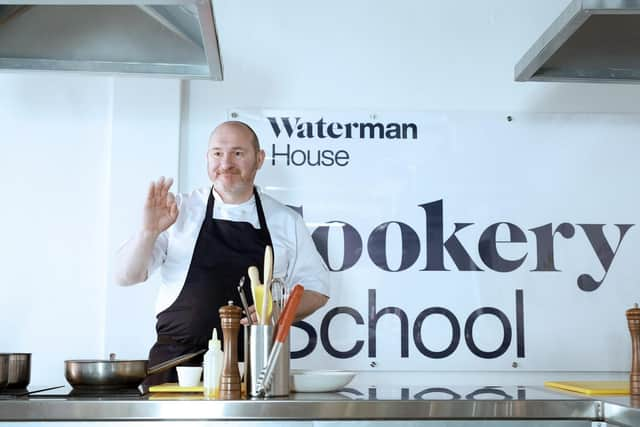
Continuing collaboration will be essential to achieve the objectives of the strategy. Building long-term collaboration and partnership across the industry underpinned a series of conversations is a central by holding conversations co-ordinated by Food NI, many held at local hospitality establishments such as Hillsborough Castle, Waterman House Restaurant and Academy Restaurant, both in Belfast. Significantly, meals were involved and featured locally sourced ingredients by prominent and award-winning chefs.
A feature of the collaborative events has been the outstanding calibre of contributors to all the conversations and the engagements with local food and farming representatives.
A good example of this conversation collaborations took place at Waterman House that was hosted by Food NI Chairman Neal Kelly of the Henderson Group and featured Prof Nigel Scullin, Head Queen’s University’s School of Biological Sciences and globally respected Institute of Global Food Security.
Other eminent contributors included Prof Aedan Cassidy, Chair in Nutrition and Preventive Medicine and Co-Director Co-Centre for Sustainable Food Systems on ’Science and innovation in food systems’; Dr Lynda Perkins, Researcher in agro-food on sustainability and nutritional aspects of foods with emphasis on animal sourced foods on ‘the Importance of animal sourced foods’; Tim Rowe, Agri-Food Consultant with emphasis on livestock procurement, processing and supply chain management and accredited master butcher on the ’Demand for protein and the impact on major protein sources’; and Patrick Holden CBE, Farmer and Founder and Chief Executive of the Sustainable Food Trust and previous director of the Soil Association on ‘Farming systems and need for change – a farmer’s perspective’.
Another important event at QUB was a lecture by Ash Amirahmadi OBE, the chief executive Canada’s Sofina Europe and of Finnebrogue in Downpatrick.
Delivering the George Scott Robertson Memorial lecture at Queen’s University’s Riddel Hall in association with the Belfast’s Institute for Global Food Security last month Mr Amirahmadi stressed that food and drink isn’t just an industry — it’s a growth sector and a cornerstone of our national security.”
His theme was “how we adapt to these trends to deliver long-lasting food security and economic growth”. He said significant progress was required in four key areas:
1 - People: Responding to the workforce challenge through measures to bring a new and diverse workforce into food and farming;
2 - Farming: Engaging with and supporting our farmers;
3 - Policy: A radical change in policies and regulations to support food and farming rather than get in its way;
4 - Innovation: Collaborating within the industry, with academic institutions, and with others “to deliver the innovation we need to adapt to the challenges and opportunities ahead”.
The inspirational lecture followed an excellent and equally stimulating workshop, also at Riddel Hall, on One Health, Food and Sustainability, that featured expert contributions from Alex Cook, the Food Strategy Programme Manager from Carmathenshire in Wales; Patrick Holden CBE, a farmer who set up the Sustainable Food Trust; Edward Morgan of Castell Howard Food; Prof Danielle McCarthy, a nutrition specialist from QUB; and Jack Hamilton, chief executive of Mash Direct in Comber.