
Dairy Council insight: A manifesto for dairy’s sustainable future
Northern Ireland’s dairy industry is calling on the incoming Executive to deliver a coordinated programme of support that will strengthen competitiveness, unlock sustainable investment and give farmers and processors greater certainty for the future.
That is the central message of the Dairy Council for Northern Ireland’s 2027 manifesto, A Pathway to Success. It identifies four priorities for government: direct capital grant funding; a planning system fit for the future; support for a sustainable circular economy; and a coordinated policy pathway that allows the wider dairy and agri-food supply chain to invest with confidence.
The most immediate ask is for the Department for the Economy to provide direct capital grant support to help unlock future investment in milk processing. Northern Ireland’s processors receive significantly less capital grant assistance than competitors in Great Britain and the Republic of Ireland, yet they are operating in global markets where investment in productivity, environmental performance and added value is essential.
This request for support is not made in isolation. It is a call to invest in an industry that generates close to £2 billion in annual sales, one which directly involves more than 3,000 farming families and 2,300 processor employees and supports economic activity in ncommunities across Northern Ireland.
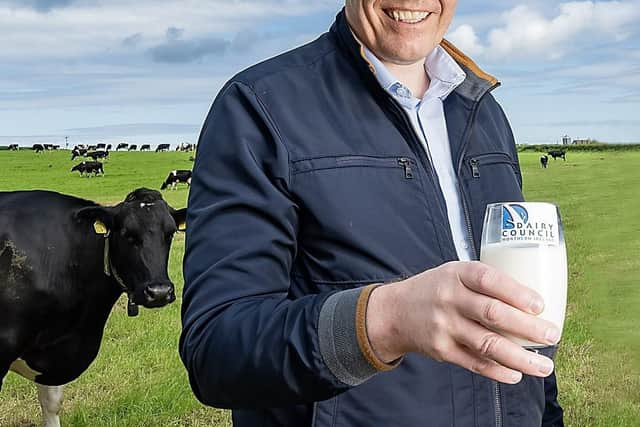

The Dairy Council represents farmers and processors responsible for more than 90% of the milk produced and processed locally. Northern Ireland dairy products are consumed in moremthan 80 countries and account for over 43% of local food and drink export sales outside the UK. More than 800 million litres of raw milk produced here are also sold to EU member states, generating in excess of £300 million each year.
Those figures demonstrate the scale of the opportunity, but they also underline what is at stake. Dairy businesses cannot afford to stand still while international competitors continue to invest. Modern processing facilities require major, long-term capital commitments, often running to tens of millions of pounds, to increase efficiency, decarbonise production, adopt digital automation and artificial intelligence, and develop higher-value products for changing markets.
A more effective planning system is equally important. Investment decisions can only move at the pace required if planning processes are timely, proportionate and capable of supporting strategically important projects. Government must also recognise the dairy sector’s role in a sustainable circular economy, where resources and by-products are managed more efficiently and new technologies help reduce environmental impact while creating economic value.
Taken together, these measures would enable processors to make transformative investments, strengthen regional balance, support wage growth and keep Northern Ireland at the forefront of advanced food manufacturing. They would also create a stronger operating environment for family farms, allowing the benefits of investment to flow through the wider supply chain.
Food security adds further urgency. Northern Ireland produces around one sixth of the UK’s milk output. With the combined population of the UK and Ireland forecast to grow by a further two million people by 2030, the importance of resilient domestic food production will only increase. Supporting dairy farming and processing should therefore be viewed not simply as sectoral assistance, but as investment in essential food-producing infrastructure.
Engagement with political parties at Stormont is already underway. Our message is straightforward: the sector has the ambition, expertise and market reach to grow sustainably, but it needs a joined-up legislative and investment environment to do so. Farmers and processors need policy certainty, practical support and a clear recognition of dairy’s contribution to the Northern Ireland economy.
These issues will also be central to discussion at the annual Dairy Conference on Tuesday, 20 October at CAFRE’s Greenmount Campus. Organised by the Dairy Council, the Ulster Farmers’ Union, AgriSearch and CAFRE, this year’s event is themed ‘Driving Profitability: Delivering Sustainability’.
The conference will bring farmers, industry representatives and policymakers together to examine how innovation, data-led evidence and practical experience can improve both the profitability and long-term sustainability of dairy enterprises. It is a timely opportunity to consider how the industry can respond to immediate pressures while preparing for future growth.
Northern Ireland has a dairy sector with a strong international reputation, a substantial export footprint and deep roots in the rural economy. The opportunity now is to turn those strengths into the next phase of sustainable growth. Delivering the priorities in A Pathway to Success would give the sector the confidence and capacity to invest, compete and continue contributing to food security and prosperity for years to come.
The Dairy Conference at CAFRE’s Greenmount Campus is free to attend, but booking is essential. Register at: www.ufuni.org/event/dairy-conference-2026/