
Home-grown sustainability: An integrated system in Hillsborough
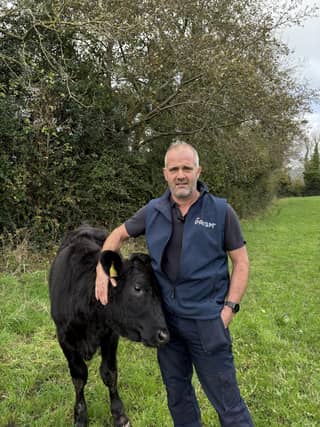

As Northern Ireland’s farming sector continues to adapt to the need for more sustainable models, mixed enterprise farmer Fred Murphy from Hillsborough is participating in ABP’s Programme for Improvement the Sustainability of Red Meat (PRISM 2030).
PRISM 2030 launched in November 2022 supported with an initial investment of £1.5 million. Since then, 350 selected farmer suppliers including 52 in Northern Ireland have been participating. Through his involvement, Co. Down Farmer Fred Murphy is fine-tuning a traditional, integrated system to meet the demands of modern agriculture - balancing performance, soil health, and climate responsibility.
Fred runs a 200-acre family farm at Hillsborough, with 140 acres set in grassland.
The rest supports arable production namely potatoes, spring and winter barley. Fred operates a dairy beef finishing system, finishing 120-130 Wagyu and Aberdeen Angus calves a year as part of ABP Integrated Livestock Supply chains, achieving in spec carcass weights at 26 months of age on average.

His system reflects a smart, low-input circular model. Aside from purchased calf pellets, all other feed is produced on-farm with his own barley straw being incorporated into the ration. Even the waste from their potato processing—used to supply local catering businesses—is fed back to cattle as part of a complete diet.
“Everything here has a use,” he says. “Waste becomes feed, feed becomes fertiliser—it’s all connected.”
Fred joined ABP PRISM 2030 to better understand and optimise his system’s sustainability because it focuses on reducing emissions, improving animal efficiency, and boosting environmental performance. With funding and guidance, the programme helps participating farmers adopt practical changes that can make a measurable difference.
Fred has adopted some new practices since joining ABP PRISM 2030 such as regular weighing, installation of solar panels and incorporating red clover into the grassland sward. The aim is to maintain at least 25% red clover within the grass sward improving the protein quality of his silage, reducing bought-in meal whilst improving soil health and structure. “It’s about tweaking the system,” he says. “We’re looking at growing more of our own protein crops to reduce inputs and cut the age at slaughter.”
Reducing slaughter age is a key focus under the ABP scheme. With the majority of red meat’s carbon footprint linked to Scope 3 emissions (mostly from farms), Fred is looking at ways to cut emissions through better performance and resource use.
With Sustainable Agricultural Payments part of a wider push to improve nutrient management, soil health, and biodiversity on local farms, Fred is already ahead of the curve on many of these goals. “We know potatoes are tough on soil structure,” he admits. “That’s why we’re careful about how we manage rotations and use muck to rebuild fertility.”
His approach is a working example of circular agriculture: crops feed cattle, cattle feed the soil, and all of it feeds the farm’s bottom line.
As ABP PRISM enters its next phase, participating farms are now undergoing second-stage assessments to evaluate the progress made. The initiative has already identified five focus areas for improvement—pasture quality, age at slaughter, livestock health and fertility, fuel use, and alternative feeds—all of which Fred is actively working on.
Farming isn’t just about efficiency for Fred. It’s also about making the farm resilient and future-proof. “We’re not trying to reinvent the wheel,” he says. “We’re taking what works and making it better. ABP PRISM is helping us back that up with data and direction.”