
How multi-species swards save a dairy farmer money
For six years I have been working towards completely eliminating the use of artificial fertiliser on my dairy farm on the outskirts of Belfast.
So far, I have managed to reduce my fertiliser bill by around £20,000, and in some of my fields I simply no longer need it. There are several reasons why I have been able to do this, but one of the most important is multi-species swards.
In the fields that are now fertiliser-free, I have sown a blend of herbs such as plantain, deep- rooting plants like chicory and nitrogen-fixing species such as red and white clovers.
Coupled with a mixture of different grasses, this diverse sward allows nutrients to be brought up to the surface from much deeper within the soil, making more available to the grass for my cows.

As awareness of nature-friendly farming techniques grows, multi-species swards are becoming more common on Northern Irish farms. This is unsurprising. Given the current economic and geopolitical climate, full of unexpected shocks to farms and their bottom line, anything which can help reduce inputs and control costs has to be a sensible investment choice.
It’s not just financial resilience that the swards are bringing to my farm. It’s under foot as well. The diversity of root systems in the swards and the fungal and bacterial biodiversity they are helping to foster is improving the health of my soil year on year. Deeper roots aerate the soil and make the grasses healthier as they delve further down in search of nutrients, rather than having it given to them on the surface through feeding from above.
This is particularly valuable when we consider our changing climate. All the roots in my soil from the swards improve its permeability, ensuring it drains better and takes on a spongy consistency which can then hold on to the water for use during the longer, hotter and drier summers that we are increasingly seeing. Transforming my soil in this way into a year-round system of effective water management gives me much greater confidence for the future.
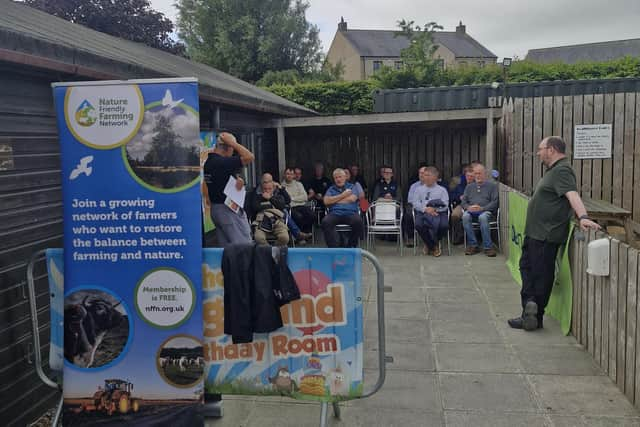
Organisations like the Nature Friendly Farming Network (NFFN), where I am a member of the Northern Ireland steering group, have been promoting practices such as multi-species swards and holding knowledge exchange events where farmers can learn from those already using them. This is crucial, because managing multi-species swards is very different to nurturing a traditional ryegrass field.
Now, in a very welcome move, Daera has also acknowledged their value in contributing to a farming system with fewer inputs, more biodiversity, healthier soil and solutions to key issues such as run-off.
In this year’s Farming with Nature Transition scheme, as part of the herbal ley option, farmers can receive either £467 or £521 per hectare for establishing multi-species swards.
The higher rate will be given to support farmers with more species in their swards.
Applications must be done by the end of July, and I would urge farmers not to delay.
This finally gives farmers who are curious about the economic and environmental benefits of multi-species swards the financial incentive to have a go. As someone who is fully convinced of their massive benefits for our farms, I am very pleased to see policymakers supporting farmers to futureproof their businesses without the risks of dipping into their own pockets. I believe multi-species swards are a win-win for farmers, and I hope that with Daera’s new investment we will see that far more widely.
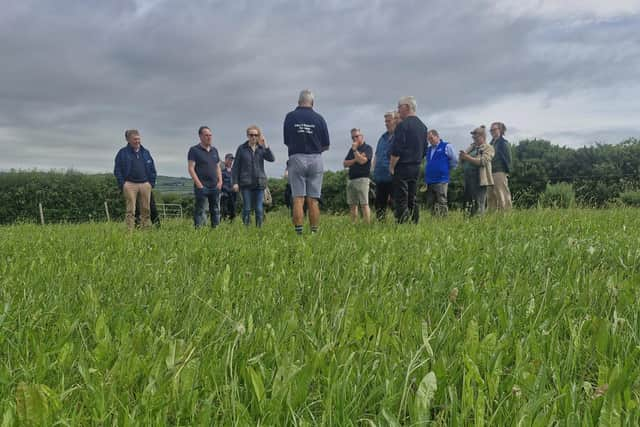
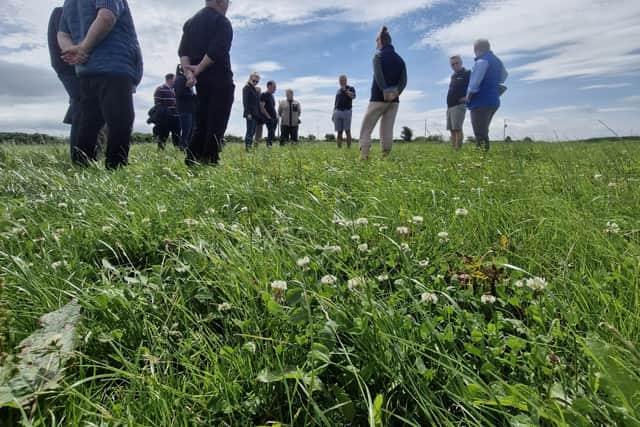
Recently, with the support of Danske Bank, I opened my farm gate to a group of farmers and advisers, offering them a warts-and-all look at the nature-friendly farming system I am developing and the changes I am making. One of the biggest challenges we face in embracing these techniques is how they contradict ideas we have held in farming for many years. We have been taught to hate weeds and have fixed ideas about what our farms
should look like. This remains a difficult issue, and may require combining traditional low-input farming techniques with modern technology which can carry out precision weeding.
We don’t have all the answers, and are very much working through the challenges as we go. However, we are seeing our input costs steadily dropping each year as we advance through our 10-year farm transition. In difficult times, seeing those fertiliser costs vanishing from farm account books could make it all seem worth it.