
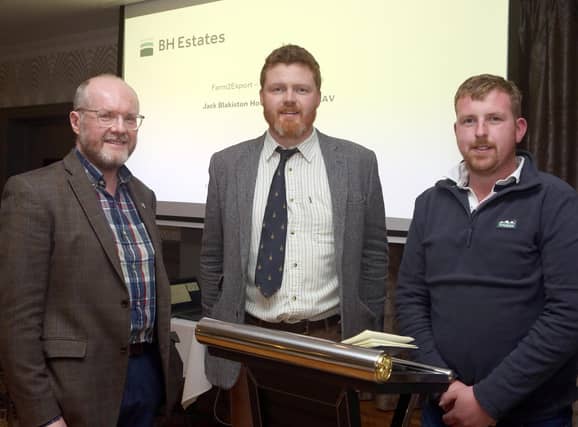

The speaker at the October meeting of the Club was Jack Blakiston Houston, MRICS FAAV who heads up the Farm2Export project based at Blakiston Houston Estates, Dundonald.
The BH Estate was awarded £4m funding from DAERA for their Sustainable Utilisation of Livestock Slurry Phase 2 project known as Farm2Export.
The Estate uses mobile separation technology designed to extract solids for use in their anaerobic digestion plant. High phosphorous content will be processed into a fertiliser.
Jack explained that following his education and earlier work in the UK and abroad, he and his wife, Emma, moved back to Northern Ireland in 2017 to take over the running of the estate’s businesses from his father, Richard Blakiston Houston. He is also an examiner for the Rural Valuers Association.
The Estate has an agricultural business based on a dairy herd, known as the Reynolds Dairy Farm, a renewable business and a consultancy and valuation business.
The Estate has been using a slurry separator from 2017 and began feeding solids to their AD plant from January 2018 and found a similar response to grass silage. A demonstration was given to the Ulster Grassland Society in 2019 and in March 2023, they began trials using a mobile separator on neighbouring farms.
They took delivery of the Slootsmid SMS 6 separator from Holland which aims to scale up the production of solids for AD plants and BH Estate was then awarded the DAERA funding for their Phase 2 project.
Their aim is to replace grass silage with slurry solids fed to the AD plant and make 30,000 tonnes of bio-based fertiliser. High phosphate-based fertiliser is in big demand in countries outside Northern Ireland.
Jack explained how slurry separation can reduce slurry dry matter content by 27% to around 5%. The separation process also increases the space on farms for more slurry storage by taking away the solids and it results in regulatory compliance.
There are now an estimated 65 farms using slurry separation in Northern Ireland. He illustrated the economies of using this technology.
He explained to farmers that if they are employing contractors to undertake this service, the faster the separator works, the less solids will be removed. Despite being charged an estimated £150 an hour for this service, he said it is better not to rush it as a better outcome will result.
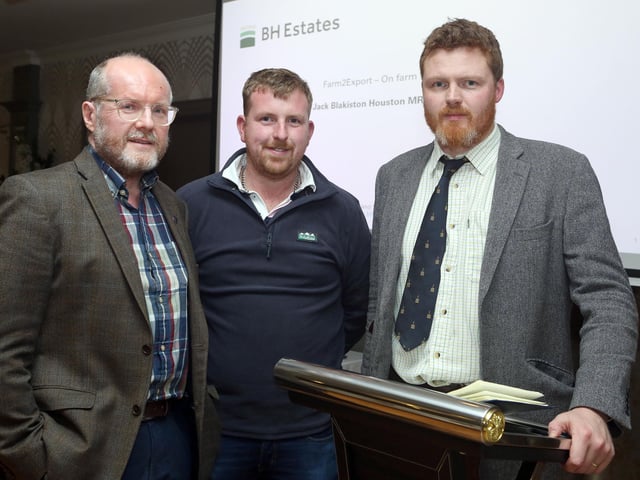
5. Jack Blakiston Houston (right) guest speaker at Fermanagh Grassland Club with (from left) William Johnston, secretary and Alan Burleigh, chairman.
Jack Blakiston Houston (right) guest speaker at Fermanagh Grassland Club with (from left) William Johnston, secretary and Alan Burleigh, chairman. Photo: Raymond Humphreys
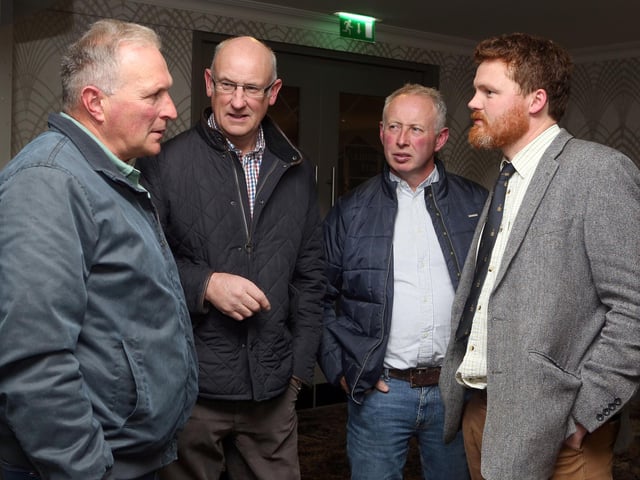
6. Jack Blakiston Houston (right) guest speaker at Fermanagh Grassland Club with club members (from left) Robin Clements, Trillick; Derek Sauderson, Churchill and Michael McCaughey, Trillick.
Jack Blakiston Houston (right) guest speaker at Fermanagh Grassland Club with club members (from left) Robin Clements, Trillick; Derek Sauderson, Churchill and Michael McCaughey, Trillick. Photo: Raymond Humphreys
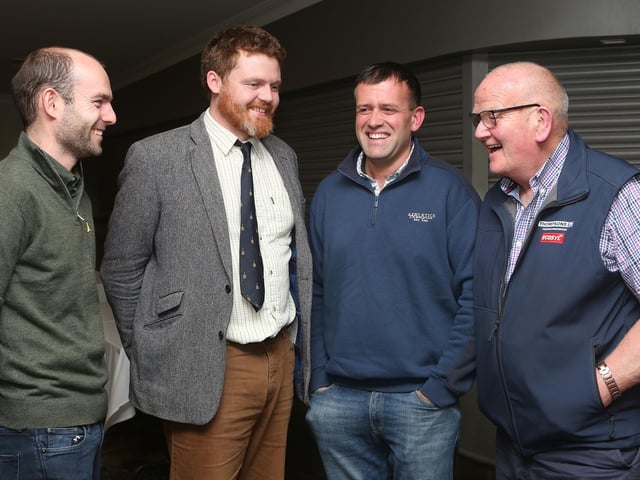
7. Jack Blakiston Houston (second left) guest speaker at Fermanagh Grassland Club with club members (from left) Nigel Graham, Kinawley, Colin Foster, Macken and Abraham Veitch, Kinawley.
Jack Blakiston Houston (second left) guest speaker at Fermanagh Grassland Club with club members (from left) Nigel Graham, Kinawley, Colin Foster, Macken and Abraham Veitch, Kinawley. Photo: Raymond Humphreys