
Look no further than the Simmental - James McKane
Suckler producers searching for an efficient and profitable cow need look no further than the Simmental, says James McKane who has a lifetime’s experience working with the breed
“Simmentals are future fit; we’ve adopted a relatively low input high output system and they tick all the boxes.
"They’re fertile, have ample milk, great growth rates from forage-based diets, and equally important, they’re docile.”
Add together the herd’s performance efficiency and it has the hallmarks of contributing to reduced emissions.
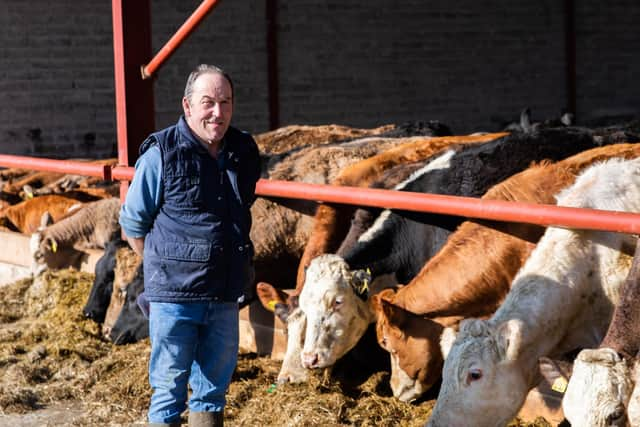

“We’ve a 55-cow herd of predominantly Simmental genetics run with two Simmental stock bulls, and usually end up averaging 100% calves reared.
"We’re achieving our target for the entire herd to calve from mid-February within a 12-week block.
"Cows and calves are turned out as soon as the weather permits, and they look after themselves eating nothing but grass, supplemented with magnesium licks, throughout the season which we like to extend to at least seven months,” explains James who farms at Laymore, near Ballymena in partnership with his wife, Laura and with help from brother, Bill.
“The cows and heifers milk like trains right through to the bitter end without any meal and they keep themselves in body condition score 3 to 4 right round the year.
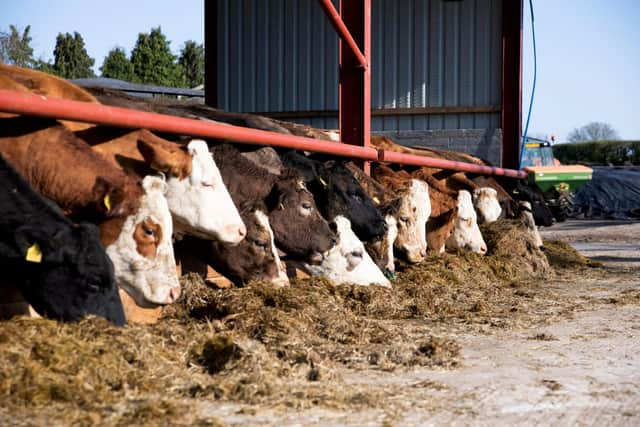
"Furthermore, we’ve never fed creep to the calves; it’s another expense, results in poaching and what’s more, we don’t need to, their mothers have plenty of milk.”
Following weaning, the herd is housed and thrives on pure silage diets, without any supplementary feed, until turn out. James explains replacement heifers are sufficiently well grown to serve at 350kgs and calve at two years.
“They’re bred to the Angus and we synchronise. Since we strive to be more and more efficient, there’s no way we would think about keeping them on for another year grazing valuable grass.”
While a few of the later born male calves are steered and sold as stores, most are kept entire and are currently finishing within an average 14 months at 380kg and sold deadweight on to a rising late spring market. The majority are grading within the U bracket, the remainder R3.
“On housing, these bulls are introduced to a diet of first cut grass silage and meal, and after a settling down period, by the turn of the year we finding they’re averaging 1.7kg DLWG.
“In fact, we’ve just started to weigh the bulls on a monthly basis - it was something the NI Simmental Club has encouraged us to do, and its proved to be an eye opener finding out how they’re really performing.
"I would never have picked out some of those bulls that are doing up to 2.0kg DLWG.”
James’s Simmental journey began in 1971 when he saw the breed for the first time pictured in Farming Life accompanying an article marking one of the initial Simmental importations to the province made by W David Perry, Killane.
“David was a friend of the family, so I asked my Dad if we could visit and ended up bringing home a Simmental heifer; she was my 13th birthday present.
"She cost £40 which was a lot of money at the time, however she turned out to be an investment for life.”
Since then, James says it’s been a slow road to success.
“I’m a first-generation farmer and made sacrifices to save up pocket money sufficient to buy one pedigree heifer from Killane in 1978, before growing the herd to stocking capacity on our 100-acre grassland unit. We’ve now got six pedigree cows registered under the Springfarm prefix and are presently hoping to introduce ET to help expand the herd.
" It’s a development that’s been inspired by daughter, Megan’s love of the breed and interest in showing at local agricultural shows.
“I’ve also got a contracting business so I’m away from the farm a lot, particularly during spring and summer.
"Again, that’s where Simmentals score, they’re so quiet and easy to handle, and we’ve always been confident our cattle are safe for our two daughters, Megan and Ruth to work amongst.”
He adds: “For this unit to have a future, then we’ve to keep costs down, be as efficient as possible and only keep low input high performance cattle.
"Our Simmentals are ticking all the boxes.”
· The Northern Irish Simmental Club is staging its annual spring sale at Swatragh Livestock Market on Friday 5 May.
James McKane is hosting an open day/farm walk on Saturday 20 May organised by the Club in conjunction with the Society.
About the breed: Simmental is a breed of cattle whose history dates back to the Middle Ages. Early records indicate that Simmental cattle were the result of a cross between large German cattle and a smaller breed indigenous to Switzerland. The name Simmental is derived from the name of the area where the cattle were first bred - the Simme Valley which is situated in the Berner Oberland in Switzerland.Technically, the Simmental designation includes several breeds in Europe.
The name is given specifically to the breed in Switzerland, while in Germany and Austria it is known as Fleckvieh, and in France as Pie Rouge. The Pie Rouge includes three separate herd book registries namely Abondance, Montbeliard and Pie Rouge de l'Est.The breed has spread to all six continents. Total numbers are estimated between 40 and 60 million Simmental cattle worldwide, with more than half in Europe.