
Miscanthus enjoys a revival of note
Miscanthus was first identified as a perennial crop for set-side ground on Irish arable farms – north and south - almost two decades ago, writes Richard Halleron.
Back then it was grown as a bio-energy option which, when mixed with peat, could be sold as a valuable fuel source to Irish industry and home owners.
However, this business plan started to run out of steam as successive governments legislated to minimise peat harvesting and burning across the country.
In response to these trends, the area of miscanthus started to drop-off significantly.


But this was not the case on the Co Meath farm of the O’Keeffe family, who identified that the crop can be put to use a ‘super’ bedding material for livestock of all kinds.
As it turns out, miscanthus has absorbency powers that are far superior to either straw or peat.
And when finely chopped, it can be used as a bedding material without comparison in stables, poultry units traditionally bedded livestock courts and dairy cubicle systems.
The production of miscanthus perfectly complements an arable operation; not from the point of view of adding to a specific rotation; but rather from the perspective that the crop requires good land in order to meet its full growth potential.
In addition, the crop requires ‘active drying’ under Irish growing conditions.
This entails the use of handling and storage facilities that are most commonly found on arable farms.
So let’s start with the basics: what is miscanthus?
It is a tall perennial woody grass of East Asian origin, which has a high biomass yield potential.
The crop has been evaluated in Ireland since 1993.
This work has confirmed that miscanthus grows best in areas that have relatively high temperatures and are pre-disposed to high solar radiation.
The conditions required for growth are not unlike those for maize.
However, miscanthus has a lower threshold temperature in comparison to maize.
The results from Irish trials confirm that annual yields in the range 10-15t/ha of dry matter can be achieved under Irish conditions.
James O’Keeffe farms at Creevagh, near Crossakiel in Co Meath.
He currently grows 56ac of miscanthus.
The family had previously established an initial 24ac of the crop as a set-aside commitment back in 2006.
Organic cereals and beans, grown to the highest possible standards, make up the rest of James’ farming operation.
Red clover is also grown as an integral part of the crop rotation followed across his 180ac of crops.
“The original miscanthus area was planted out with the support of a 50% set-aside grant back in 2006,” he explained.
“And it has been fully retained since that then.
“The plan is to further expand the area of miscanthus grown on the farm.
But this will be undertaken at our own expense: grant aid is no longer available.”
According to James, miscanthus is a hard crop to establish.
It requires good ground and a soil pH of 6.8, in order to maximise production levels.
The crop is planted out in the form of sterilised rhizomes, which are sourced from the UK.
The sterilisation process ensures that the subsequent crop will not enter its flowering and seed production stages
James explained:“The rhizomes are physically placed in the ground by operators sitting on a machine that resembles an old potato planter
“It’s a pretty slow and man power intensive operation.”
Rhizomes are planted out at a density of about 16,000 per hectare.
An initial establishment rate of round 90% can be expected.
Sites that are fully exposed to sunlight throughout the year are required to maximise crop performance.
“Newly established crops are left untouched for two years.
"After that, they can be harvested on an annual basis.
“Individual plants will reach 10ft in height. Miscanthus is a perennial crop.
"Within our own farming operation we are still regularly harvesting the sites that were established almost 20 years ago.”
The harvesting of miscanthus gets underway around the middle of March.
The leaves produced by the previous year’s growth would have fallen off the plant stems towards the end of the previous November.
James O’Keeffe again:“The stems are cut down to almost ground level and allowed to air dry for a month.
“The plan is to get the crop as close to a 15% moisture content in the field as possible.
"Depending on the weather and ground conditions, the miscanthus is harvested around the middle of April.
“It’s important to get the crop off the ground before the rhizomes start to put up new shoots.
“The period directly after harvesting is critically important.
"In terms of a fertiliser requirement, a generous application of cow or pig slurry is all that’s required.”
He added: “There are cattle sheds on the farm, which are rented out to local livestock farmers.
"The slurry from their cattle provides the fertiliser nutrients required by the miscanthus.
“If required, additional slurry is available from local pig producers.
“It’s important to get the slurry on to the ground prior to the rhizomes putting up new shoots.”
Weed control in newly established miscanthus crops is important. Grass weeds can out compete the newly planted rhizomes and the appropriate management steps must be taken.
In more mature crops, weed control become less of a challenge.
As soon as a crops gets up and running, the amount of light getting through to ground levels falls-off dramatically.
In addition, the leaves that fall from the stems during the autumn period form a thick mat at ground level.
This prevents the germination of new weeds during the subsequent spring period.
“Some perennial weeds, such as scotch, can be a problem,” James further explained.
“However, they can be treated effectively with a suitable herbicide prior to the emergence of new shoots directly after harvest.
“Miscanthus is not prone to any diseases that we know about under Irish conditions.
"So there is a zero requirement for fungicides and chemicals of this nature.
“In many ways, this complements the organic grain business.”
Directly prior to the harvest, the miscanthus is rowed up, as would be the case with any crop of grass.
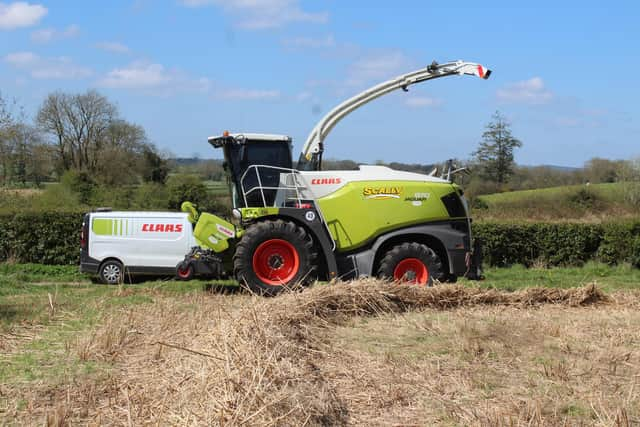
The crop is then lifted by a local contractor with a precision chop harvester, set for a chop length in the range: 1.0 to 2.5cm.
“This is a pretty heavy duty operation,” James explained.
“The miscanthus is very woody in nature and it takes machines in the 800 to 900 horse power capacity to get through it.”
The chopped miscanthus is then taken to the main yard in trailers, where it is placed in sheds with floor drying facilities.
“This year, the crops coming off the fields have a moisture content of around 20%,” James commented.
“We need to get that figure down to around 15%. So active drying will be required.
“In terms of output, we are looking at an average yield of around 5t/ha in dry matter terms.”
All of the miscanthus produced by James is sold for bedding.
“We are working with equine businesses and livestock farmers from as far way as Co Galway,” he confirmed.
“The bedding material is sold on a cubic metre basis at a guaranteed moisture content of 15%.
“Driving all of this is the fact that the chopped miscanthus has very high levels of absorbency.
“This means, it can soak up large volumes of effluent while keeping stock dry.
“Another advantage is the fact that that miscanthus is an inherently sterile material.
"This is of critical importance when used as a bedding material for broilers and laying hens.
“Specifically, where poultry clients are concerned, we will also test the material for pathogens prior to delivery.”
Looking to the future, James is also seeking to develop greater numbers of customer outlets for his miscanthus within the dairy sector.
“We are involved in on-farm trials at the present time,” he explained.
“The miscanthus bedding can be used directly by the likes of Bobman cubicle cleaners without the need for any alteration to the specification on the machine.
“And on that basis, the material should be very attractive to dairy farmers. We will coordinate delivery of the miscanthus to customers on a countrywide basis.”
James concluded: “From a production point of view, miscanthus is a perfect complement for any traditional or organic arable operation.
“In our own case we are trying to deliver added value across all the crops that we grow.
“It’s all about developing a closer relationship with the end consumer. This approach is the only way that I can see of securing the premium prices required to deliver sustainability for all farming businesses.”
At a more general level, miscanthus represents a renewable source of fibre with a wide potential range of uses as biomass or fibre.
These include decorative fencing, compressed board, insulating and packaging materials, paper, plant and substrates, and energy.
The use of natural renewable fibres as substitutes for synthetic materials, which are based on finite petrochemical resources, has obvious advantages in the context of the environment and sustainability.
However, farmers considering growing this crop should first have a profitable end use lined up as establishment costs alone are quite substantial.
In Northern Ireland, where straw is already imported in large quantities, the potential use of ‘home-grown’ miscanthus as an alternative bedding option seems obvious,
In the first instance, the crop grows well in this part of the world. Harvesting should not prove that difficult as a forage harvester or forage wagon can be easily tweaked to pick up the dried crop from the field.
And, assuming normal spring weather conditions, the drying of the harvested miscanthus should not prove that significant a challenge.
Miscanthus is generally harvested from February to April when the moisture content of the material is at its lowest.
Harvesting has been carried out using a self-propelled precision chop maize harvester.
An alternative method is to use a conditioner mower.
Moisture contents in Irish trials have ranged from 27 to 35% depending on season and harvest date.
The lower the moisture content, the higher the crop value.
Precision chopped can be taken directly to a covered store area. Alternatively, it can be baled in the field. It should be baled into 8 x 4 x 2 bales to facilitate transport. The bales must be stored under cover.
Meanwhile,
Hosted on a working farm, the annual Cereals event next month will be offering live demonstrations across a wide range of manufacturers and machinery types.
Arable farmers will be able to see the latest innovation, new product ranges and precision technology solutions for their systems.
In the Syngenta Sprays & Sprayers Arena, visitors can discover how to improve efficiency, deliver accuracy and lower costs, with a full schedule of sprayer demonstrations.
The latest sprayers will be put through their paces including air-assisted, skid unit, self-propelled, trailed and mounted sprayers. Market-leading companies will present the latest innovation and application technology on offer.
The two-day event is being held at a new site this year - Thoresby Estate in Nottinghamshire – on 13-14 June. www.cerealsevent.co.uk.