
NI weekly market report
NI weekly market report
03 August 2026
Grains
UK feed wheat futures (Nov-26)
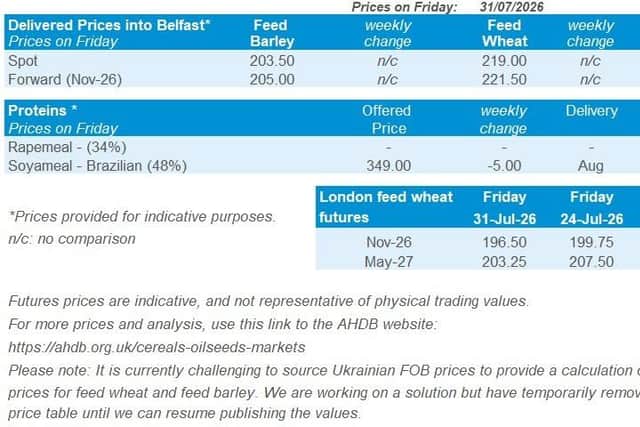

UK feed wheat futures reversed some of the prior week’s gains, following the sentiment of the global market. Nov-26 UK feed wheat futures dropped £3.25/t (-1.6%) last week to close Friday at £196.50/t.
The Relative Strength Index (RSI) decreased from 75 on 24 July to 70 on 31 July. The RSI remains in the overbought zone. This can trigger a pause or retreat in prices if there isn’t further supportive market news, but further news can still push prices higher.
Market drivers
Global grain markets remained volatile last week but broadly ended down under pressure. Prices began the week easing from the previous week's Black Sea-related gains, before being supported on Thursday as renewed attacks on grain infrastructure and shipping heightened concerns over potential disruption to exports from the region.
However, these gains proved short-lived, with global grain futures falling on Friday as traders took profits following strong gains through July. Market sentiment was also influenced by currency movements and broader supply fundamentals.
Despite the late-week decline, developments in the Black Sea continue to be a key source of uncertainty and volatility for global grain markets.
Last Thursday, the European Commission has lowered its 2026/27 EU grain production forecasts, reflecting a tighter supply outlook. Soft wheat production is now estimated at 124.4 Mt, down from 126.3 Mt last month and 8% below the previous season. As a result, soft wheat exports have been reduced to 29.0 Mt, while end-season stocks are expected to fall to 12.9 Mt.
The sharpest revision was for maize, with EU production cut to 51.9 Mt from 59.9 Mt in June, driven by lower plantings and challenging growing conditions. This has increased the EU's projected maize import requirement by 5.0 Mt to 24.0 Mt. Barley production was also revised lower, now forecast at 51.1 Mt.
The cut to the maize crop was not a surprise given French maize crop conditions continued to deteriorate last week, highlighting the impact of challenging growing conditions. As of 27 July, just 34% of the crop was rated in good or excellent condition, down from 38% a week earlier and well below the 69% recorded at the same point last year. This represents the weakest crop rating since comparable records began in 2011.
Meanwhile, the French harvests of wheat and barley are now complete. Looking ahead, the key watchpoint for grain markets remains the flow of exports from the Black Sea. Recent attacks on shipping, port infrastructure and agricultural export facilities have heightened concerns about potential disruption to one of the world's most important grain export regions.
Paris rapeseed futures in £/t (Nov-26)
There was pressure across the week for Paris rapeseed futures. The Nov-26 contract decreased by 6.7% from Friday 24 to Friday 31 July, closing at £438.99/t.
The relative strength index (RSI) is 49, down from 63 the week prior, with prices moving closer to the support level of £430.00/t.
Market drivers
Oilseed markets came under pressure last week, driven by improving crop prospects and weakness across the global vegetable oil complex. Further to that, crude oil markets came under pressure last week as tensions between the U.S. and Iran eased, reducing geopolitical risk premiums. Additional pressure on crude oil prices came from expectations of increased OPEC+ production and concerns over weaker global demand, particularly from China and the United States. Nearby Brent crude oil closed Friday at $90.12/barrel, down 6.9% across the week.
One of the main drivers was forecasts for beneficial rainfall across the US Midwest which improved soyabean prospects. The expected rain is particularly important as the crop enters the pod-setting stage, a key period for determining yield potential.
With weather concerns easing and expectations for a large US crop remaining intact, futures moved lower despite continued strong demand from the domestic crushing sector. Currently 63% of US soyabeans are in good to excellent condition, with a further update to this due to be published this evening by the USDA.
Favourable weather conditions across the Canadian Prairies continue to support canola yield potential.
Last Thursday, the European Commission reduced its forecast for EU sunflower seed production in 2026/27. Output is now projected at 9.5 Mt, down from 10.1 Mt estimated last month.