
Opinion: While once seen as the problem, British farming now holds the solution to climate change
For decades, farming has been cast as the villain in the climate change story. Industrial agriculture, intensive livestock operations and synthetic fertilisers have all contributed to the global environmental crisis. But after witnessing first-hand the transformation happening across British farms, I'm convinced we're witnessing a fundamental shift: farming is evolving from climate problem to climate solution.
While once seen as the problem, British farming now holds the solution to climate change
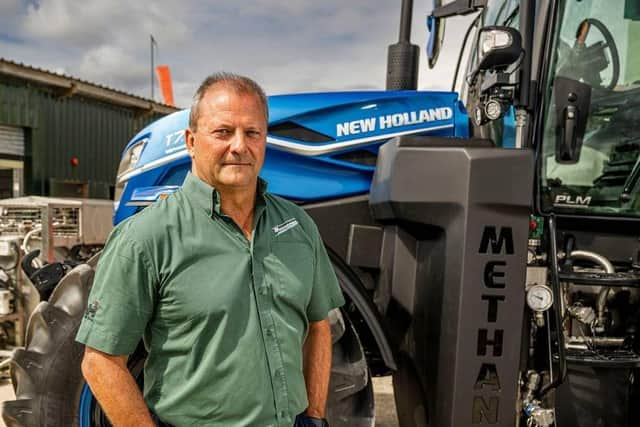
By Dr Chris Mann, Co-founder & Chief Technology Officer, Bennamann
For decades, farming has been cast as the villain in the climate change story. Industrial agriculture, intensive livestock operations and synthetic fertilisers have all contributed to the global environmental crisis. But after witnessing first-hand the transformation happening across British farms, I'm convinced we're witnessing a fundamental shift: farming is evolving from climate problem to climate solution.

This transformation isn't just theoretical, it's happening now, driven by regenerative practices that are rewriting the rules of sustainable agriculture.
The regenerative revolution
The movement back to regenerative farming represents a return to traditional practices, enhanced by modern technological breakthroughs. Regenerative farming is eliminating the need for artificial fertilisers, reduces reliance on purchased feed and keeps livestock outdoors through a pasture-based model.
The economics of this model are compelling. When you halve the costs of fertilisers and purchased feed, everything you grow becomes more profitable. This is financially transformative for farmers who are struggling with rising costs and volatile markets.
The environmental benefits are equally remarkable. Regenerative farming produces food with significantly higher nutrient levels whilst simultaneously sequestering carbon in the soil. Carbon-rich soil holds more water, has better structure and is more fertile for growing crops.
One of the most exciting developments is mob grazing, which artificially recreates the conditions of natural herds like bison. By concentrating animals in smaller areas for short periods, farmers force competition for grass, ensuring animals eat everything rather than selectively grazing choice plants whilst leaving unattractive thistles and weeds.
This intensive rotational approach leaves behind what initially looks like devastated soil. However, this chewed-up ground is rich with urine and dung deposited exactly where it's needed. Within days, farmers move the herd to the next small patch, allowing the grazed area to recover.
The results are extraordinary. Grass grows back faster and stronger, soil carbon levels from the manure increases dramatically and farmers can support many more animals on the same land area.
Methane: From waste to wealth
Perhaps the most critical element of farming's climate solution lies in methane management. Agriculture produces approximately 49% of UK methane emissions according to the UK Government’s Department for Environment, Food & Rural Affairs Agri-climate report 2024 but this represents an enormous opportunity rather than just being a problem.
Animals farmed regeneratively on pasture produce less methane in their digestive processes compared to those fed artificial feeds indoors. Importantly, when we capture methane from slurry storage, we can achieve something remarkable: negative carbon emissions.
The UK produces approximately 90 million tonnes of livestock waste annually, yet only 3% currently undergoes methane capture. This represents both a massive environmental failure and an enormous economic opportunity.
Additionally, when farm waste is managed through anaerobic digestion, this waste becomes a valuable fuel source whilst simultaneously solving storage and spreading challenges that plague farmers during wet weather.
The technology making it possible
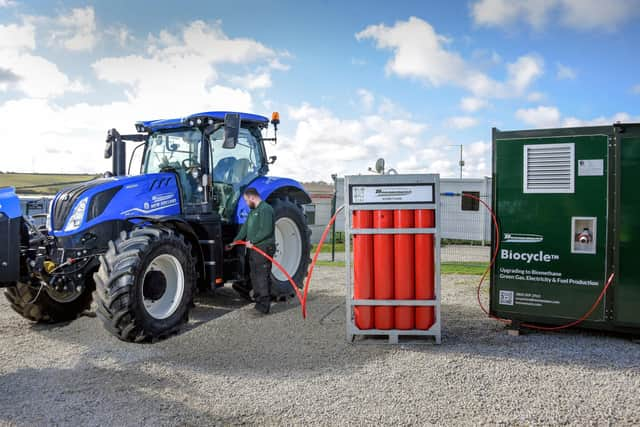
Traditionally, anaerobic digestion has been limited to large, grid-connected installations. However, new approaches are making small-scale, distributed systems economically viable. Mobile upgrading systems such as Bennamann’s Biocycle™ can visit multiple farms, processing biogas into compressed biomethane that can be stored and transported like conventional fuel.
This approach transforms the economics entirely. Rather than requiring massive infrastructure investments, farmers can share upgrading equipment across several operations, dramatically reducing payback periods. Bennamann’s goal is that within three years the farmer will see a return on their investment.
The captured methane can fuel New Holland’s methane-powered tractors and even provide compressed natural gas for local transport fleets and off-grid electric vehicle chargers.
But the potential of this technology extends far beyond agriculture. Grass waste from golf courses, playing fields, roadside verges and domestic gardens represents enormous untapped energy potential. Bennamann’s own calculations suggest that one square metre of grass cuttings over a year contains roughly the energy equivalent of one litre of petrol. Scale that up to a football pitch, and you’re looking at around 5,000 litres worth of energy potential over a year’s worth of cutting.
This distributed approach to waste management could revolutionise our entire energy system. Rather than transporting waste to centralised facilities, small-scale anaerobic digesters could process organic waste locally, creating a network of community energy hubs.
The climate imperative
The mathematics of climate change make methane capture essential, not optional. Climate models projecting 1.5°C warming limitation assume methane levels will fall from current levels by 35% of more.
Put simply, we cannot achieve net zero without capturing agricultural methane.
This makes farming's transformation from problem to solution not just beneficial but absolutely critical.
A new economic opportunity
This agricultural transformation represents more than environmental necessity it's also an economic opportunity. Developing distributed energy systems, methane-powered equipment and circular farming practices creates entirely new technology sectors.
The UK is already becoming a world leader in methane tractor technology and AD upgrading. This expertise represents valuable export potential as every country with livestock faces identical challenges. As well as this, consumer demand for sustainably-produced, carbon-neutral food products is creating premium markets for regeneratively produced goods.
What we need now is recognition that farming's relationship with climate change has fundamentally shifted. Rather than continuing to view agriculture as a problem from a climate perspective, we must embrace its potential as the foundation of our climate solution. But more than that, farming could be our most powerful tool against climate change.