
Removing trees from farms is why our soil is struggling - agroforestry is the solution

Ever since agriculture began to specialise and move away from mixed farming businesses with several enterprises, trees have largely been seen as more of a nuisance than an asset.
Across Northern Ireland (and the UK as a whole), trees and hedges were removed to create larger fields to improve the efficiency of farm operations.
At first, the negative effects of this on the soil weren’t apparent, so landowners could fairly easily justify their decisions. However, as we come to understand soil biology more, we can no longer ignore the unintended consequences of removing nature from our farming.
We still have so much to learn about the fungal life in the soil beneath our feet. All too often, we associate fungi with diseases on cash crops, which has resulted in huge amounts of money being spent on chemical fungicides to prevent this from happening.

However, these diseases tend to be a warning sign of poor levels of biological activity in our soils. At the same time, it is now clear there is far more beneficial fungal life in healthy soil ecosystems than we previously realised.
These fungi are essentially soil’s public transport and infrastructure networks. They provide plant roots with key nutrients, and they are one of the main drivers of aggregation, which allows vital nutrients, air and water to freely move around the soil.
Grass tends to provide a bacterially dominant environment, while trees tend to provide a fungal-dominant environment (hence why you often see fruiting fungi in forests). For healthy soil life, you need a good bacterial-to-fungal balance, and this is something I feel we are largely missing in our soil on farms.
When the balance of bacteria and fungi in soil is not there, soil aggregation tends to be poor, leading to problems with compaction and soils that struggle to absorb water. This leads to waterlogging when we get heavy rainfall and drought in dry periods.

Northern Ireland is known for having comparatively high levels of rainfall. It is therefore no surprise to me that, with trees missing from many of our farms, we are now experiencing problems with water infiltration, as trees are the main root engineers for soil.
We need to recognise the benefits trees can bring. Unfortunately, mention trees to many people and they will assume you either mean rewilding with the creation of dense canopy forests across our island, or close-spaced conifer plantations. Industries that used to be close, like forestry and farming, have become very polarised.
Agroforestry is neither of these things, and I believe it is the solution to the problems our soil faces. Agroforestry (or silvopasture or silvoarable, to use the two terms I prefer), involves carefully designing trees into your farm system to reap benefits for soil, livestock and crops.
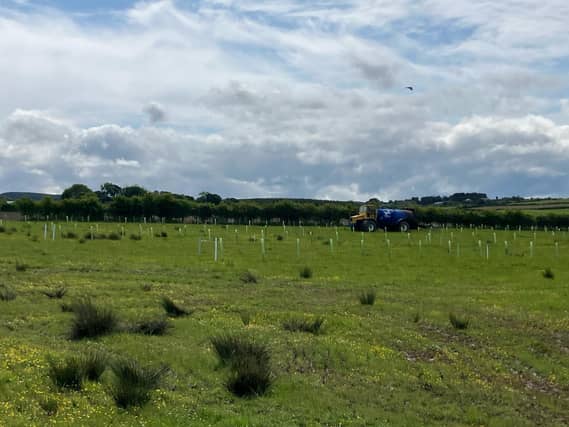
At our farm in County Derry, with the assistance of the Woodland Trust, we have planted around 1,800 native trees in four fields covering around 17 acres. They are predominantly planted in rows around 10m to 20m apart, with between two and four metres between each tree.
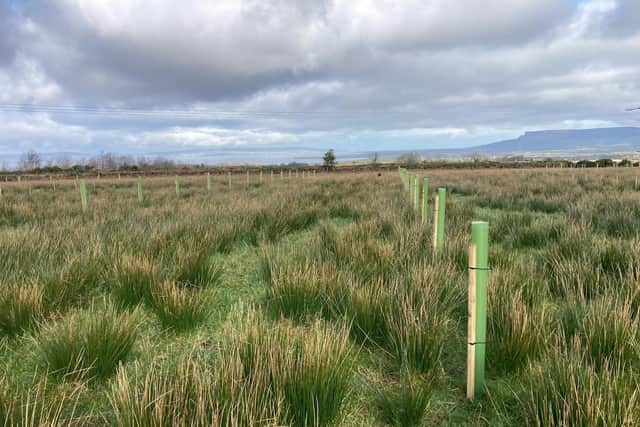
We’ve done this work for numerous reasons, but the main one is to improve soil function. These fields are difficult to manage in wet weather, and have areas of rushes and poor grass growth. The tree roots will help open up the soil and make more land suitable for growing grass rather than rushes. Alder should boost our soil health as it fixes nitrogen. The grass growth will also improve under the shade of the trees in the heat of summer, while in autumn the leaf litter will provide nutrients to the soil. Far from reducing our production, we believe planting trees will increase it.
It’s not just the grass that needs the shelter of the trees. Our livestock will benefit from the trees both in very warm and bitterly cold weather. Willow provides them with forage to browse and is rich in tannins, which act as a natural anthelmintic. Research from AFBI Loughgall shows its well-established agroforestry trail has extended grazing periods in spring and autumn, saving large amounts of money on bought-in feed.
Agroforestry also has huge potential to increase biodiversity on farms, from the smallest lifeforms that dwell in the soil to the birds living in the trees’ branches.
In short, agroforestry strikes me as a win-win solution for both the environment and for the financial sustainability of our farms.