
Sheep farmers sought for DAGI trial
DAGI (Drench And Grazing Integration) is on it’s way from NZ, to help farmers in the northern hemisphere visualize worm larvae on their paddocks.
When these larvae are ingested by your stock, they become worms that limit production and force you into drenching – but what if you could avoid them in the first place?

For decades, New Zealand sheep farmers had a simple answer for worms: drench the flock every three or four weeks, keep the paddocks clean, and push the lambs through. It worked brilliantly. It intensified grazing, it boosted growth rates, and it built an industry.
The trouble is, every time we drenched, only the worms with resistance genetics survived to breed. We bred the smart ones. Today more than a third of NZ farms have triple drench resistance — and when we drench, it’s often only the smart ones that survive. The system that worked for so long has fallen over.
The industry in NZ has a framework for the way forward, called FARMED: Feeding, Avoidance, Refugia, Monitoring, Effective Drenching. Most farmers can do Feeding, Monitoring and Effective Drenching well. The hard two are Avoidance and Refugia — because both require seeing something invisible.
Avoidance means not grazing vulnerable stock on paddocks loaded with larvae.
Refugia means deliberately keeping a population of susceptible worms — the ‘dumb’ ones — alive on the farm, so they breed with the resistant (smart) ones and produce offspring that have some ‘dumb’ genes – and therefore still respond to drench. And here’s the problem: 90% of worms aren’t in your sheep. They’re on the pasture. No farmer can see a blade of grass loaded with microscopic larvae, and no farmer can track in their head which paddock has lots of those larvae, or whether they are likely to be ‘dumb’ or ‘smart’.
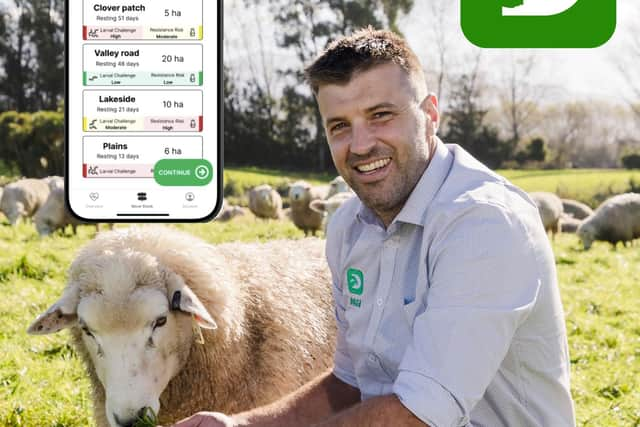
That’s the problem DAGI solves. You put in your stock movements, your drenches, and your faecal egg counts. Age, weight, energy intake, weather — all automated.
The app runs the parasite lifecycle in the background and paints every paddock on your farm with two traffic lights: one for larval contamination, one for resistance risk.
Red, amber, green. You open DAGI in the morning and you can see, at a glance, which paddock your lambs should go on and which to save for cattle or maybe crops or silage.
This means you can avoid the larvae in the first place, rather than just treating once the animals are already infected. Less exposure to worms = less need for drench.
And less reliance on drench means better productivity. Animals with a worm burden experience a growth check that they never get back – even when wormed. So avoiding the worms in the first place means your stock grow faster. Built by vet Ryan Luckman, it’s a practical tool that solves a problem – not just another piece of tech for the sake of it.
DAGI also shortens the slowest feedback loop in agriculture: dairy farmers know by the next morning’s vat how their day went; sheep farmers can wait months. DAGI’s history tab closes that gap — this movement, this drench, this result.
DAGI isn’t a silver bullet. It’s a tool — the way cow collars in dairy are a tool. It takes the invisible and makes it visible, so farmers can make better decisions every time they move stock. It does the heavy lifting, so farmers can just go out and farm.
NZ farmers are facing the problem of drench resistance on a terrifying scale, and it’s creeping into other countries. We have seen what happens when drenches stop doing a good enough job, and we fall off a cliff in terms of being able to manage worms with chemicals. We want to use what we’ve learnt in NZ to stop farmers elsewhere falling into the same pit. DAGI is coming to Ireland and the UK at the start of 2027 and we are looking for about 50 sheep farms to beta trial the UK version.
There are no limits on whether or not you think you have drench resistance, how often you do FEC’s or how many sheep you have. If you’d be interested to hear more, email [email protected] and we’ll be in touch with more info down the track.
Find us at https://www.dagi.nz
Or on socials: Instagram @dagi.nz, Facebook @dagi