
The Northern Ireland Market Report
31 March 2026
31 March 2026
Grains
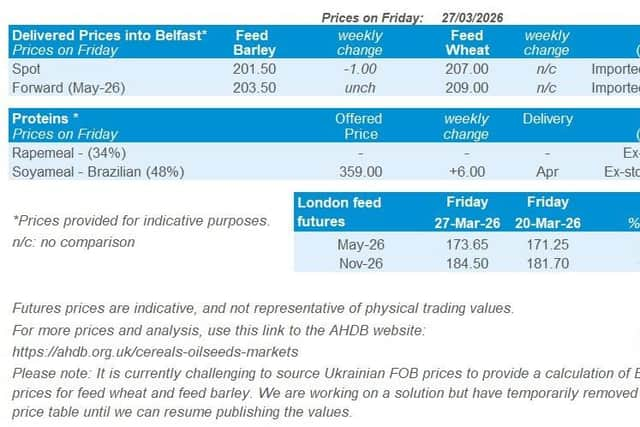
May-26 UK feed wheat futures ended the week up £2.40/t (+1.4%) at £173.65/t. The domestic market reversed the drop from the week prior, UK feed wheat futures followed the broad support of global grain markets across the week. Based on Friday’s close the relative strength index (RSI) was 60, up from 56 on Friday 20 March. The RSI still remains around the overbought zone (70).

Market drivers
Broadly grain markets were supported across the week, despite some profit taking on Friday. Support was mainly driven by a mix of weather risk, export demand, technical trading and geo-political unrest in the Middle East. There was support on the US market as Chicago wheat gained 1.6%, while Paris milling wheat (May-26) was unchanged across the week, from pressure on Friday.
Geopolitical unrest continues to significantly support higher energy, freight and fertiliser costs, alongside concerns over shipping disruption through key routes such as the Strait of Hormuz. President Trump announced an extension for Iran to open the Strait of Hormuz or face destruction of Iranian energy plants; this comes as Iran rejected his 15-point plan on ending the war.
Further to that, weather risk also played into the market over the last week. Dryness across the US Plains supported the market with major wheat producing states such as Oklahoma, Kansas and Nebraska experiencing severe to extreme drought. Rains are expected in these key areas over the next week which will help relieve some crops. However, the trade will closely monitor this as this is a key fundamental market driver, given that we are approaching the US spring crop planting window.
USDA Prospective Plantings and Quarterly Grain Stocks reports are likely to be the main near-term market drivers, with traders focused on whether acreage confirms the market’s current bias toward fewer maize acres and more soyabeans, as well as whether old-crop stocks come in tighter or looser than expected. There is caution in the market that these numbers may not be representative of the true picture given the recent geo-political unrest and the rise of fertiliser costs could further drive a shift from maize to soyabeans.
Middle East conflict: impacts and implications for UK farmers
Conflict in the Middle East continues since the beginning of March. While there remains limited evidence of physical disruption to agricultural input supply in the UK, gas, oil and freight markets continue to be impacted with implications for agricultural input costs. Here, we cover the expected impacts on fertilisers, oil-based inputs and feed while considering the wider implications for farming.
Rapeseed
May-26 Paris rapeseed futures in £/t fell slightly from Friday to Friday, dropping to just over £434/t. Prices are close to the 20-day rolling average, which could indicate the nearest level of support or resistance. The relative strength index (RSI) fell from 55 to 54 Friday-Friday and is indicating a lack of market momentum.
Market drivers
Paris rapeseed futures May-26 ended last week down 0.4% at €500.25/t, while the Nov-26 contract gained 0.7% to €497.00/t. The price difference between old (May-26) and new crop (Nov-26) Paris rapeseed futures is now at €3.25/t likely driven in part by the increasing unpredictability of the future. Technically speaking, current prices are close to the €500/t strong resistance/support level.
Currently, the oilseed market is mainly influenced by geopolitical factors, such as the volatility of crude oil prices resulting from the war in the Middle East, and the uncertainty surrounding the rescheduled meeting between Donald Trump and Xi Jinping.
The future of agricultural commodities is also being considered in the context of rising production costs. Chicago soyabean futures and Winnipeg canola futures (May-26) fell over the week (20 to 27 March) by 0.2% and 0.8% respectively.
US net export sales of soyabeans for 2025/26 totalled 668.9 Kt for the week ending 19 March. This figure was more than twice that of the previous week and exceeded the top estimate from analysts. However, the prospect of soyabean exports from the US to China is currently unclear.
Meanwhile, the US finalised the biofuel blending quotas for the 2026/27 period last Friday, providing some support for soyabean crushing.
Last Thursday, the European Commission published its first rapeseed production forecasts for the EU-27 in 2026/27, estimating production at 19.9 Mt, compared to 20.1 Mt in 2025.