
The significance of the ABP Angus Youth Challenge continues to evolve
The impact made across society as a whole by the ABP Angus Youth Challenge continues to progress. This is a direct consequence of the initiative maintaining its momentum as a must-dofor Yr. 11 students across Northern Ireland.
All of this reflects the fact that the challenge is much more than a ‘farming competition’ attracting students: in reality it is a vehicle allowing those taking part to develop new skill sets that are almost impossible to teach in a standard classroom setting.
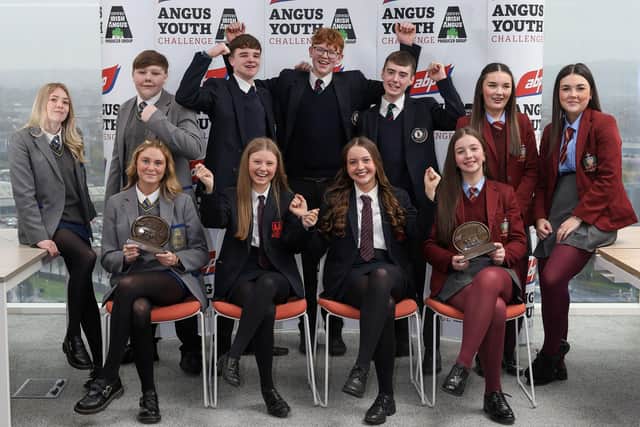

Teachers and students have recognised this fact in equal reality, which is why schools from both rural and urban settings are keen to take part.
No other initiative of its kind has managed to attract such a diverse range of entrants.
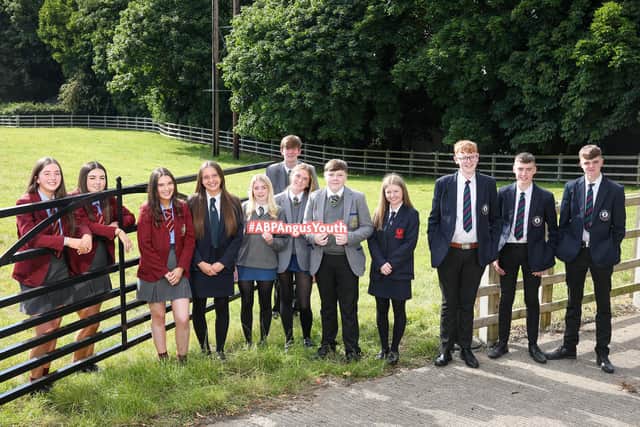
And once in the schools, the core themes associated with the Challenge are communicated out to local communities courtesy of the activities undertaken by the competing teams and their use of social media.
The ABP Angus Youth Challenge is a skills-based agricultural competition for 14-to-15-year-olds (Year 11) in Northern Ireland, run by ABP in partnership with the Certified Irish Angus Producer Group.
It has been designed to meet a number of objectives. These include the provision of hands-on experience that bridges the gap between the classroom and the workplace, supporting GCSE curriculum subjects: such as agricultural science, biology, business studies, and home economics.
The challenge also promotes fact-based nutrition: encouraging an informed, balanced, and evidence-based view on beef consumption as part of a healthy diet.
Another key objective is that of highlighting sustainability and climate action. In other words, shining a positive spotlight on sustainable farming practices, animal welfare, traceability, and environmental responsibility within local beef production systems.
Meanwhile the 2025/26 Challenge is fast coming to a conclusion. The four schools selected as finalists are: St Patrick’s High School Keady; Ballymena Academy, Blessed Trinity College, Belfast and St Patrick’s College Dungannon.
The past 13 months have seen the members of the respective teams develop their initial entries, follow-through with their bespoke projects, complete a highly instructive study tour and then present to the final judging panel.
The 2026 awards’ ceremony will take place at the RUAS Eikon Centre on Thursday next (October 22nd). The event is fast becoming a centre piece of the farming and food year in Northern Ireland.
Irrespective of the final outcome, each of the four teams has demonstrated significant initiative and outside-of-the-box thinking in getting to this stage.
But within all of this a number of key outcomes have emerged.
The first is the extremely positive impact of the challenge on the skills development opportunities it delivers for those students taking part.
Teacher, Clare McIlvenny, from St Patrick’s College, take up this point:
“The competition has helped to significantly improve the presentation and communication skills of all the team members.
“It has also helped to improve their levels of self-confidence, which is critically important as they move forward with their careers.
Conor McNeill, from Annaclone in Co Down, teaches at Blessed Trinity College.
He agrees, adding:
“The school is based in North Belfast. None of the pupils have a farming background. So, getting involved with the competition required the team members to step out of their comfort zone.
“And it has worked. The origins of the school entering the event goes back to a visit made to the Balmoral Show.
“We keep sheep at home. And I took the opportunity of bringing a couple of lambs up to the school last year, simply to give the students of what practical farming is all about.
“And it was very easy to see those that were really interested in the farming way of life.”
Fiona O’Neill, the supervising teacher for the team competing from St Patrick’s High School Keady, fully agrees with these sentiments.
She said:
“The competition has been a great opportunity for our pupils to take their learning beyond the classroom.
One of the biggest benefits has been seeing their confidence grow, particularly with public speaking and sharing their ideas with others.
They’ve worked together and learned more about the important role women play in agriculture in Northern Ireland.
“From a school’s point of view, it’s lovely to see pupils get involved in something that matters to their community and realise that their voices can make a difference.”
The other theme that has again come to the fore courtesy of the challenge is the recognition on the part of the participating students that farming can offer very rewarding career opportunities for people from all backgrounds.
Déaglán McFarlane, a member of the Blessed Trinity College team, explained:
“Prior to getting involved in the competition I would not have thought of following a careerin the farming and food sector. But that has changed now. Both industries have a lot to offer, from every point of view.
Dar Cush, a member of the St Patrick’s College team, has been extremely taken by the breadth of science that drives farming systems.
“In our own case, we took a research-based approach when it came to assessing the performance of our Aberdeen-Angus cattle that we had to manage for a 12-month period.
“It was an approach that focused on both grazing and indoor feeding systems.”
A fundamental driver of the ABP Angus Youth Challenge is the unique opportunity provided to the four finalist team of each managing their own five Aberdeen-Angus weanling cattle for a full year and then selling them to ABP.
Samantha Dunlop and Katie McNeilly are the members of the Ballymena Academy team. They took the decision of looking at the role breeding and genetics play in improving the performance achieved by Aberdeen-Angus cattle.
And in their case, it was very much a case of interacting with farmers directly on this matter.
Katie further explained:
“We went to this year’s Ballymena Show and canvassed farmers directly on their attitude to animal breeding systems and how these impact on their businesses across the board.”
Significantly, both students are fully aware of Northern Ireland’s new Bovine Genetics project and the core use of genomics and the genetic analysis of individualanimals within this.
Samantha commented:
“We asked a representative from the delivery body, Sustainable Ruminant Genetics, to attend a farmers’ supper, which we hosted as part of our project earlier this year.
“The depth and scope of the new science involved in this project is very obvious. And I think it’s important that livestock farmers make use of these advances as they look to the future.”
Courtesy of their project, the team from St Patrick’s High School in Keady looked at the opportunities for women within agriculture.
Gráinne Anderson, one of the team members, commented:
“We enjoyed the overall experience and knowledge gained through the whole project.
“We loved meeting new people, talking to industry experts and learning new things along the way.
“The whole experience was such an amazing opportunity, and we are so grateful to be a part of it along with the other schools.”
She added:
“We learned so many valuable lessons and skills which helped us to develop further and gain confidence in making a difference in the agricultural sector for all women and encourage more women to get involved in the industry.
“We think that continuing to encourage and support all women it will continue to allow so many more to have the confidence and the same opportunity to get involved.”
But competing in the ABP Angus Youth Challenge isn’t simply a one-way process for the teams taking part.
Complementing the hard work they put in to developing their entries and projects comes the opportunity to travel, enjoy and learn from new experiences.
And for the 2205/26 ABP Angus Youth Challenge cohort, all of this materialised around visits to Harper Adams University College in Shropshire.
It is one of the UK’s elite centres of third level agricultural teaching and research. The centre also boasts a recently established veterinary faculty.
In tandem with the visit to Harper, the members of the four teams making the finals of the 2025/26 Challenge had the opportunity to visit ABP’s demonstration farm at Bromstead in Staffordshire.
While visiting these locations each of the teams were given the opportunity to present their own ideas to their hosts in attendance.
They also visited local primary schools, where, again, they had the opportunity to talk about the themes and ideas that they had included within their own ABP Angus Youth Challenge projects.
This was a specific point picked up on by Dara Cush, from St Patrick’s College.
He said:
“For me, competing in the Challenge has been a journey of personal development. My presentation skills have improved immensely, and my levels of self-confidence have increased.
“It has been a very positive experience.”
And so, the scene is set for the 2026 ABP Angus Youth Challenge Awards.
The event provides a show case for all of the teams making this year’s final while also giving an opportunity for schools competing in 2026/27 competition to get a real sense of what it is about and what they can look forward to over the coming months.
Parents and teachers will be in attendance as well as industry leaders from across the entire spectrum of farming and food in Northern Ireland.
Never before has a schools’ initiative of this kind managed to gather such momentum. And it really is a case of success building on success.
Above all else the ABP Angus Youth Challenge has been a clarion call on behalf of the farming industry here, confirming in a very clear and unambiguous manner that agriculture and food needs people from all backgrounds and with the myriad skill sets to help ensure its future at the heart of our economy and society.
Meanwhile, the teams from Ballymena Academy, St Patrick’s College, Holy Trinity College and St Patrick’s High have already demonstrated that they are winners: they have the skill sets and commitment to make that all important difference at the very highest level.
To say that farming and food here punches above its weight is an understatement. The industry is already producing and manufacturing enough high-quality protein foods to meet the requirements of some 10M people: five times the population of Northern Ireland.
Moreover, all of this can be built on for the future in a wholly sustainable manner.
This is a great news story, which the ABP Angus Youth Challenge is helping to tell in a very effective way.
And it’s not the organisers of the initiative that are making this happen: it is the hundreds of young people across Northern Ireland, who commit each year to telling us all: ‘we can make the difference.’An long may this continue to be the case.