
Arable land sales dominate the reduced supply of farmland marketed in Great Britain
The area of farmland marketed was 15 per cent lower in Great Britain during the first half of 2025 (H1) than for the same period of last year according to Savills latest analysis, while the average farmland value fell by one per cent.
However, these results conceal significant regional and farming sector variances currently at play in the market.
Andrew Teanby, Director of Savills rural research, commented: “The performance of “corn” versus “horn” appears to be influencing the types of property marketed and how these launches are received by potential buyers.
“Our analysis shows that currently arable land accounts for a much higher proportion of the market than usual.”
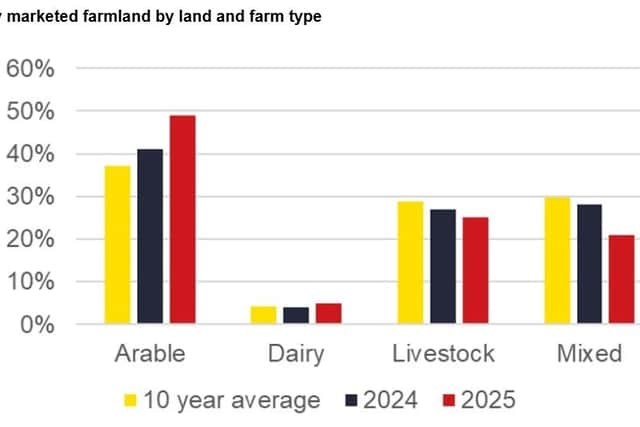

Sector focus
During H1 2025, 49% of the acreage launched was farms that are predominantly arable enterprises compared to the 10-year average of 37%. In total, the arable farms marketed in H1 2025 cover 41,600 acres, which is the most since 2015; the average for the intervening nine years is 27,800 acres. Meanwhile, dairying land across Great Britain is consistently at four to five per cent of the market, while livestock and mixed farms currently account for a smaller proportion of the land marketed.
Andrew added: “Beef and lamb prices are presently high, while cereal prices have fallen by 14% over the past 18 months, and margins for combinable crops are currently low. This, coupled with the sharp reductions in delinked payments for 2025 and 2026, could be prompting arable farmers to evaluate their options, potentially leading to some sales.”
National supply levels
In England, the supply in H1 2025 was 17 per cent lower and in Scotland, it was 14 per cent lower compared to H1 2024. In Wales, the three per cent increase can largely be attributed to the marketing of the 3,784-acre Nannau Estate, in Gwynedd.
Regional differences
Across the English regions, the East and West Midlands do not fit the overall trend of reduced supply – during the first half of this year 55 properties were marketed, compared to an average of 39 between 2012 and 2016. In the West Midlands; Herefordshire, Shropshire and Staffordshire are each at least 30 per cent more active than they were between 2012 and 2016. However, overall, the region has not exceeded the amount of land marketed in H1 2024.
Market evidence
Alex Lawson, Head of Rural Agency, Savills, commented: “Pricing has become more acutely driven by individual circumstances, principally quality (of land, buildings and infrastructure) and location. The presence—or absence—of high-quality infrastructure is playing a more prominent role in determining the strength of buyer interest.
“There are some very well-funded buyers for “the right thing”, but they have often become increasingly discerning.”
In Scotland, “Although few transactions have been completed, early evidence suggests values are holding steady,” saidLuke French, Head of Rural Agency in Scotland. “Interest is strong in established local hotspots, such as southeast Scotland, where private sales have been driven by progressive businesses expanding and external capital,” he continued.
The outlook
The strength of competition and prices achieved continues to vary widely between and within regions. The overall average value of GB agricultural land decreased by one per cent during H1 2025, to £8,200 per acre from £8,300 recorded at the end of 2024. This fall is largely attributed to a slight fall in average values in England.
The dry weather has led to an early harvest, and although yields have been affected, early reports suggest they are often exceeding expectations, so sentiment may improve. There are numerous policy changes underway that affect farmers, including the inheritance tax reform legislation, which is expected soon.