
August 2026 warmer, duller and slightly wetter than average recorded at Armagh

Armagh Observatory has reported that August 2026 was warmer, duller, and slightly wetter than average.
Taking June, July, and August together, this was the warmest meteorological summer on record at Armagh, and both sunnier and drier than average. This summer was the second at Armagh, after 1976, to see heatwaves in each of the three summer months.
The mean temperature this August was 16.3 degrees Celsius (61.3 Fahrenheit), approximately 1.7 C warmer than the (1796–2020) 225-year long-term average August temperature at Armagh (14.6 C) and 0.8 C warmer than the most recent (1991–2020) 30- year August average (15.5 C). August 2026 is now equal ninth in the list of warmest Augusts at Armagh, shared with August 1976, August 1880, and August 1856.
Average August temperatures at Armagh have increased significantly over the last thirty years or so. While the (1961–1990) 30-year August average was 14.8 C the most recent (1991–2020) 30-year average was 15.5 C, an increase of approximately 0.2 C per decade. During the last fifteen years, only five Augusts have seen average temperatures below the most recent 30-year average, suggesting that the observed August warming trend is continuing.
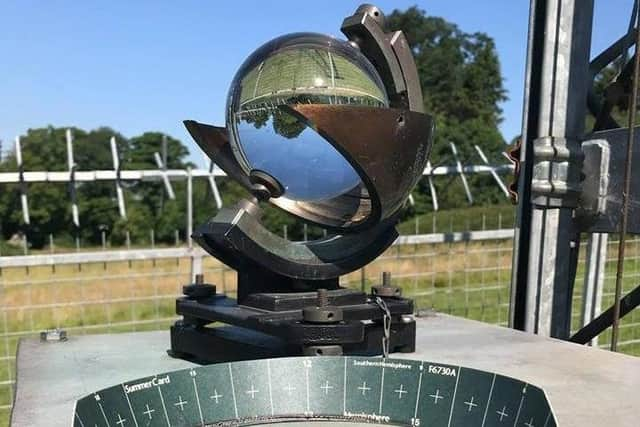

The warmest day (highest maximum air temperature) was 27.9 C on the 12th, followed by 26.8 C on the 13th, and 25.2 C on the 11th. These three days, each with a maximum temperature greater than or equal to 25.0 C constituted an August heatwave, the first August heatwave at Armagh for four years, that is, since the 9th to the 13th of August 2022. This month’s warmest day, however, was only the third warmest day of the year, the two warmer days of the year being 29.8 C on June 25 and 28.0 C on June 23.
The lowest maximum air temperature or coolest day was 16.3 C on the 16th, followed by 16.6 C on the 29th and 17.0 C on the 20th. The lowest minimum air temperature, or coolest night, was 5.0 C on the 24th, followed by 7.4 C on the 22nd, 7.7 C on the 21st.
The highest minimum air temperature, usually the warmest night, was a very mild 17.5 C on the 13th, followed by 16.7 C shortly after the time of observations (09:00 GMT) on the 11th but attributed to the 12th, followed by 15.6 C on the 28th. The night of the 13th was the warmest August night at Armagh for 20 years, that is, since the 6th of August 2006 (highest minimum air temperature 17.7 C), and the eleventh warmest August night on record at Armagh.
The lowest grass-minimum temperature was -1.4 C on the 24th, followed by 0.6 C on the 22nd, and 0.9 C on the 10th. There were no air frosts this month but one ground frost.
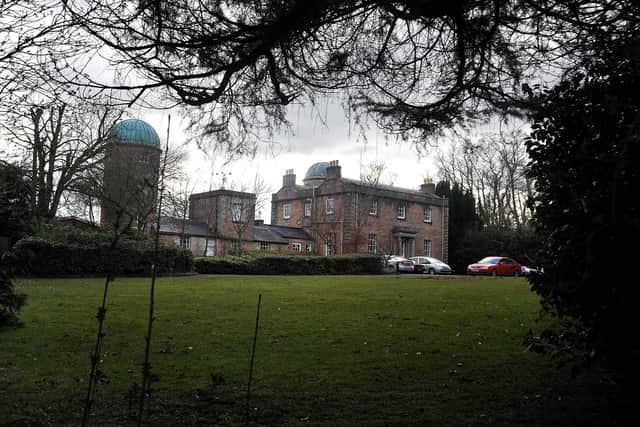
The observer recorded swallows on the 8th and 20th. On the second of these days the swallows seemed to be preparing for an unusually early migration to their wintering grounds in Africa, but in fact they continued to be observed in the Observatory grounds for at least another week until early to mid-September.
The observer also recorded an unusually early appearance of about a dozen fieldfares flying from tree to tree near the met station on the morning of the 24th. The fieldfare is a medium-to-large migratory species of thrush that normally overwinters in Northern Ireland between October and March. Before this month’s observation the earliest recorded incidence of fieldfares in the Observatory demesne was early September.
This month there was also a deep partial eclipse of the Sun, which occurred during early evening of the 12th. This was observed from the Astropark by Armagh Observatory and Planetarium staff who were able to explain the eclipse to approximately 800 visitors who had gathered to see the eclipse. Thickening cloud approaching from the west held off just long enough for everyone to get a stunning view of the rare celestial spectacle. Unfortunately, cloud prevented observations of the Perseid meteor shower later that night.
Despite 18 rain days this August, that is, days with at least 0.2 mm of precipitation, no rainbows were reported this month. Total precipitation was 83.45 mm (3.29 inches) including 5 trace values, that is, 83.2 mm if trace values are ignored. This is just over 1% more than the 183-year long-term (1838–2020) average August precipitation at Armagh (82.35 mm) and 6% more than the most recent (1991–2020) 30-year average (78.6 mm). August 2026 was therefore slightly wetter than average, the wettest August at Armagh for three years.
The wettest day was the 29th, with 14.4 mm (0.57 inches) of rainfall, closely followed by the 3rd with 14.3 mm and the 27th with 11.0 mm.
With a total of 120.4 hours of strong sunshine, August 2026 was rather duller than average, the only month of the three summer months June, July, and August, to achieve that distinction. This August recorded approximately 90% of the 140-year (1881–2020) long term August average at Armagh (133.1 hours) and 86% of the most recent (1991–2020) 30-year average (140.6 hours). This was the dullest August at Armagh for five years, that is, since August 2021 (100.7 hours of strong sunshine).
The three sunniest days were 11.7 hours on the 24th, followed by 9.6 hours on both the 10th and 21st. This month included three sunless days and five ‘dull’ days, defined to be days with less than 0.5 hours of strong sunshine, both results close to the August average at Armagh.
This year the meteorological summer was remarkable for its exceptional warmth. This was the warmest summer on record at Armagh, beating the previous record (1995 and 2025) by 0.1 C. The few warmest summers at Armagh are now summer 2026 (16.6 C); 2025 and 1995 (both 16.5 C); 2006 (16.3 C); 1983, 2023, 2021, 2018, 2013, and 1826 (all 16.2 C); and 1976 and 2022 (both 16.1 C).
Summer 2026 was remarkable also for recording heatwaves in each of the summer months, the only other example at Armagh being summer 1976. In the past, heatwaves have been relatively rare at Armagh, occurring on average just once every three years, but climate change has led to a rapid increase in their frequency. For example, there has been at least one heatwave at Armagh in each of the last six years except 2024.
This summer, June and August were wetter than average, but July was so dry that total summer precipitation (176.25 mm including 15 trace values) was still drier than average. This was approximately 80% of the 183-year (1838–1990) long-term summer average at Armagh (219.4 mm) and 84% of the most recent (1991–2020) 30-year average (219.4 mm). This was the driest summer for two years, that is, since summer 2024 (151.55 mm including 15 trace values).
Similarly, although August was duller than average, this was more than balanced by the relatively sunny June and July. This summer, with 474.6 hours of strong sunshine, recorded approximately 11% more strong sunshine than the 140-year (1881–2020) long term average summer sunshine at Armagh (426.7 hours) and 13% more than the most recent (1991–2020) 30-year average (420.0 hours).
These data refer to observations at Armagh Observatory, which has been recording the weather since 1795.