
Cool heads and not social media rants are needed now
Donald Trump’s social media posts are more rants than posts, even by his standards.
However he hit a new low this week for many people, with a post portraying himself as Jesus healing the poor, while pouring scorn on the Pope.
Despite Leo being the first American pope, Trump has said he will not be welcome in the United States. His offence was to question the war in the Middle East, which to most observers would seem to be something directly in the job description for a pope. Down the road this will have implications for Trump with the 25 per cent of US adults who identify as Roman Catholic – with 55 per cent of those voting for him in the 2024 election.
However, among all the nonsense he posts, Trump did manage to highlight recently a serious and global issue for agriculture. That was the rising price of fertiliser, with Trump threatening action against companies using the war to “price gouge” the price for American farmers.
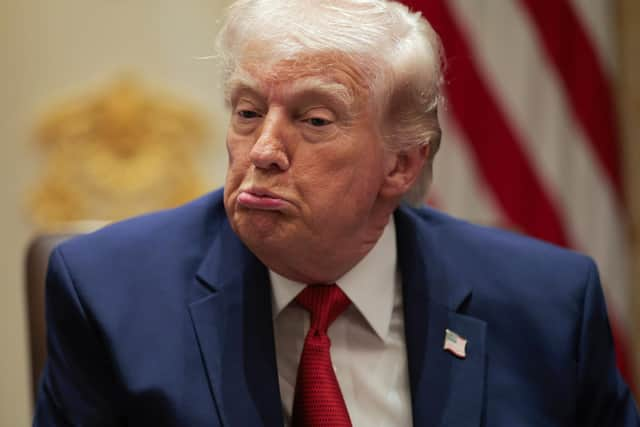

This was very much playing to his support base, given that US farmers backed him. But it is also a strange comment for a president who has been unwavering in his support for big energy companies.
While the point was valid, he is powerless in a global market to reverse the fallout as a result of a war that has closed the vital Straits of Hormuz, through which an estimated 55 per cent of the requirements for global fertiliser production pass. The war and its consequences show no signs of easing. If it cannot be resolved soon it will become another long war for the US, like Vietnam, Afghanistan and Iraq.
Analysts are now warning that governments will face huge problems in Europe this winter, when people are simply unable to afford the cost of heating homes. The UK has avoided tackling this problem, not because it does not want to, but because the dire state of the public finances make it impossible to afford even targeting those most in need of support.
The Irish government has made a big hole in its surplus of tax revenues over spending by giving £650 million in support to cut fuel costs and help farmers and hauliers. This is having no real impact or indeed calming criticism around the rising cost of living. The situation we are now in of key farm inputs, including fertiliser and fuel, is not, as in 2022 when Russia invaded Ukraine, solely about price.
For the first time we are looking at the prospect of a situation where products may not be available, regardless of how high prices rise. The European Commission has warned already how this could work out when it comes to fertiliser. Farming is ultimately about margin control.
That applies regardless of location, enterprise or scale. This is the outworking of the old business adage that turnover is vanity, while profit is sanity. We are now heading into a situation of rising food prices.
The rise will not be big enough to maintain the status quo in farm production, dogged as it is by rising costs. In that margin calculation farmers will look on one side at the rising price they will receive for what they produce.
But on the other side of that profit and loss account is the rising cost of every input. Margin protection is then about asking what areas of those rising costs can be targeted as a negative while higher farm gate prices are a positive.
The European Commission concern is that farmers will seek to cut back on fertiliser, either because of price or availability.
That would hit production, but would be partly offset because prices are higher, meaning a new margin dynamic is created. If that happens on a widespread scale it is obviously a threat to European food security, with the EU more vulnerable than the energy rich United States.
It also has significant implications for jobs in food processing at a time when imports of raw materials are not the easy alternative they were a few weeks ago. This would add to the downward economic spiral we now face, further reducing tax revenues and governments’ ability to help people hit by global events.
This is why cool heads and not self-indulgent social media rants are needed from the White House. This week Trump hit a new offensive low, but experience suggests new and even deeper lows could yet be found.