
‘Miracle’ White-tailed Eagle spotted in Scotland following appeal for sightings

A “miracle” White-tailed Eagle that was nursed back to health by its parents after suffering a broken wing has been spotted in the skies over the Isle of Mull following an appeal by RSPB Scotland. In 2024, experts were stunned after two White-tailed Eagles on Mull spent a year caring for their injured chick in behaviour never witnessed before in the species
The male chick had fallen from the pair’s nest in July 2023 during bad weather, which resulted in a significant break to its left wing. It continued to be fed by its parents but took to the skies weeks after its uninjured sibling, which fledged the nest in the autumn as is typical of the species. During this period the bird was nicknamed ‘Kinky’ by a local sailor due to the visible kink in its wing as a result of the injury.
In an unprecedented observation which stunned experts, Kinky was spotted the following breeding season at a new nest site continuing to be fed by his parents. It was described by RSPB Ambassador and White-tailed Eagle expert Dave Sexton as a “miracle chick” and highlighted a caring side to the species not often seen.
Despite the good news of Kinky’s survival there were fears he would not be able to survive independently because his wobbly flight may impact his ability to hunt. He was last seen in autumn of 2024 still with his parents before disappearing from the area. This year his parents were spotted breeding once again with Kinky nowhere in sight, leading to fears that he had not survived his first winter alone.
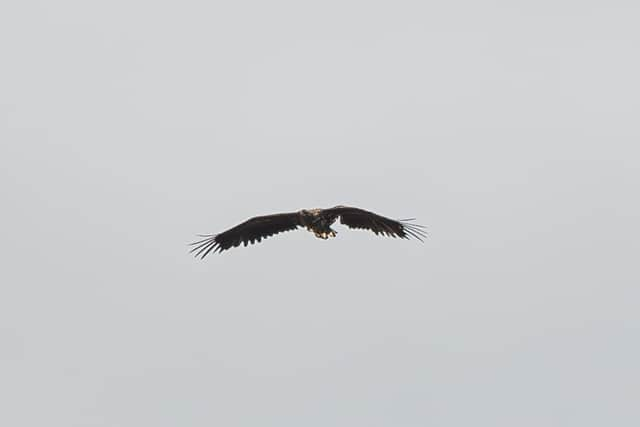

In April, RSPB Scotland called on Scots to report any sightings of the bird, which could easily be identified due to his distinctive wing shape.
On July 1, an immature White-tailed Eagle was spotted by Blair Ketteringham, a crew member of the Mull Charters vessel Lady Jayne, circling over the island of Forsa in Loch na Keal in Mull. Ketteringham quickly noticed that the bird had a distinctive kink in its wing and snapped some pictures, which he immediately sent to Dave Sexton with the message: “He lives!”
Dave Sexton, said: “It was 2pm when the WhatsApp message and photo came through. I was just having a cup of tea and nearly spilled the lot when I looked at it. Frankly I was in disbelief as I seriously doubted if Kinky could survive last winter without his parents to support him. Clearly they had to move on with their lives and are finally breeding again this year but of Kinky there’d been no sign despite our appeal. He was soaring high over Eorsa like any other eagle would and eventually came down to land where he interacted briefly with a different adult sea eagle. It’s testament to his strength of character and incredible survival skills that he seems to have overcome his major injury – with a lot of help from mum and dad”
He added: “For most eagles, a broken wing would be a death sentence as they’re unable to hunt and feed. But Kinky is a shining example of what perseverance can achieve. What the future holds for him now aged two years old is impossible to predict. But I wouldn’t mind betting he goes from strength to strength as he approaches adulthood in three years’ time. He’s one of Mother Nature’s survivors. What a bird!”
White-tailed Eagles are the UK’s largest bird of prey. Known as “flying barn doors” they have wings that can span up to eight feet across. They were historically persecuted to extinction here in the early 20th Century, but successful reintroductions mean this spectacular species can now be seen once again, with their greatest numbers in Scotland. They are afforded the highest level of protection as a Schedule 1 species and are a magnificent sight to see along rocky coastlines and lochs near the sea. As their name suggests, they have a distinctive white tail, making them easily recognisable.
The UK population has now reached an estimated 200 pairs, with their range gradually expanding from west to east and north into the Cairngorms. In Scotland, Mull is the best place to see White-tailed Eagles but you can also spot them on Skye, Islay and the Outer Hebrides. In England, the RSPB Arne reserve and Isle of Wight offer great opportunities for sightings.