
Northern Ireland weekly market report - 15 July 2025
Northern Ireland weekly market report - 15 July 2025
15 July 2025
Grains
UK feed wheat futures (Nov-25)

Last Friday, UK feed wheat futures almost reached the 20-day moving average of £178.66/t, having tested the key support level of £175/t in recent weeks. While the Relative Strength Index (RSI) increased from 43 to 47 (Friday-Friday), it still does not indicate any significant momentum in the market.
Market drivers
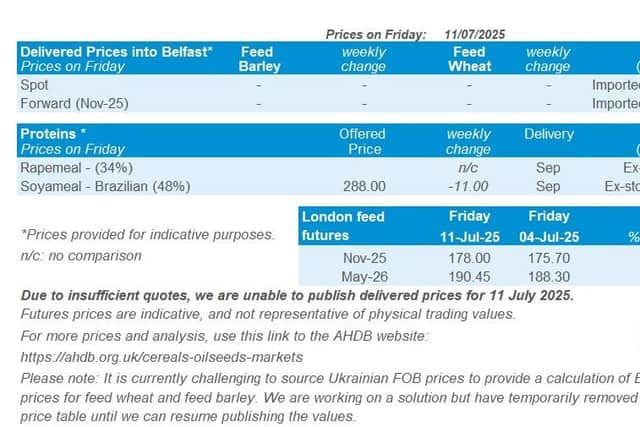
Nov-25 UK feed wheat futures gained £2.30/t (+1.3%) last week, closing at £178.00/t on Friday, while Paris milling futures rose by 1.6%. European grain futures were supported last week due to concerns about dry weather, short-covering by funds, and the euro's weakening against the US dollar.
However, Chicago wheat futures (Dec-25) fell by 2.2%. The harvesting campaign in the US is putting pressure on the market and outweighing any supportive factors at present.
On Friday, the USDA published its World Agricultural Supply and Demand Estimates (WASDE) report, which showed global wheat ending stocks below the average trade estimate. Projected global wheat ending stocks for 2025/26 were lowered by 1.2 Mt to 261.5 Mt compared to June figures, mainly due to reductions in Canada and the EU. Compared to June, forecasted lower production in Canada, Ukraine and Iran offset higher production in the EU, Kazakhstan, Pakistan and Russia.
Last week, the Ukrainian Grain Traders Union (UGA) predicted 2025/26 wheat production at 22.5 Mt, with exports of 16.5 Mt (USDA 15.5 Mt). The forecast also predicted maize production of 29.3 Mt and exports of 24.0 Mt, as well as barley production of 4.9 Mt and exports of 2.3 Mt. There is import demand for Ukrainian barley from China.
SovEcon, an agricultural consultancy, increased its forecast for Russia's wheat exports in the 2025/26 season by 2.1 Mt to 42.9 Mt. However, the USDA's WASDE report forecasts much higher exports, at 46.0 Mt.
Meanwhile, the USDA's export sales report for the week ending 3 July showed net wheat sales of 567.8 kt, which was at the upper end of trade estimates. Maize export sales exceeded the highest estimates.
The winter wheat harvesting campaign in the US is accelerating, with 53% complete as of 6 July compared to a five-year average of 54% for the same time. Market participants are focusing on spring wheat crop conditions in the US due to them being lower than last year. Maize crop condition scores in the US are high, which is putting pressure on the feed grains market.
Stratégie Grains decreased its EU maize production forecast by 3.0 Mt to 57.4 Mt, compared to figures from the previous month, lowering domestic use and exports while increasing imports.
Futures prices are indicative, and not representative of physical trading values. The latest daily futures settlement prices are available on our website.
Rapeseed
Paris rapeseed futures in £/t (Nov-25)
Last week (Friday to Friday), Paris rapeseed futures (in £/t) remained below the 20-day moving average and closed a little under £412/t. The relative strength index (RSI) also fell back again from 53 to 41 this week showing a drop in market momentum.
Market drivers
Paris rapeseed futures (Nov-25) finished last week at €475.50/t, down 2.1% on the week. This downward pressure came from positive crop reports in the US and Canada amid good weather over the week and positive weather forecasts looking forward.
Oil markets showed signs of stabilisation last week; nearby Brent crude oil futures hovered near $70/barrel.
The pound reached a three-week low against the dollar on Friday at $1.3499 and the lowest in a month against the euro €1.1540 (LSEG) this comes after signals that the Bank of England may make interest rate cuts.
Winnipeg canola futures fell sharply last week, pressured by widespread rainfall and technical selling. The Nov-25 contract fell 5.1% to close the week at CA$682.70/t, with prices hitting a one-month low mid-week. Forecasts of cooler weather and easing crop concerns prompted traders to scale back positions. While the market is said to remain “twitchy” as weather remains a key concern until at least late August, overall sentiment is currently bearish. Despite the retreat, current values remain above last year’s levels.
US soyabean futures also weakened last week, pressured by favourable Midwest weather, softer export demand, and escalating trade tensions. Rainfall and mild temperatures supported crop development, prompting fund selling and weighed down on prices, with the Chicago Nov-25 contracts closing 4.0% down on the week. Export uncertainty lingers amid US–China tariff strains and proposed US duties on Brazilian soybeans. A larger than expected increase to the forecast for US soyabean stocks at the end of 2025/26 on Friday by the USDA further dampened sentiment.
The USDA expects Ukraine’s oilseed output to rebound in 2025, supported by improved growing conditions and increased acreage. Sunflower production is expected to increase on last year to 14 Mt (+1.0 Mt) but still lower than local analysts. The rapeseed crop is expected to be down 0.1 Mt to 3.7 Mt but is still higher than local analysts’ estimates. Conflict-related disruptions continue to pose risks, particularly around labour availability and harvest logistic, factors that could limit export capacity despite strong production potential.