
Northern Ireland weekly market report - 18 August 2025


Northern Ireland weekly market report - 18 August 2025
18 August 2025
Grains
UK feed wheat futures (Nov-25)
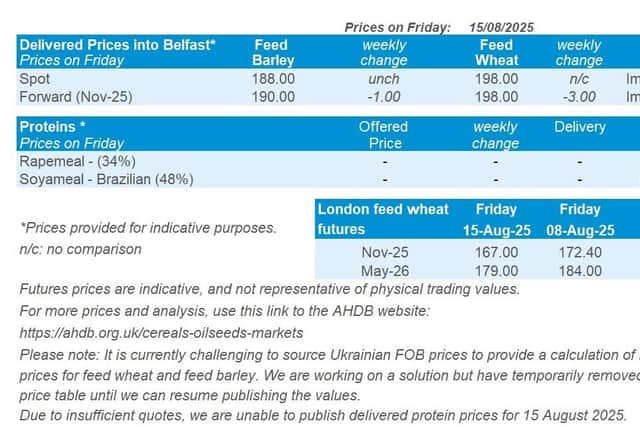
UK feed wheat futures continued to move lower last week (Friday to Friday), unfortunately breaking through the ‘support level’ of £170/t.When analysing price trends, a ‘support line’ is seen as a level that it may be harder for prices to fall below.
The relative strength index (RSI) eased from 36 to 21, moving to levels described as ‘oversold’ in technical analysis and showing the significant downward market momentum. An RSI at ‘oversold’ levels can also indicate this is a time to watch markets more closely.
Market drivers
UK grain markets remain under pressure as Nov-25 UK feed wheat futures hit new contract lows last week, including on Friday (£167.00/t). The pound remained near stable against the euro, the European harvest continued with a positive outlook for French wheat as well as the strong US maize harvest projection weighed on prices.
In Europe, French soft wheat quality is mixed so far, showing more crops with lower protein contents than in 2024 but specific weights above the five-year average (FranceAgriMer).
Meanwhile, in Germany, harvesting has resumed after earlier rain delays.
Paris wheat futures steadied midweek, supported by talk of German sales to Algeria and French shipments to Egypt amid limited early Black Sea supply. Speculative traders have also reduced net short positions, hinting that they may believe that the downward trend may be easing. However, the continued strength of the euro vs US dollar limited the support.
The pound moved up from £1= €1.1547 to €1.1578 over the week, though went as high as €1.1606 midweek (LSEG). This added pressure to UK feed wheat futures, forcing them lower to maintain competitiveness in wider markets.
The USDA now predicts US maize production at 425.3 Mt, up 13% higher than in 2024 and the highest on record. This prediction was 26.3 Mt higher than last month’s production and well above analysts' expectations. As a result, multiple Chicago wheat contracts went to new contract lows. While Chicago maize prices also fell initially, strong export sales and short covering by speculative traders helped prices recover at the end of the week.
Russia’s 2025 grain harvest is progressing steadily, with 75 Mt collected from nearly half of the planted area (Agricultural Ministry). This could put the country on track to meet the Agriculture Ministry’s forecast of 135 Mt, including 83-87 Mt of wheat. The 2025 forecast would slightly exceed 2024’s output (125.9 Mt, FAO).
In the southern hemisphere, Argentina’s 2025/26 maize area is set to rise by 15–20% (Rosario Grain Exchange). Maize area prospects are supported by good soil moisture ahead of planting starting in September and a shift away from soyabeans due to a decline in their relative profitability.
Futures prices are indicative, and not representative of physical trading values. The latest daily futures settlement prices are available on our website.
Rapeseed
Paris rapeseed futures in £/t (Nov-25)
Paris rapeseed futures (Nov-25) finished last week below the 20-day moving average again. The contract did approach the £400/t support level on Wednesday, but the support level remained valid and prices ended the week slightly up in £/t (Friday-Friday).
The relative strength index (RSI) decreased from 46 to 41 during the week, indicating the decreasing price trend of late.
Market drivers
Paris rapeseed futures (Nov-25) increased last week, finishing at €473.75/t, up €5.50/t (1.2%) from the previous Friday. Chicago soybean futures (Nov-25) increased by 5.6% during the week. However, Winnipeg canola futures (Nov-25) decreased by 1.3% over the same period.
Winnipeg canola futures were highly volatile last week, coming under pressure on Tuesday. This followed the news that China had imposed a 75.8% anti-dumping duty on imports of canola from Canada, effective from last Thursday.
On the other hand, Chicago soybean futures increased after the USDA's World Agricultural Supply and Demand Estimates (WASDE) on Tuesday due to world soybean ending stocks being lower than trade estimates. Also, in the week to 12 August, speculators decreased their net short position in Chicago soyabean futures.
The USDA’s WASDE report also reduced global oilseed production for the 2025/26 season by 3.3 Mt to 690.1 Mt, mainly due to lower soyabean and sunflower production. Global sunflower production was lowered by 1.2 Mt to 55.1 Mt due to hot and dry weather conditions resulting in lower yields in the EU, Ukraine, Turkey and Serbia.