
Northern Ireland weekly market report: 20 October 2025
Northern Ireland weekly market report: 20 October 2025
20 October 2025
Grains
UK feed wheat futures (Nov-25)

November 2025 UK feed wheat futures reached a new contract low of £163.50/t last week (10 - 17 October), which is now the new support level. Prices finished slightly below the 20-day moving average.
The relative strength index (RSI) remained at 46 throughout the week, indicating that there was no change in momentum compared to the previous week. There is no clear indication of the direction of future price movements.
Market drivers
Global grain futures were mixed last week. A lack of key information from the USDA adding to uncertainty was a key driver of some of the marginal support across the week. Chicago maize futures were supported by the prospect of a lower yield than previously forecast in the September WASDE, as harvest has progressed over the last few weeks, there are questions to whether yields are as big as initially forecast. Further to that, US farmers' have been inactive in selling new crop supplies.
Chicago wheat futures (Dec-25) increased by 1.1%, while Paris milling wheat futures (Dec-25) remained unchanged. Chicago maize futures (Dec-25) were the main driver last week, closing 2.3% up.
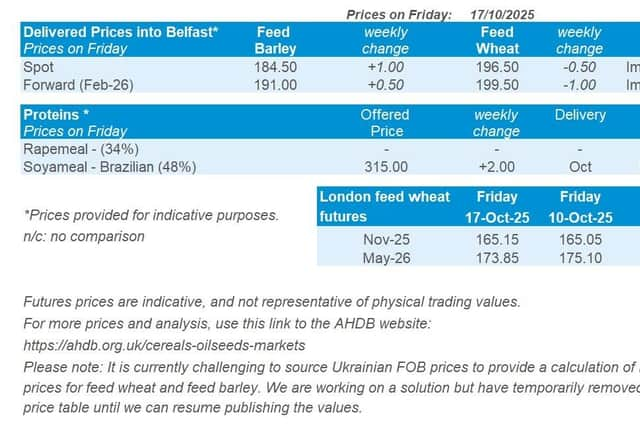
UK feed wheat futures (Nov-25) finished the week at £165.15/t up £0.10/t (0.1%) on the week. In addition to being influenced by the global grain market, domestic feed wheat futures were also affected by sterling strength against both the US dollar and the euro. Under pressure from a stronger sterling and a decrease in open interest, Nov-25 futures contract reached a new contract low of £163.50/t at last Thursday's close.
Despite nearby Paris milling wheat futures being unchanged week-on-week, there was pressure in the forward market due a stronger euro against the US dollar and competition from other sources in the export market. Competitively priced Argentinian wheat attracted demand in Morocco. This dampened export sentiment following recent French shipments.
FranceAgriMer published that, by 13 October, 27% of soft wheat had been planted for harvest 2026. This was well ahead of the 10% recorded at the same time last year, when wet weather hindered autumn sowing, and above the five-year average of 22%.
The Russian agricultural ministry is reducing the export tax on wheat from the period of 22 to 28 October. These taxes are lower than those introduced in the previous period, which will continue to lower the floor price of the global wheat market, as Russian supplies become more competitive and exports could increase.
A key watchpoint for the Black Sea region over the next couple of weeks is the Ukrainian maize harvest, which could further be delayed as there are widespread rains forecast in key maize areas, which could pose a delay to harvest and impact maize price sentiment.
Rapeseed
Paris rapeseed futures in £/t (Nov-25)
In £/t terms, Nov-25 Paris rapeseed futures traded below the 20-day moving average last week (10 – 17 October), closing near the £400/t support level.
The relative strength index (RSI) fell from 47 to 39, signalling weaker market momentum. This points to a bearish outlook unless fresh demand or market support emerges.
Market drivers
Rapeseed prices eased last week (Friday-Friday), with Nov-25 Paris rapeseed futures down €4.25/t to €462.25/t. The decline was mainly driven by the completion of Canada’s canola harvest, pressure in brent crude oil, and nearing the start of Australia’s canola harvest, where production is optimistic and this is weighing on the market.
In contrast, Chicago soyabean futures (Nov-25) rose by 1.3%, supported by stronger-than-expected US soyabean September crush figures from the National Oilseed Processors Association (NOPA). Market sentiment also improved after President Trump announced plans to meet China’s president later this month, boosting hopes for better US-China trade relations.
China maintained strong soyabean imports, mainly sourcing from South America due to ongoing trade tensions with the US. In September 2025, imports reached 12.87 Mt, up 4.8% from August and 13.2% higher year-on-year. Between January and September 2025, total imports stood at 86.19 Mt, compared to 81.85 Mt during the same period in 2024 (China customs data - LSEG).
In the EU, soyabean imports between 01 July and 12 October reached 3.41 Mt, slightly down from 3.68 Mt last year. Rapeseed imports fell sharply, down 53% to 1.09 Mt, reflecting the highest EU rapeseed crop since 2014 of 19.9Mt (EU Commission).
Looking ahead Brazilian soyabean plantings will start to become a critical market sentiment driver. Brazilian soyabeans plantings are estimated at 24% complete (as of 16 Oct), up from 14% reported a week earlier (AgRural). Further to that, Brazil’s crop agency Conab expects a record soyabean harvest of 177.64 Mt in 2025/26, up from 171.50 Mt last year. The rise in production is driven by a 3.6% increase in planted area.
In Australia, the Grain Industry Association of Western Australia (GIWA) has raised its canola forecast to 3.8 Mt, up from 3.3 Mt previously, with Western Australia remaining the country’s leading export region. By comparison, the Australian Bureau of Agricultural and Resource Economics and Sciences (ABARES) projected 3.3 Mt for Western Australia in September, production increases could be expected by ABARES in December.