
Northern Ireland weekly market report: 6 October 2025
Northern Ireland weekly market report: 6 October 2025
6 October 2025
Grains
UK feed wheat futures (Nov-25)
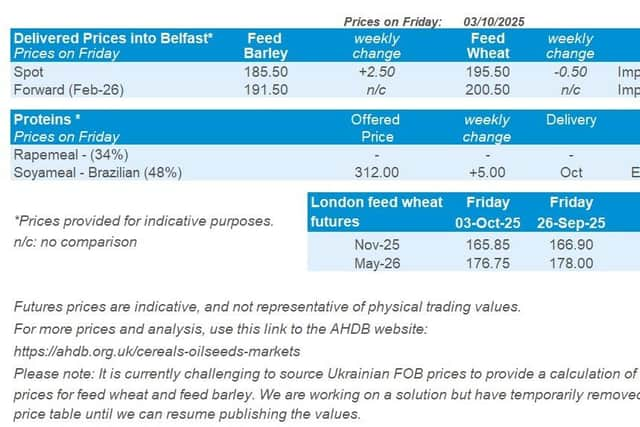

Nov-25 UK feed wheat futures traded largely below the support level of £167/t last week (26 September–03 October), before recovering slightly to finish the week closer to that mark. In technical terms, a support level represents a price point where markets often find it harder to fall much further.
The relative strength index (RSI) also moved up from 39 to 49, suggesting momentum is improving though not yet enough to point to a firm upward trend.
Market drivers
Global wheat markets fell further last week (Friday-Friday) as ample global supplies continued to weigh on prices, despite a brief boost midweek from import tenders in Jordon, Taiwan and Saudi Arabia. UK feed wheat futures (Nov-25) closed at £165.85/t, down £1.05/t (0.6%) over the week, while Chicago wheat and Paris milling wheat futures (Dec-25) each slipped by 0.9%.
In the US, winter wheat drilling reached 34% by 28 September, below the five-year average, although dry conditions across the Plains could slow progress. The maize harvest is gathering pace, with 18% complete and 66% of the crop rated good to excellent, well above the five-year average of 58%. The USDA’s Quarterly Grain Stocks and Small Grains Summary, report released on Tuesday (30 September), showed higher-than-expected wheat production and inventories compared with Refinitiv trade estimates, adding to global supply pressures.
In Ukraine, wheat exports so far this season (01 July-03 October) totalled 4.75 Mt, compared with 6.40 Mt at the same stage last year. The Ukrainian agriculture ministry expects the 2026 winter wheat area to grow by 9% to 5.2 Mha year-on-year, as farmers shift land away from maize and sunflower, following drought conditions that devastated this year’s sunflower crop and sharply reduced corn yields.
SovEcon has trimmed its September forecast for Russian wheat export to 4.3 Mt, lower than both last month (4.4 Mt) and a year earlier (5.1 Mt). The Russian agriculture ministry also confirmed last week that the wheat export duty will be reduced by 20% from 08 October.
In Argentina, the Buenos Aires Grain Exchange raised its 2025/26 wheat crop forecast to 22.0 Mt up from 20.5 Mt, supported by strong yields and ample soil moisture. Maize output is also expected to reach a record 58.0 Mt, supported by an expansion in planted area.
The EU commission reported soft wheat exports for 01 July–28 September at 4.37 Mt, down from 6.36 Mt over the same period last year, with some data from France and others member states still pending. In France, maize harvesting reached 24% by 29 September, up from 14% the previous week, with 62% of the crop rated good or excellent, unchanged on the week but below 79% a year ago (FranceAgriMer).
Rapeseed
Paris rapeseed futures in £/t (Nov-25)
Last week (29 September - 03 October), Paris rapeseed futures (in £/t) reached a support level of £400/t, finishing at slightly below at £399.65/t.
The relative strength index (RSI) showed a fall in market momentum fell from 58 to 51 over the week. However, there is no clear indication of the direction of future price movements.
Market drivers
The price of global oilseeds has been volatile over the last week, driven by a decrease in the price of crude oil and unpredictable soyabeans demand. Paris rapeseed futures (Nov-25) fell by €13.00/t (2.8%) to €458.00/t on the week. As the last trading day for Paris rapeseed November 2025 futures approaches, open interest is decreasing, while it is increasing for February 2026.
Chicago soyabeans futures (Nov-25) gained by 0.4%, while Winnipeg canola futures (Nov-25) fell 1.6%, respectively on the week. Winnipeg canola futures are under additional pressure as weather across the Canadian Prairies has aided the canola harvest finishing up.
After testing a strong technical support level of $10/bushel ($367.44/t) last week, Chicago soyabean futures finally closed higher in response to news of potential further trade deal negotiations between the US and China. However, harvesting pressure on soyabeans in the US is still a current bearish market concern. The US federal government “Shutdown” that began last week could lead to a lack of transparency in the market, with delayed or missed publications from the USDA.
Additional pressure on the oilseed complex came from a fall in Brent crude oil futures (Dec-25), which dropped by 6.8% over the course of the week.