
Northern Ireland weekly market report - 7 July 2025
Northern Ireland weekly market report - 7 July 2025
7 July 2025
Grains
UK feed wheat futures (Nov-25)
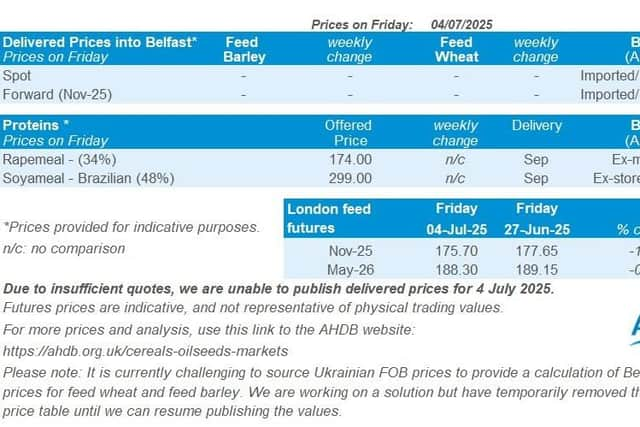

Last week (Friday to Friday), UK feed wheat futures remained below the 20-day moving average and closing prices hovered just above the key support level of £175/t. Although the market closed above this level there were trades below it, suggesting this could be an important point to watch markets.
Market drivers
Nov-25 UK feed wheat futures fell by £1.95/t (-1.1%) last week, closing at £175.70/t on Friday. The domestic market tracked European prices lower, with Dec-25 Paris milling wheat futures down 1.0%. Pressure came from currency fluctuations, ongoing harvest progress and larger-than-expected US stocks. Meanwhile, Dec-25 Chicago wheat futures rose by 3.0% by Thursday; the market was closed for the US Independence Day on Friday.
The USDA’s quarterly grain stocks and acreage report, released on Monday, showed US old crop wheat stocks at 23.2 Mt as at 1 June. This was 22% higher than the same time last year and above analysts’ expectations. The area for the 2025 wheat crop was estimated at 18.41 Mha, slightly above forecast.
Currency movements added to the pressure. On Tuesday, the euro reached a near four-year high against the US dollar, making EU wheat less competitive and driving prices lower. This and re-positioning by speculative traders initially supported Chicago wheat futures, but gains were capped by profit-taking ahead of the Independence Day weekend.
Harvest is well underway in the Northern Hemisphere. The US winter wheat harvest was 37% complete by 29 June. Warm and dry conditions are supporting a good start in Europe, with 11% of France’s soft wheat crop cut by 30 June, well ahead of the five-year average of 4%. According to the Buenos Aires Grain Exchange, Argentina’s 2025/26 wheat planting has reached 78.2% of the planned area, with a recent cold snap potentially benefiting crop growth.
Russia, the world’s largest wheat exporter, has cut its wheat export tax to zero for the first time since 2021, effective from 9 July (LSEG). This could potentially add more supply to global markets.
Maize remains a key focus as it enters a critical growth stage, with heat in Europe raising concerns over yields. However, forecast rainfall in the US Midwest could be supportive of yields.
Futures prices are indicative, and not representative of physical trading values. The latest daily futures settlement prices are available on our website.
Rapeseed
Paris rapeseed futures in £/t (Nov-25)
Nov-25 Paris oilseed rape futures (in £/t) finished just below the 20-day rolling average last week, despite edging above on Wednesday. Market momentum also eased; the relative strength index (RSI) fell back from 58 to 53.
Market drivers
Paris rapeseed futures (Nov-25) edged down €0.50/t (-0.1%) last week to close at €485.75/t on Friday. Chicago soyabeans and Winnipeg canola futures (Nov-25) gained 2.4% and 3.9% respectively.
In the US, there was optimism around strong soyabean crop conditions, after 66% was reported in good to excellent condition on 29 June. These favourable crop conditions anchored the US market and limited price rises last week. Argentina’s soybean harvest for the 2024/25 season has concluded, reaching 50.3 Mt, 100 Kt higher than last year’s output, according to the Buenos Aires Grains Exchange.
In Canada, a resumption of trade talks with the US and ongoing dryness in Western Canada supported prices. Crushers could also benefit from stronger US vegetable oil demand for biodiesel in 2025/26, though tight supply and logistics remain challenges.
With a smaller area year-on-year, Canadian canola production depends heavily on yields. In Saskatchewan, the top growing region, crop conditions remain variable following recent thunderstorms, which brought both beneficial moisture and hail damage across parts of the province. However, southern areas remained dry, and topsoil moisture levels overall declined week-on-week. Oilseed crops continue to develop faster than last year but lag seasonal norms, particularly in central areas.
The wider vegetable oil complex also supported oilseed markets last week. Indian palm oil imports hit an 11-month high in June, climbing 61% month-on-month to 953 Kt. India is the world's biggest buyer of vegetable oils. News of this strong buying and a Reuters poll showing industry expectations for a pullback in Malaysian palm oil stocks in June supported palm oil and wider vegetable and oilseed prices.