
The potential for clover inclusion in grassland swards
The inclusion of red clover in grass swards can help maintain silage yields without the application of chemical nitrogen, writes Richard Halleron.
In addition, forages containing significant levels of red clover will contain higher levels of protein than would be the case if a grass monoculture was harvested.
Work has also confirmed that the quality of the protein in red clover exceeds that, which is available in grass.
These were a number of the key points communicated at a farm walk hosted by AgriSearch on the Co Tyrone dairy farm of Philip and David Clarke earlier this week.
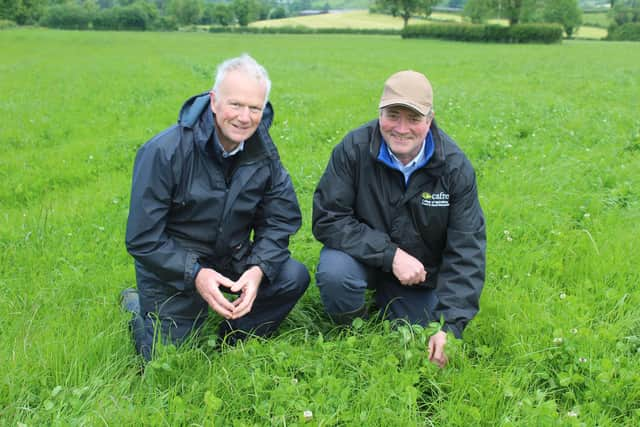

The father and son team are taking part in a ‘ZeroNSile’ project, designed to look at the potential impact of red clover and lucerne within dairy and beef production systems.
Last June saw them establish a perennial ryegrass: red clover: white clover sward on a 12ac field, close to the village of Augher.
This followed-on from trials carried out by Agri-Food and Biosciences’ Institute (AFBI) scientists, indicating that red clover swards can produce up to 14t of dry mater per hectare per annum over a four-year period.
“We have been impressed with the way in which the sward has performed up to this point,” David explained.
“The field was sown out at the end of June.
“And while the weather was holding up at that stage, the continuous rain soon followed.
“However, we did manage to get two cuts of silage baled in 2024: the first was very much a clean-up operation as it allowed us to deal with the fat hen and fumitory that had quickly grown up after the new ley was sown out.
He continued: “Our plan is to graze out the sward out with replacement heifers at the shoulder ends of the growing season. And this was achieved last autumn and during the early spring weeks of this year.
“I am fully aware that high clover swards can predispose cattle to bloat.
“With this in mind we have made sure that the cattle are not hungry when put out on to the new ley.
“There is also a bloat preventative treatment that can be put directly into the water supply.”
From a silage making perspective, the Clarkes intend taking a multi-cut approach with their red clover sward in 2024 and beyond.
“All of this will be weather-dependent,” David explained.
“We took a first cut at the beginning of May and will be pushing ahead with six-week cropping intervals during the weeks ahead.
“At some stage we will give the crop an opportunity to flower.
“This is a critically important phase within its annual growing cycle.
“The plan is to put all this year’s red clover silages into the clamp.
“One issue now apparent relates to the fragility of the clover plants, post cutting.
“They are prone to shattering as they dry out.
“The decision was also taken to use an additive on the red clover silages.
“Yes, we will go with a 24-hour wilt.
“We decided against tedding the crop.
“Where cutting is concerned, we asked the contractor to keep the mower blades three inches above ground level.
“This was to protect the crown of the red clover.
“The crowns are the growing points of the plants.
“If these are destroyed, then the clover dies out.
“This is an issue that must be addressed from both a silage making and grazing perspective.”
Establishing a red clover sward
AFBI grassland agronomist, Dr David Patterson, attended the farm walk.
He confirmed that plans to established are clover based sward should kick-in 12 months, or even 24 months before the new ley is actually sown out.
“This approach gives sufficient time to sort out any weed related issues that may be apparent within the existing sward,” he further explained.
“Dock control is a case in point.
“Getting soil pH up to a value of 6.5 is also critically important.
“Red clover will not meet its growth targets in acid soils.”
According to Patterson, red clover swards must be established in the late spring/early summer period.
“This approach ensures that soil temperatures are sufficiently high so as to encourage clover growth from the outset.
“A firm, fine seed bed must be established.
“Red clover seeds are extremely small.
“So a very shallow sowing depth must be achieved.”
He continued: “Another key advantage of a late spring sowing date is the opportunity it provides of creating stale seed beds.
“Taking this approach allows many of the weed seeds already in the soil to germinate before the new ley is established.
“These weeds can then be effectively killed-off using a suitable herbicide prior to sowing.
“This approach significantly reduces the weed challenge confronting the newly established swards.”
The AFBI also agronomist confirmed that red clovers are very sensitive to most herbicides.
He said: “Annual weeds, such as fat hen and fumitory, can be physically dealt with by taking a first cut of silage.
“Seedling docks, however, represent a challenge of a different magnitude.
“There is only a very selective range of herbicides now available in the UK that can be safely used to deal with this specific weed challenge in red clover swards.
“Farmers should get bespoke advice on this issue.”
The AFBI agronomist confirmed that, assuming an effective post emergent herbicide becomes available in 2024, it should be used between six and eight weeks after the new crop has been sown out.
He further explained: “The majority of the clover plants must be at the trifoliate leaf stage with docks at a small enough size t be dealt with efficiently.
“Spraying too early will kill clover seedlings: spraying too late means that the canopy has closed over and, as a result, a high percentage of the target weeds have protection.”
Where the management of chickweed is concerned, effective control can be secured by grazing newly established swards with sheep or calves. But this must be for a short period of time only.
“Spot spraying of weeds is also feasible in certain circumstances,” said Patterson.
“Another option is to take a very early cut of silage, which will remove a lot of the competition pressure caused by the likes of chickweed.”
Patterson specifically highlighted the strong root structure of red clovers and the benefits this can deliver in terms of improved soil structure.
Courtesy of his presentation on the day, David Clarke highlighted the need to supply red clover swards with adequate potash and sulphur.
He commented: “To date we have applied significant volumes of cattle slurry to the swards at the appropriate times.
“This was supplemented with muriate of potash.
“On reflection, I should have used potassium sulphate, as a means of also boosting available sulphur levels to the crop.
Possible drawbacks of red clover
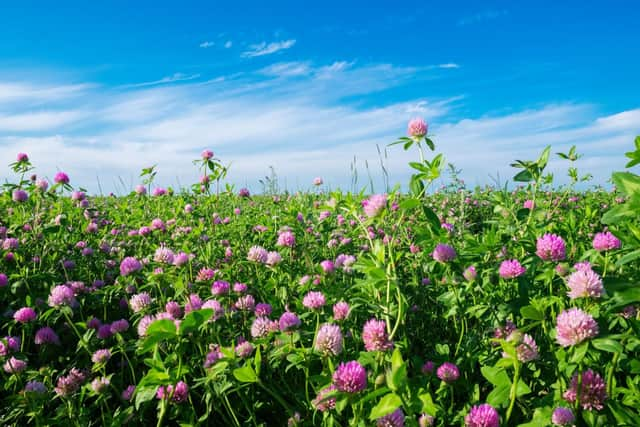
Red clover has the ability to fix 250kg of plant available nitrogen from the air on an annual basis.
It also builds soil fertility for subsequent crops – typically providing 40 to 50kg of nitrogen per hectare.
Red clover can be grown on a number of soil types.
The silages produced from the crop, are in the main, more palatable than those made from grass alone.
These are the upsides.
However there are a number of challenges associated with the growing of red clover/grass swards crops.
Persistency is one of these.
Red clover will remain active within a grass crop for a maximum of four years.
In addition, a five-year break is needed between the establishment of successive red clover crops in the same ground. This is because of plant disease-related issues.
David Clarke again: “We are fully away of this issue.
“The 12ac filed sown out last year is part of 30ac block.
“Our plan is to let the current red clover sward run its course over the coming three to four years.
“After that, we will establish a red clover sward on a rotational basis around the block.
“This should allow us to come back to the original field in about 10 years’ time.”
It was also confirmed at the farm walk that no grant aid is available towards the creation of red clover swards in Northern Ireland.
This contrasts with the situation south of the border, where specific government support is available towards the establishment of these leys.
It was estimated that red clover accounted for 20 per cent of the dry matter currently within he sward established by the David and Philip Clarke last year.
AFBI’s David Patterson indicated that the figure would rise to 40% by the end of the summer period.
Demand for clover continues to grow
Meanwhile, the inclusion of clover – red and white - in grass re-seed mixes has increased significantly over the past two years, according to Germinal technical director, Dr Mary McEvoy.
“It’s a trend that can be traced back to the dramatic increase in fertiliser prices that directly followed Russias’s invasion of Ukraine,” she explained.
“And it makes absolute sense for farmers to include realistic levels of clover as part of their grassland re-seeding programmes.”
The Germinal representative is also very conscious that many grazing paddocks have been damaged as a result of the very wet spring conditions.
“In some cases the remedial action may simply entail rolling the affected ground and then patch those badly affected areas with seed,” she commented
“However, in some cases it might be a case of pushing ahead with a complete re-seeding operation.”
McEvoy confirmed that grass sown out at the beginning of May can be grazed lightly by cows seven to eight weeks later.
She explained: “It takes six weeks to get the new grass plants to become well established.
“At that stage it would be appropriate to spray for weeds.
“This leaves a new sward ready for grazing before the end of June.
“Cows are regarded as the animals of choice to graze off new grass, provided ground conditions are suitable and the grass plants pass the pull test.
“Trials carried out in Ireland confirm that new grass swards established at the beginning of May can produce up to 10t/ac of dry matter in their first season.”
Mary McEvoy continued: “Even if a dry spell hits during the month of May, there will be sufficient moisture available from early morning dews to allow the growth of newly establish grass plants.
“However, grass re-seeds established in June and July can become problematic if a dry spell comes in at that time of the year.”