
There’s a lot happening within the sheep sector at the present time

Recent weeks have seen a significant degree of focus placed on all aspects of sheep production in Northern Ireland, writes Richard Halleron.
The 2023 sheep census confirmed a total sheep population of some 2M head in Northern Ireland including 973,718 breeding ewes. Approximately 40% of local farmers have sheep with the value of ovine output totalling almost £110 million on an annual basis.
These figures reflect the significance of the sheep sector to the rural economy.
Traditionally the industry has enjoyed support from Brussels and, post-Brexit, directly from Westminster. However, the transition to new support arrangements for agriculture as a whole in Northern Ireland has led to no new measures being agreed – as yet - to meet the specific needs of the sheep sector.
Former Stormont farm minister, Edwin Poots, had indicated that a bespoke support fund had been ring fenced for the industry. But, as yet, Department of Agriculture, Environment and Rural Affairs (DAERA)policy officials not come forward with active proposals that would provide a suitable support framework.
These circumstances have led all relevant stakeholders to join forces under the aegis of a sheep taskforce.
Launched at the beginning of 2023, its key focus is that of securing bespoke support measures for flock owners in Northern Ireland.
Agriculture minister to meet with Northern Ireland’s sheep taskforce
It has recently been confirmed sheep taskforce members will shortly meet with the current Stormont farm minister, Andrew Muir, in the near future
In tandem with this, task force representatives are expecting to take part in further meetings with representatives from the Department of Agriculture, Environment and Rural Affairs (DAERA) with the aim of agreeing future sheep support measures
Co Antrim EasyCare flock owner, Campbell Tweed, is a member of the task force. He commented:
“We will be pressing the need for effective support measures to be made available to the sheep sector.
“There is no provision for specific schemes of this type at the present time. However, future funding has been ring-fenced within the scope of the reform measures to be introduced across agriculture in Northern Ireland over the coming 24 months.”
According to the task force member, future support measures will be designed to deliver improved performance and matching genetic gains at individual flock level.
He explained:
“Schemes of this nature already operate in the Republic of Ireland.
“Delivering improved genetic merit across Northern Ireland’s sheep sector represents a win:win scenario for farmers.
“Better performing sheep are inherently more efficient. They are also more likely to secure better market prices.”
Campbell continued:
“Delivering improved performance and efficiency levels will also act to reduce the carbon footprint of the sheep sector.
“However, it should be pointed out that flock owners are already securing very high levels of environmental sustainability.”
The task force published its initial report, looking at the future of Northern Ireland’s sheep sector, in February 2023.
It underlined the importance of sheep production to Northern Ireland’s economy and identified how it could be supported to deliver much more.
The report specifically called for collaboration between government, meat processors and farmers, so as to ensure the sheep industry has a stable and sustainable future at the heart of the rural economy.
The work of the task force has specifically identified the need to maintain a ‘critical mass’ within the sheep sector.
This will be required to secure the infrastructure needed to develop the industry and secure a level of future profitability.
According to the report, the starting point for this process is retaining the current level of meat and wool output.
Longer term perspectives would be better secured if productivity was increased and output grew.
Securing extra output can come from extra breeding animals or greater yield from existing breeding animals. Task force members believe the latter option can deliver the best outcomes.
The importance of wool
Wool remains an important output from the local sheep sector
New season fleeces are now arriving in significant quantities at the Ulster Wool depot in Co Antrim. Balmoral Show is the traditional start to the new wool season in Northern Ireland.
Ulster Wool chairman, Brendan Kelly, commented:
“It has been the usual slow start to the wool season. Volumes coming into our depot in Muckamore will start to build up during the weeks ahead.”
Kelly is also Northern Ireland’s representative on British Wool, He was recently rep-elected for another three-year term.
Kelly further explained:
“A key objective is to ensure that the monthly wool auctions are delivering the best possible price on behalf of flock owners.
“And it’s far from bad news in this regard. We now have 164 licences committing to use and specifying UK wool in their products.”
He added:
“British Wool is also working closely with organisations in both New Zealand and Australia to secure improvements in the global prices paid for wool.
“Currently the prices being achieved at British Wool auctions are on a par with those being secured in New Zealand for comparable grades of wool.
“Wool accounts for only one per cent of the world’s fibre market at the present time.
Significantly, Kelly is predicting a reduction in wool volumes handled by British Wool over the coming 12 months.
“This reflects the latest UK census data,” he commented.
Kelly is also confirming that fleece weights were lower in 2023, relative to what would have been expected in a normal year.
As a result of the reduced wool clip in 2023, wool returns are similar to last year for Ulster Wool members in 2024.
Most core grades are up 1p or 2p/kg. However, ‘mountain’ grades are slightly lower, with the overall lower wool intake weight impacting the returns.
“Prices strengthened in the autumn but have weakened again over the last two months with mountain wool types struggling all season,” Brendan Kelly commented.
As a group, along with British Wool, we handled 2,500t less wool in 2023, primarily due to lighter fleeces.
“Our typical member delivered 10% less wool in 2023 than in 2022.”
He continued:
“The decline in wool volumes reduced our returns by around 7p/kg If we had handled the same weight as the previous year, many grades would have been up 20p per fleece.
“Every additional 500t that we handle improves returns for all members by 1.5p/kg.”
With plastics positioned as wool’s greatest competitor, low wool prices are an issue globally.
Kelly commented:
“The rise of oil-based fibres over recent decades has driven down the value of wool. The world is, however, now starting to wake up to the environmental damage these fibres cause, and the sustainability credentials of wool.”
New income streams are making a growing contribution towards members’ payments. The traceability scheme generated £150,000, while grading for the Isle of Man and other initiatives also boosted returns.
He continued:
“We are committed to creating long-term value for sheep farmers. Sheep farmers can be a stronger force by supporting Ulster Wool together. We understand the recent wool prices have been disappointed to many, including ourselves.”
Brendan Kelly concluded:
“But with the initiatives we have in place, from traceability to our consumer marketing activity and our licensing scheme, we truly believe that the long-term outlook is encouraging.
“As such, we urge sheep farmers to continue supporting us as we continue to navigate these difficult times. Working together, we can build a positive future for wool.”
Exploring the sheep genome
Meanwhile, the use of genotyping techniques to find the exact DNA coding that controls the various traits expressed by sheep continues apace.
Currentlt, scientists from the Roslin Institute at the University of Edinburgh are currently investigating the genetic basis upon which certain breeds of sheep voluntarily shed their wool.
Wool shedding, however, is not a simple switch-on: switch-off process. Individual sheep can demonstrate a range of abilities, where shedding is concerned.
Some are able to shed all their wool: others none at all. In between these two extremes, sheep will demonstrate the complete range of shedding capabilities.
The members of the Roslin team have come up with a scoring system, which takes full account of this reality
The scale starts at the figure ‘zero’, reflecting animals that do not shed at all, up to the figure ‘nine’ for animals that will lose all of their fleeces. Scores are determined courtesy of a visual assessment process.
Wool shedding normally begins at the end of April and continues through the rest of the spring and early summer months.
The EasyCare breed, as a case in point, has been developed with a strong focus on the ability of the sheep to shed their wool.
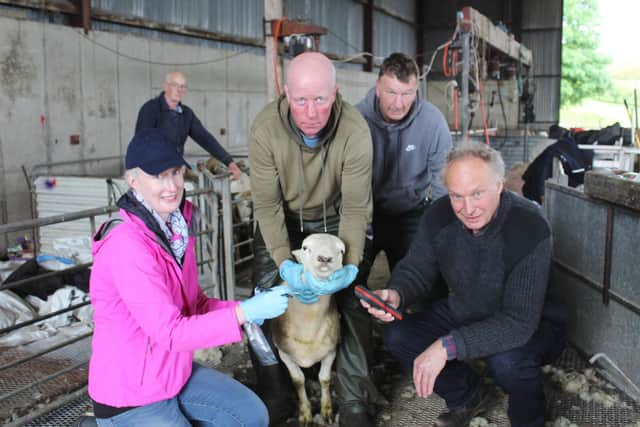
The Roslin Institute’s Dr Emily Clark was a recent visitor to the EasyCare flock of Campbell Tweed, who farms at Cairncastle, in Co Antrim.
While there she took nasal swabs from 160 young rams, all born in 2023. A shedding score was recorded for each animal as the swab was taken.
These yearling rams were lambs retained as potential flock sires and the sampling was carried out at the next stage of selection when they were physically assessed.
As part of the critical evaluation process carried out by Canmpbell Tweed, any animal that was not deemed suitable for breeding at that stage was culled
All lambs within the Tweed flock are electronically tagged at birth. This makes their individual identification at any stage a straightforward process, using an electronic reader.
Emily Clark explained:
“My visit to Northern Ireland follows-on from work carried out by my Roslin colleague, Denis Headon , ten years ago.
“We have already carried out a lot of work to identify the specific part of the EasyCare genome is that is responsible for wool shedding.
“It’s now a case of fine tuning this, in order to identify the exact genetic sequencing that drives the wool shedding process.
“The nasal swab sample taken from Campbell’s rams will help significantly in this process.”
Campbell Tweed commented:
“The end game, from a commercial point of view, is to develop a test that will identify the wool shedding ability of individual sheep at a very early age.
“In our own case, we physically score the wool shedding ability, alongside with the physical performance of all the breeding sheep that we make available for sale.”
The current sheep shedding research at the Roslin Institute has been funded by the Biotechnology and Biosciences Research Council (BBSRC) under the aegis of UK Reserach and Innovation