
Will lime be left until next year – again?
We all know lime is important, but it is one of those jobs we often never get around to. There is always silage to cut, slurry to spread or another urgent job waiting.
Lime has always provided a good return on investment. However, with feed and fertiliser costs increasing and continued uncertainty in global markets, correcting soil pH is now more important than ever.
The next 14 days could provide valuable opportunities to spread lime on farms where ground conditions allow. If last spring is anything to go by, we cannot assume that another suitable opportunity will come along soon.
Another year can quickly pass


It is easy to say that lime can wait until spring—but spring brings the rush to get slurry spread. Before long, first-cut silage is approaching and lime is postponed again because of the risk of contaminating the crop.
Suddenly, another season has passed and lime is still on the list. Meanwhile, another year of applying slurry and fertiliser to low-pH fields means poorer nutrient efficiency and less value from every pound spent on nitrogen, phosphorus and potassium.
That is why any suitable opportunity to spread lime should not be missed.
Give it one hour
On the next wet day—or even over a couple of tea breaks—set aside one hour to open your Soil Nutrient Health Scheme results.
Instead of losing that half hour scrolling through TikTok or checking MartEye—important as that may be—use it to identify the fields that need lime.
You do not need to tackle the whole farm at once. Start with the five fields showing the greatest lime requirement or those expected to produce the most grass next year. Prioritise the fields with the lowest pH and make a practical plan for getting them limed.
Aim for pH 6.2 on mineral grassland and pH 5.5 on peat soils. Farms trying to obtain more benefit from clover or multispecies swards may want to consider a higher target pH of around 6.5. Always follow the recommendation for each individual field.
You already have the results—use them now rather than waiting until they are out of date.
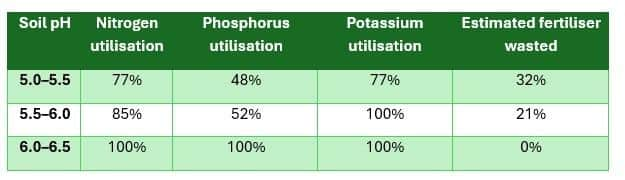
Low pH reduces fertiliser utilisation
The cost of low soil pH can be seen in fertiliser utilisation.