
Working conditions hold the key to farming’s future, European conference hears

Ministers, EU institutions and researchers from over 20 countries meet in Dublin as Ireland’s Council Presidency steers talks on the next Common Agricultural Policy.
Farmers love their work. Europe’s largest survey of working life, carried out by the EU agency Eurofound, finds farmers are among the most enthusiastic workers in Europe.
Half of those working in agriculture say their job always gives them a sense of a job well done. But the same survey finds agriculture has the lowest earnings and the poorest career prospects of any sector, and the highest exposure to heat. Three in four agricultural workers work weekends and half cannot say what they will earn three months from now. Farming is also one of Europe’s most dangerous occupations. Its fatal accident rate is close to that of construction and more than three times the average for all sectors, and official figures understate the true toll. SafeHabitus research estimates that EU statistics miss around four in 10 farm deaths. These figures frame the SafeHabitus Conference and Film Awards 2026, which opened on Tuesday, 3 November at Teagasc Ashtown in Dublin.
Held in association with Ireland’s Presidency of the Council of the European Union, the conference came as Ireland chairs negotiations on the next Common Agricultural Policy, and as EU policy puts the attractiveness of farming high on the agenda.
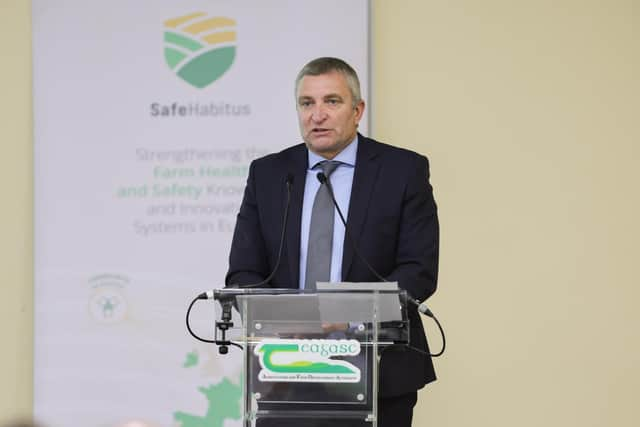

Over three days, Minister for Agriculture, Food and the Marine, Martin Heydon TD, Minister of State with special responsibility for Forestry, Farm Safety and Horticulture, Niall Collins TD and the European Economic and Social Committee president Seamus Boland joined researchers from across Europe, North America and South Korea to ask what it will take to make farming an attractive career. “Whether young people choose farming, and whether those already farming stay, come down in large part to working conditions: ability to earn a decent income, work-life balance and whether it fits with family life, how safe the work is, and its effect on health and wellbeing,” said Dr David Meredith of Teagasc, principal investigator of SafeHabitus.
He said: “Good working conditions build the social resilience that an attractive, competitive farming sector depends on.” Speaking ahead of his address at the conference tomorrow, Minister Heydon said: “Farm safety is one of the most critical issues facing farming and is an area that I have prioritised in recent years.
“Three quarters of the twenty-four people who died on Irish farms last year were over 60 years of age.
“This brings home the importance of taking all necessary steps to ensure farms are safe for everyone who comes in the gate.
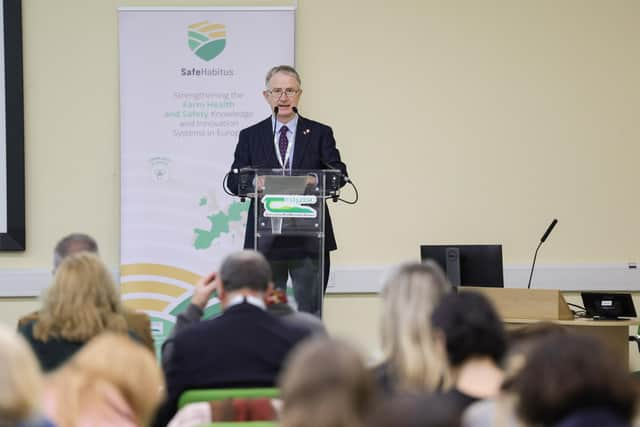
“I am urging farmers to take the time to review their safety at all times and carry out any necessary checks, maintenance and repairs without delay.” Speaking at the opening of the conference, Minister Collins said: “We will hear from leading national EU and international researchers over the coming days about the challenges that farmers and farm families face.
“But knowledge alone isn’t enough; farmers need support to make changes to make their farms safer while also supporting their health and wellbeing.
“In addition to a range of initiatives to support the safety, health and wellbeing of our farmers, safety training is built into my department’s farm schemes.
“My department supports on-farm investment in farm safety through 60% grant aid under TAMS3 and through accelerated capital allowances. Building a positive culture of farm safety means making the safe choice the easier choice.” Seamus Boland, president of the European Economic and Social Committee, said: “Farmers and farm workers are the backbone of Europe’s rural communities, and the conditions they work in will decide whether those communities have a future.
“The European Economic and Social Committee has long argued that farming must become a genuine career choice for young people.
“That means fair incomes, safe and healthy work, and a real voice for farmers, workers and civil society in the policies that shape their lives.” Congratulating Teagasc for hosting this important three-day conference, Minister of State with responsibility for Food Promotion, New Markets, Research and Development, Noel Grealish TD, said: “Research is key to understanding farmers attitudes and behaviours related to farm safety and developing actions which will be effective in improving this.
“The SafeHabitus project, which brought together researchers from Teagasc with a range of European collaborators through Horizon Europe, has significantly added to the knowledge base in this area and it builds on national research that my department is funding, such as the project ‘Safer by Design’ for which I announced funding of €748,000 in Call 2025. I look forward to learning about how the research can be developed into practical supports for farmers.” Professor Frank O’Mara, director of Teagasc, said: “Our strategy, Innovating for Impact, makes the attractiveness of farming one of our core priorities. That means developing more resilient, labour-efficient farm systems that support the livelihoods and wellbeing of farmers, farm families and farm workers.
“Through our integrated research, advisory and education services, we work with farmers and farm families to support the adoption of practices and technologies that improve working conditions, strengthening both the competitiveness and the resilience of Irish farming.” The conference included the SafeHabitus Film Awards, recognising documentary films on the realities of farming life, on Tuesday afternoon.
- Did you enjoy this story from Farming Life? If so, sign up for our free newsletter.