


The tour aimed to broaden members’ agricultural understanding, develop their leadership skills, encourage further innovation within Northern Ireland’s agri-sector, strengthen cultural exchange and global connections and share learning across YFCU and the wider farming communities.
The two-week trip took place from Friday 26th June 2026 to Thursday 9th July 2026.
Having completed the first full day of visits on Monday 29th June 2026, members gained an insight into two different beef farming systems and the scale and diversity of agriculture in the province.
The first visit of the trip was to Cattlelands Feed Yard, a family-run beef finishing operation, where members were welcomed by Farm Manager Mike.
Harry Chambers (Collone YFC) provided this overview of the visit, giving an insight into the large-scale finishing enterprise which processes over 40,000 cattle each year, alongside a further 450 suckler cows.
He remarked: “The Cattlelands operation extends across 160 acres, with cattle kept outdoors in pens of 200 throughout the year. The farm employs around 25 staff, with a further 10 employees brought in during the winter months.
“One of the most striking aspects of the visit was learning how the farm operates in Alberta’s extreme winter climate, where temperatures can fall as low as -40°C. Water pipes are buried more than seven feet underground to prevent freezing, while electric heaters are fitted to water drinkers across the farm, which come from a 19-million-gallon water reservoir.
“Cattle are purchased between six and twelve months of age for $2,500–$3,000, spending an average of 240 days on the farm. The target is to achieve daily liveweight gains of approximately 3.5–4lb.
“Cattle receive a hormone implant on arrival, followed by a second implant around 70 days later to support growth rates. The scale and efficiency of the handling system was another highlight, with the facility capable of processing up to 600 cattle per hour.
“More than 60% of the cattle finished at Cattlelands are Aberdeen Angus, with the breed selected for its easy-fleshing ability.
“Cattlelands also operates its own feed mill to produce feed for the animals, using approximately 300,000 tonnes of feedstuffs annually. Around 3,000 acres of irrigated ground are used to produce silage each year, while 10,000 round bales of straw are required to bed the cattle during the winter.”
Following the visit to Cattlelands, the group travelled to the pedigree Hereford farm of Patrick and Karen Huestis where James McConnell (Collone YFC) gave this overview: “Pedigree Hereford breeding has been a long-standing part of the Huestis family, with Patrick explaining how his parents bred a yearling heifer which went on to achieve major success, winning Hereford yearling championships in both Canada and the USA during the mid-1970s.
“Patrick also shared his previous experience in agriculture, having farmed just outside Vancouver where he reared more than one million turkeys per year alongside his Hereford enterprise. However, after spending much of their lives near the busy city of Vancouver, Patrick and Karen decided they were looking for a quieter and more peaceful way of life.
“The couple subsequently made the approximately 11-hour journey to Airdrie, Alberta, where they purchased the farm they now call home.
“The farm extends to 160 acres, divided into eight paddocks, and is home to around 35 Hereford cows along with their youngstock.
“Calving begins in mid-February, with cows generally calving outdoors unless temperatures fall below -9°C, at which point there is a risk of the calves’ ears freezing.
“Members were allowed to view the farm’s breeding bulls, which command impressive prices through a combination of word-of-mouth sales, Facebook Marketplace and pedigree sales.
“Patrick discussed the differences between his previous and current farms, explaining how the previous holding was considerably more productive due to differences in climate and soil type.”
The two visits provided YFCU members with a valuable opportunity to compare very different approaches to beef production, from a large-scale commercial finishing operation handling tens of thousands of cattle annually to a smaller pedigree Hereford enterprise focused on breeding quality livestock.
Victoria Minford (vice president) explained that as the members were making their way back to their hotel, they stopped by a pasture where their tour guide Claire Finn showed her Hereford and Aberdeen Angus herd. Claire, along with her Father Graeme, practises farming methods which include adding alfalfa, sainfoin and vetch seeds into minerals, so when eaten by the cows and excreted, it can grow new grass and be added to the soil structure.
The second day (Tuesday 30th June 2026) began with a visit to the Ten Brummelhuis family’s 140-cow robotic dairy farm, where members learned of how the family moved from the Netherlands to Alberta in 2022, initially establishing a herd of 50 cows before expanding to 140 cows across their 740-acre farm.
Gareth Baird (Straid YFC) remarked: “Aaron Ten Brummelhuis has spent the past 24 years developing the herd’s genetics, moving away from a purely Holstein herd and introducing Brown Swiss and British Friesian to improve overall herd health. Since moving to Alberta, the family has also transitioned the farm to organic production. Of the approximately 500 dairy farms operating in Alberta, only six are organic, making the Ten Brummelhuis farm part of a small and unique group of producers.
“Aaron explained how the family takes a preventative approach to herd health, following the principle that prevention is better than cure, which is particularly important within their organic production system. The herd is milked using three Lely robotic milking systems and housed in a freestall barn fitted with waterbed mattresses and sawdust bedding. The cows also have access to grazing, with a Lely grazing gate used to manage their movement and allocation of approximately three acres of grass per day.
“The herd is achieving an average daily yield of around 31 litres per cow, with milk testing at approximately 4.3% butterfat and 3.4% protein. The base milk price is around $1.30 per litre, equivalent to approximately 69p, with the family also receiving an organic premium on the milk quota they hold. he farm operates an all-year-round calving system, with heifer calves retained and reared on the farm. Beef-bred calves are sold off the farm at between five and seven days old, achieving approximately $1,500–$1,800 per calf. Members also learned about the family’s approach to calf rearing. Calves are fed pasteurised milk until around four months of age, alongside barley and alfalfa, with the family opting for a slower and more natural weaning process.”
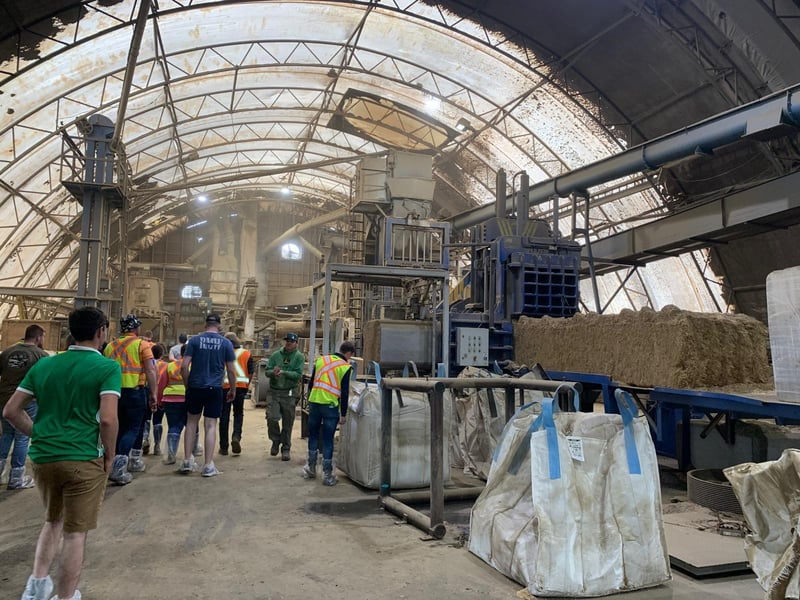
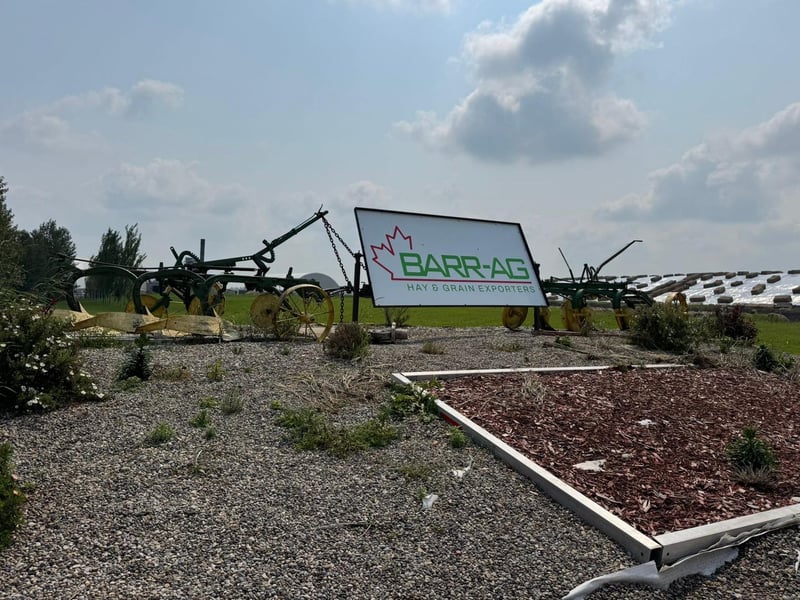
The group’s second visit of the day took place at Canada’s leading exporters of hay, alfalfa and grain products.
Kerry Jamison (Kilraughts YFC) remarked: “Members toured the company’s main processing yard just outside Olds, where they saw first-hand how agricultural products are processed for both domestic and international markets. The visit provided an insight into the production of alfalfa pellets, as well as Barr-Ag’s main enterprise of drying corn silage. One of the company’s silo pits can hold the equivalent of approximately 6,000 acres of harvested crop. Barr-Ag export their products internationally to markets including Japan, Korea, Qatar, Saudi Arabia and China. The scale of the operation highlighted the significant role Alberta plays in supplying forage and feed products to customers around the world.
“Members learned how the corn silage is dried from approximately 55% moisture down to between 5% and 8%, before being tightly compressed into 450kg bales. Once properly dried and stored, the bales are non-combustible and can have an extremely long shelf life provided they remain dry. Following processing, the bales are loaded onto trucks before travelling by rail to Vancouver, a journey which takes approximately 10 days. From there, the products are shipped internationally, with sea journeys taking up to a further 30 days depending on the destination.”
The final visit of day two took the group to Iron Kreek Ranch, owned and operated by Kevin and Roxi Ziola.
Eirinn Braniff (Ballywalter YFC) provided this insight into the visit: “The tour began at the ranch’s newly constructed heated timber-frame horse barn. Roxi is hugely passionate about rodeo, a love for the sport which runs deep within her family. Members heard how her grandfather was a two-time World Champion buck rider.
“The Ziolas currently own 15 horses, and the group was fortunate enough to meet the ranch’s newest arrival - a foal which was just one week old at the time of the visit. Iron Kreek Ranch operates as a regenerative beef farm, with all livestock certified as grass-fed. The ranch is home to approximately 200 cows alongside its youngstock and operates a successful direct-to-consumer meat programme.
“Customers order and pay for their meat in advance, with the business relying heavily on word-of-mouth recommendations and developing strong relationships between the producer and consumer. This approach allows the Ziolas to market their beef directly while building a loyal customer base.
“The cattle are predominantly grass-fed, with hay used as a supplement when necessary. Farming in Alberta presents its own unique challenges, particularly due to the climate, with around 200 days of winter each year and approximately 100 of those days experiencing extremely harsh and icy conditions.
“The ranch extends across 12 quarters of land, equivalent to approximately 1,920 acres. While cattle prices are currently favourable, Kevin and Roxi emphasised that their focus extends beyond short-term returns, with profits being reinvested into the land and farm infrastructure.
“Their long-term goal is to build a sustainable and profitable business that can be passed on to future generations, particularly their daughters. This commitment to succession planning was evident through recent investments in the business, including the construction of the new horse barn.”
The visits during day two provided members with a diverse insight into agriculture in Alberta, from organic milk production and robotic technology to international feed exports and regenerative beef farming. They also highlighted the importance of long-term planning in developing sustainable agricultural businesses. Travel opportunities like these further highlight the commitment that Young Farmers’ Clubs of Ulster have of educating their members on farming practices across the world, and encouraging them to bring innovative ideas back to home soil.
9. YFCU CANADA TRIP 8.jfif
The Young Farmers’ Clubs of Ulster (YFCU) were delighted to send twenty-five of their members on an agri-study tour to Canada explore Canadian agriculture, gain global insight and bring new ideas home to Northern Ireland. Photo: YFCU
10. YFCU CANADA TRIP 10.jfif
The Young Farmers’ Clubs of Ulster (YFCU) were delighted to send twenty-five of their members on an agri-study tour to Canada explore Canadian agriculture, gain global insight and bring new ideas home to Northern Ireland. Photo: YFCU