
Brussels Notebook: More of the same will be the order of the day for agriculture
August is traditionally a time-out month when it comes to politics.
This is particularly true of the politics around agriculture in the EU. The August break for politicians, officials and lobbyists is just about sacrosanct. The focus shifts to preparing plans for what might be achieved in the autumn. This has a new edge in Europe this year, as there will be a big push then to secure agreement on at least the outline of a new CAP from 2028 onwards.
As farm politics wind down until the autumn, for the first time since Brexit it is clear the UK and EU are on very different political tracks when it comes to priority issues. In the UK the farming lobby is desperate to find any mechanism to have its voice heard by a government with a greater urban focus than ever. Extra funding is off the agenda, given the overall state of the economy and the demands of the Treasury.
Farmers will press again for further changes on inheritance tax, but this now has to be even more in hope than in expectation of a positive result. Like the unfair cut to winter fuel payments, as one of the first decisions of the Starmer administration, Labour has already taken the pain and criticism around the inheritance tax changes. They remain morally and economically wrong; they are muddle-headed and on an tax revenue versus economic damage ratio a flawed approach. But that logic, compelling as it might be, is unlikely to change hearts at Westminster.
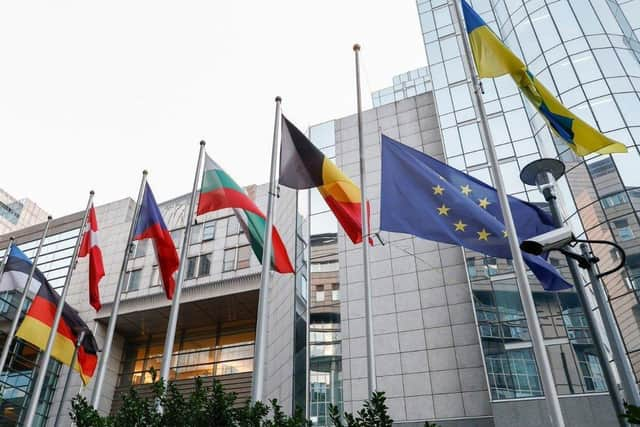

The EU is on a track towards changing the CAP; it could become less central to EU policy and less generous for the first time since its creation in the mid-1960s. But the farming voice remains powerful and politically influential in Europe to a degree we can only envy.
In recent weeks the EU has confirmed its commitment to policy simplification in agriculture and continues to stress the strategic importance of European food. Budgets are tight, but in the run-up to the August break it produced an additional 500 million to help ease the burden of higher energy and fertiliser costs.
This is another indication that there is little confidence in Europe the US and Iran will find the way to a deal to ease this problem by returning shipping through the Straits of Hormuz to how it was before the war. This contrasts dramatically with the situation here and it goes to the heart of one of the biggest negative outcomes of Brexit. As an EU member state the UK was plugged into EU agricultural decision making.
It gained by default from the campaigns waged over funding and policy by the key agricultural member states in Europe.
The UK was very much a part of that bigger farming lobby; it performed above its weight in COPA and enjoyed the benefits of the influence that it indirectly brought to policy in the UK.
Today the farming lobby has lost influence, because it is fighting national and devolved governments that no longer care about food production and farm incomes.
Their focus is on green visions at the expense of food production and the economic well-being of rural communities.
Back in 1983 the World in Action television documentary series produced a programme, Harvest Gold.
This was a critical look at the influence of the UK farming lobby over government farm policy. It was about how good lobbying maximised revenues, particularly for arable farmers, and how this access to decision makers topped anything achieved by advocates of a greener approach.
That is a forgotten era for agriculture. Indeed the tables have turned about where lobbying power lies.
What the autumn brings time will tell. Here agriculture is unlikely to see much focus at Westminster as the government targets Reform. More of the same, which is a steady decline in support, will be the order of the day.
There will be no radical shift to view food security as a strategic asset. Instead the drive will be for a cost of living ‘breathing space’ via efforts to reduce food prices at farmers’ expense. In Europe the drive for CAP reform will continue.
It will not be as bad as some predict in terms of a budget cut, but the direction of travel will be away from the generosity of past decades. But agriculture will remain a more powerful political force in Brussels than at Westminster or the devolved administrations.