
Climate Action Plan has the scope to bring about significant herd reduction measures
Stormont agriculture committee chairman, Robbie Butler has highlighted the scope for Northern Ireland’ initial Climate Action Plan to be used as a means of reducing livestock numbers.
He explained: “The documentation prepared for the Climate Action Plan public consultation, which is now ongoing references the potential for herd reduction measures to allow Northern Ireland meet its future greenhouse gas emissions targets.
“This approach is fully in line with thinking that has been put into the public domain by the UK’s Climate Change Committee and the Office of Environmental Protection.”
Butler raised this matter with Department of Agriculture, Environment and Rural Affairs (DAERA) officials at a recent meeting of the agriculture committee.
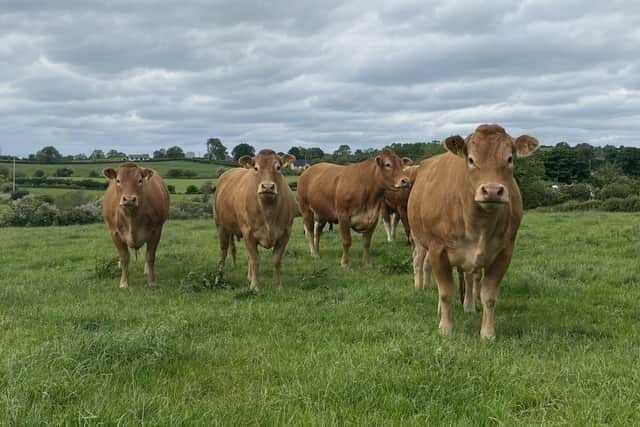

He continued: “They said that there are no plans at the present time to use livestock reduction as a means of meeting climate change targets.
“However, there is an absolute incongruity between this stance and the measures that may be contained within a climate action.
“Farmers are very aware of this issue. This is a fundamental matter that goes to the very heart of livestock production practices here in Northern Ireland.”
The envisaged climate action plan is a legal requirement of the Climate Change Act that was passed by the NI Assembly in 2022.
It will sets out the path that Northern Ireland will take to reduce greenhouse gas emissions to net zero by 2050 and demonstrates how it will be possible to achieve the first carbon budget target of a 33% average annual reduction between 2023 and 2027 compared to the baseline of 1990.
Finalising and consulting on the draft Climate Action Plan is a commitment in Stormont’s Programme for Government, with DAERA leading on the development of the plan on behalf of the Northern Ireland Executive.
The draft Climate Action Plan, now out for public consultation, includes policies and proposals identified by departments to reduce emissions across all sectors of our economy and society.
Turn to page 14
Robie Butler again: “The Ulster Unionist party is totally opposed to the principle of livestock reduction policies, as a means of achieving future climate change targets.
“Such measures will serve only to totally undermine the future sustainability of agriculture in Northern Ireland, where livestock output is a key determinant of business profitability.”
He added: “Livestock reduction measures also fly in the face of the need to maintain food security measures both in the UK and beyond.
“There is tremendous potential for agriculture in Northern Ireland to become a powerhouse of food production in the UK, where indigenous food security levels have been dropping consistently over many years.”
Agriculture in Northern Ireland is currently feeding the equivalent of 10M people. Robbie Butler firmly believes the value of this contribution to the local economy can be built on for the future.
He assumed the chairmanship of Stormont’s agriculture committee at the beginning of January this year.
So how does the Lagan Valley MLA reflect on his first six months of engagement with Northern Ireland’s farming and food sectors.
He commented: “It has been tremendously interesting and rewarding in equal measure. In the first instance, I have been blown away by the scope of the industry and the role it plays across our economy and society as a whole.
“In many ways my work with the agriculture committee has been a baptism of fire. The last six months have seen a number of fundamental challenges confronting local agriculture.
“Plans to introduce a family farm tax were followed by the introduction of Donald Trump’s fundamentally enhanced tariff regime.
“The new Nitrates Action Programme measures then followed with the public consultation on a climate action plan now thrown into the mix.
“And, of course, over arching all of this is the need to push ahead with an effective bovine tuberculosis eradication programme.”
Robbie Butler concluded: “But throughout all of this my clear focus has been on finding solutions that provide the best outcome for farming families across Northern Ireland.”