
Additional support must be found for the sheep sector
Additional funding for sheep can be found outside of the £300M annual budget that has been ring fenced by the Stormont Executive to deliver core support for local agriculture over the coming years.
This is the strongly held view of EasyCare breeder: Campbell Tweed.
The Cairncastle-based flock owner further explained: “The need to deliver additional support for sheep is obvious. And there are mechanisms through which Stormont and the Westminster government can make this available. These options must be explored.”
He added: “With regard to the actual monies required, we need parity with the measures already available in the Republic of Ireland. This works out at approximately £20/ewe.”
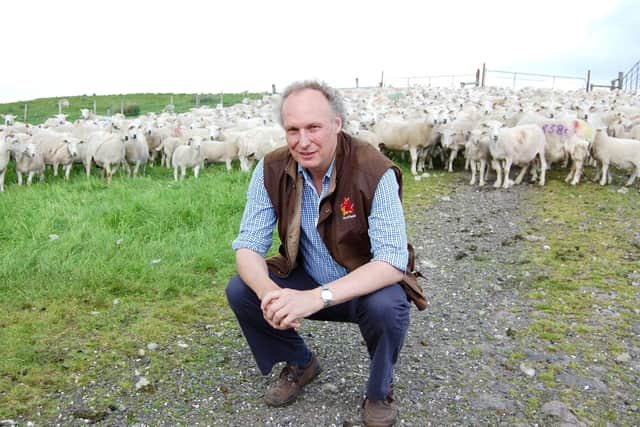

Tweed represents both the Ulster Farmers Union and the National Sheep Association (NSA) on Northern Ireland’s Sheep Taskforce.
The grouping met earlier this week in preparation for an upcoming meeting with officials within Department of Agriculture, Environment and Rural Affairs (DAERA) policy division.
Campbell Tweed again: “There are a number of steps that can be taken to quickly reflect the support needs of the sheep sector. One of these is the full recognition of sheep grazing systems within future environmental schemes.
“Grazing livestock have a key role to play in maintaining and improving the hill and upland environment.
“Recent years have seen our hill areas more predisposed to fire risks. In part, this is because sheep have not been allowed to graze down rougher vegetation during the winter months.”
He continued: “We are also seeing tick borne disease becoming more prevalent in both animals and humans. Louping Ill is now a growing challenge within sheep flocks while reported instances of Lyme disease in human are on the rise.
“Both of these issues can be significantly attributed to poor vegetation control, matters that can be directly addressed if the decision is taken to include sheep within future environmental schemes.”
In principle Campbell Tweed wants sheep to be included within the Ruminant Genetics’ Programme, thereby bringing Northern Ireland into line with the other parts of the British Isles. This will have both positive production and environmental impacts.
He commented; “This issue has been agreed to in principle. It’s a matter of coming up with the correct delivery vehicle.”
The EasyCare breeder believes that an appropriate starting point for a genetics programme targeting sheep would be to focus on those flock owners that currently performance record.
“Last year a total of 5808 lambs born in Northern Ireland were recorded through the Signet programme,” he said.
“It should be feasible for DAERA to cover the full costs of a genetic assessment programme in Year One with breeders agreeing to cover 50% of the costs thereafter.”
According to Campbell the full genetic assessment of ewes and lambs will deliver a number of key benefits for pedigree sheep breeders.
“In the first instance it will identify the parentage of lambs in all cases. There have been problems in this regard previously.
“Genetic assessment will also help to get around the problem of potential in-breeding, which has also been an issue up to this point within certain breeds. It will also help to identify genetic defects while adding more weight to the data generated by performance recording.”
He concluded: “There is a general consensus around the need for Stormont to deliver bespoke support measures for the sheep sector.
“The industry plays a critically important role within the agri food economy, particularly in
hill and upland areas. It is very important to maintain, and if possible, strengthen the health status of Northern Ireland’s sheep flock.”
UFU deputy president, Glenn Cuddy, chairs the Shep Taskforce.
He said: “Last autumn, DAERA agreed to establish a sheep-focused co-design group. However, despite repeated calls from the Sheep Taskforce, this group has not materialised. The lack of engagement and action is simply unacceptable.
“DAERA has continually cited staffing limitations as a barrier to progressing sheep sector support.
“It is extremely frustrating to repeatedly hear that the department does not have the ability to deliver for sheep farmers, yet nothing seems to be in progress to address the issue.
“Meanwhile, DAERA has prioritised the Suckler Cow Scheme and now the ‘Farming with
Nature’ programme. Support for sheep farmers has been totally left behind.”
Cuddy continued: “Our sheep farmers are fed up and are stressed by the impact that this ongoing lack of support is having on their businesses. They face volatile markets, rising costs and a looming 17% cut to their Basic Payment Scheme without any meaningful way to recover that lost income. Without direct support, many businesses will not survive.”
The Sheep Taskforce is renewing its call for DAERA to urgently establish a dedicated sheep co-design group, with a focus on:
- Genetic improvement programmes for sheep
- Animal health and welfare initiatives
- Sustainable land management and biodiversity schemes
- Capital investment support for the sheep sector
- Research and innovation specific to sheep production
The UFU representative concluded: “The sheep sector cannot be treated as an afterthought. Many NI farmers rely solely on sheep enterprises for their livelihoods. Targeted and immediate action is needed to secure the long-term sustainability of the industry.