
Going green: Think of fire risk before choosing BBQ picnic
We’re planning a family party and wondered your views on disposable barbeques? Are they a good option for outdoor entertaining.
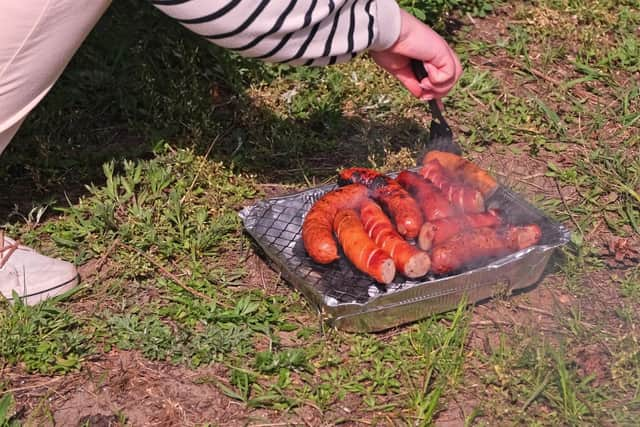
Given the exceedingly hot and dry conditions the UK has faced all year, I would plead with anyone to avoid buying disposable BBQs as without meaning to they are increasingly responsible for dangerous wildfires.

There are so many websites full of incredible catering ideas for the great outdoors including family favourites such as sausage rolls and scotch eggs, as well as
taking inspiration from other countries such as simple sharing boards including baguettes, grapes and cheese as the French do.
Unfortunately, due to global warming managing wildfire risk is now part of firefighters jobs, along with tackling increasing floods in wintertime. The more carbon pollution we put into the atmosphere, the hotter and drier our summers become and therefore, the easier it is for a simple spark to set fire to grassland or forests and spread very quickly, particularly in windy conditions.
This is why fire crews are struggling this summer to manage the frequent number of fires burning in both the countryside and our towns and cities.
According to the National Fire Chiefs Council (NFCC), crews in England and Wales have already tackled over 850 wildfires this year, a third higher than the record-breaking totals seen in 2022.
Visit https://www.theguardian.com/world/2025/aug/14/2025-on-track-to-beat-uk-record-for-wildfires-warn firefighters#:~:text=In%20England%20and%20Wales%20alone,figures%20will%20likely%20onl y%20increase website.
Most fires are started by humans, whether accidentally or deliberately. For as little as a few pounds, anyone can buy a disposable bbq as most of our major supermakets still sell these dangerous throwaway grills.
Inadvertently, someone’s party can literally cause thousands of pounds of damage, destroy wildlife and cause disruption as roads are shut to tackle flames.
Meanwhile fire crews are working in extreme heat, with reduced water supplies and pressure while putting their lives at risk. Therefore, I hope supermarkets voluntarily remove the disposable BBQs from their shelves, as they have previous dry summers or the Government should step in to ban them.
If you are having a BBQ of any sort it’s worth having a fire blanket or a bucket of sand or water to hand in case sparks literally fly. Here are some other tips to prevent fires if you are using a disposable BBQs:
Disposable BBQs must be placed on a flat surface of either bricks or paving slabs not grass or wooden furniture including benches.
Place disposable barbecues away from overhanging branches, houses, sheds or fences.
Ensure the barbecue coals have completely cooled before putting it in the bin. This will take several hours and then pour water over it to make sure it’s out.
If a fire does start call 999 immediately. Please don’t hesitate as reacting fast is critical.
The risk has become so great that there’s even a new term for cities called ‘firewave risk’ was created to explain the danger hot, dry summers bring to UK cities if multiple urban wildfires were triggered at the same time.
Visit https://www.bbc.co.uk/news/articles/c9vd79x97zlo website.
So while this advice may at first sound like a kill joy there are so many ways to have fun with friends instead.
To protect the nation’s forests, homes and wildlife, in your local community please do give disposable bbqs a wide berth.
Celebrity spot
In her latest Mother Nature video, the Princess of Wales said: “Our lives flourish when we cherish the bonds of love and friendship.
"It has never been more important to appreciate the value of one another and of Mother Nature. Summer is the season for abundance.
"Just as the flowers bloom and the fruits ripen, we too are reminded of our own potential for growth.”
Green swap
Swap plastic straws for bamboo or pasta straws. Bamboo is a fast growing, renewable material and pasta straws can be eaten after use – my kids even eat them raw. Plastic is produced from fossil fuels so well worth the swap.
Are you eligible for the Warm Home Discount?
It’s hard to imagine the winter cold in this heat, but here’s a reminder for those eligible for the Warm Homes Discount, particularly if you’ve recently moved or changed supplier or if the account is in a partner’s name.
Eligible households must be named on their electricity bill by Sunday, August 24, to receive the £150 Warm Home Discount automatically. Pre-payment meter users who use a key or card to top up must also ensure their account is in their name. Last winter, 96 per cent of eligible households received their discount automatically through this route, making it the easiest and quickest way for the overwhelming majority of households.
More than six million households will benefit this year after the Government removed restrictions that previously excluded many. Billpayers in England, Scotland and Wales are eligibly if they receive means-tested benefit such as Housing Benefit, Income-related ESA, Income-based JSA, Income Support, Pension Credit (Guarantee or Savings Credit), or Universal Credit.
Most will receive the discount automatically. In Scotland, only Pension Credit recipients are auto-enrolled – others must apply via their supplier, encouraging eligible households to check they are named on their electricity bill to automatically benefit from the discount this winter,
Sunday, August 24, is the date where energy suppliers will match their customer records against eligibility for the discount. After this date, eligible households will still be able to receive the discount, but they will have to wait for a letter to arrive. If you haven’t received a letter by January 2026, then you will need to call the helpline, the number of which will be released in August.
As well as the Warm Home Discount there are other grants people can apply for to get help with water, gas and electricity bills. Contact your utility supplier to see if you qualify for any financial support.
Some local authorities and housing associations also have assistance funds to help with the cost of living crisis, so again it’s worth a phone call or email to explore if you are eligible.
Finally, many of us can take simple steps to reduce how much energy we use at home and therefore save money on our gas and electricity bills. Several measures, such as bleeding radiators, or reducing the flow temperature of water to 60C from a combi boiler or turning off appliances at the plug don’t cost anything except a few minutes of your time so are well worth doing.
Others, such as fitting insulation tape around windows and doors cost less than £10 a roll to stop annoying and expensive cold drafts in winter.
For more energy saving tips visit One Home website at https://onehome.org.uk/topics/saving-money/cost-of-living/one-home-launches-new-video-and-guide-on-energy-saving-tips-for-any-budget/ website.
Now is a perfect time to get your home winter ready and start saving money while also benefiting the environment.
Fact or fiction
Global recycling rates for plastic are at only about ten per cent.
FACT.
Plastic production has risen from two million tonnes in 1950 to about 475 million in 2022 – and it is expected to keep rising with only about ten per cent recycled.
Visit https://www.bbc.co.uk/news/articles/cvgpddpldleo website.