
Pupils at ‘The Cope Primary School’ in Loughgall learn about ‘Good Honest Spuds’
The scale and complexity of a modern potato packing operation was put perfectly into context by Wilson’s Country Chief Executive, Angus Wilson, when he spoke recently to Primary six and seven pupils at the Cope Primary School in Loughgall, Co Armagh, writes Richard Halleron.
This talk was part of a series of talks which Angus and Joanne Weir Sales Manager at Wilson’s took to schools in the local area.
The great ability of a person who has an in-depth knowledge of a particular subject is that of communicating the principles involved in a very straightforward and easy-to-understand manner.
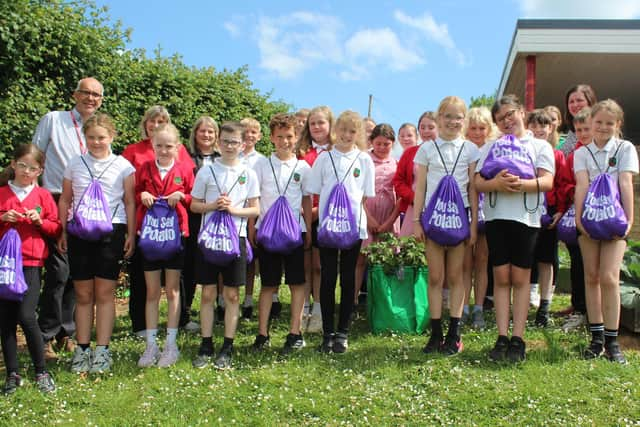

The impact made by the Wilson’s team in their talks was evidenced in real time by the number and scope of the questions asked by the children as they listened to the story of what modern potato production in Northern Ireland is all about.
The backdrop to Angus’ visit to Loughgall was the support his company gives to a unique educational initiative: the Grow Your Own Potatoes (GYOP) project.
This is a UK-wide initiative encouraging children to learn about food and farming, and promote sustainability.
Launched 20 years ago, GYOP was one of the first primary school based growing projects to build real momentum. It provides children with that all-important, touch-feel experience in terms of them actually growing their own potatoes with the support of their teachers within a school setting.

They also have the opportunity of meeting and hearing from leading representatives working within the potato industry.
Over the past 20 years, GYOP has become the largest initiative of its kind with over six million children taking part in learning where potatoes come from, how they grow and the health benefits.
So let’s start with some fun facts about the potato sector and, specifically, the role that Wilson’s Country plays with in.
So, for example, the company produces a staggering 175,000, 2kg bags of potatoes every week. These are distributed to shops throughout the UK and Ireland.
What’s more, it takes a work force of 130 people employed to make this, and so much more, happen within the business.
Two more interesting facts concerning potatoes that were related by Angus follow: approximately 2.5 billion potatoes are produced in Ireland every year and the largest single potato ever recorded weighed in at a spectacular 4.8kgs.
The grower in question was a hobby gardener in England. It is believed that his super potato was that very rare occurrence of up to four individual tubers fusing together while under the soil.
And, finally, consumers in Northern Ireland love their mash. It is the favourite way in which local people enjoy their potatoes: every day of the year.
Angus started his presentation with a history of potato production in Ireland. He pointed out that spuds are not a native crop to this part of the world: rather they hail from South America – Peru to be precise.
He further explained:
“Potatoes were brought to Ireland for the first time in 1509. And they have been growing here ever since.”
The history of Wilson’s Country goes back 38 years. As Angus explained to the children the decision was taken on his home farm at Richhill to switch from dairy cows to potato production at that time.
“He added:
“And the passion to be involved with the potato industry has remained with me ever since. Today Wilson’s Country is based in Craigavon.
We work with potato farmers throughout Ireland to produce a range of eating potatoes in bags.
“However, we also produce a range of peeled potato products, including chips and mash.
“Everything possible is done to maximise the eating pleasure of the potato products that we sell.”
Angus explained the steps taken to grow crops of high quality potatoes.
“Everything starts with the soil,” he stressed.
“Soil quality is extremely important as is preparing it properly prior to the planting of seed potatoes.
“Potatoes are grown in drills: these are a form of bed which allows the potato roots to spread out. They also provide additional drainage for the crops during periods of heavy rain.
Angus also discussed the principles of de-stoning, which acts to ensure that potato crops can grow in almost unhindered fashion.
Moreover the stones are placed between the drills, which ensures that tractors and other heavy equipment do not damage fields as they travel up and down fields throughout the growing season.
The children also learnt about the different parts of a potato plant: those that grow above and below the soil.
Angus specifically referenced the leaves, stems and roots. He also explained that the term tuber is used for a young potato while it is under the soil, attached to the growing plant.
He said:
“Keeping crops of potatoes free from disease is very important. It is for this reason thatcrops are grown in different fields on a yearly basis. This principle is called rotation.
“At harvest the potatoes are lifted and separated from the surrounding soil. A small proportion of the crop is sold as they are removed from the fields in the autumn.
“However, locally grown potatoes are eaten every day of the year. Ensuring this can happen requires the use of cold stores. These act to keep the potatoes fresh at all times.”
The nutritional benefits delivered by potatoes as part a healthy diet were discussed at length throughout the presentation, encouraging a myriad of questions from the young students in attendance.
Angus referenced the unique mix of nutritional energy, high quality protein, minerals and vitamins that are contained within a potato.
He added:
“Spuds are also an extremely valuable source of dietary fibre. And they come in a range of varieties.
“Each variety has different qualities, with the result that it can be put to a number of different uses.
“Rooster has a characteristic red skin. It can be easily boiled and can be used in a number of food dishes.
“Maris Piper on the other hand has a much higher dry matter content: it is more suited for chips.”
It was also significant that the timing of Angus Wilson’s visit to the Cope Primary School coincided with the launch of this year’s Comber Early season.
He added that the availability of these potatoes, which are grown in the North Down area was a highlight of his year.
He said:
“Comber Earlies are a unique taste sensation, best enjoyed when boiled and then eaten with a small dab of butter with a small amount of salt added for extra seasoning.
Talk of the different uses that potatoes can be put to gave the young students an opportunity to talk about their favourite potato dishes.
It won’t come as a surprise to learn that chips came up tops in this regard.
Wilson’s Country works with a range of retail and service sector outlets throughout the UK and Ireland.
Courtesy of his presentation, Angus was able to explain the difference between these customer types while also defining what is meant by the term ‘catering’.
He also discussed the principles of ‘adding value’ and ‘convenience’, commenting:
“Chefs in hotels and restaurants want to use potatoes in the most convenient way possible.
“They don’t have time to peel spuds: we do that for them. Nor do they have time to cut chips: again we do that for them.”
“And the same principle holds when cooking potatoes at home. Mums and dads are all increasingly busy people.
They want potatoes that are ready to cook. Peeling and cutting potatoes into chips just adds to the time taken to prepare a meal that everyone in the family can enjoy.
“At Wilson’s Country we recognise this fact and are committed to supplying potatoes in forms that are ready for the pot, the oven or even the air fryer.”
Delivering for the environment is an absolute priority for Wilson’s Country. Angus discussed what this meant in practical terms.
He said:
“We are committed to reducing the amount of waste that we generate to an absolute minimum.
“So, for example, all the potato peelings that we produce are fed into an anaerobic digestion plant, which is located on our site.
“In turn, this produces green electricity, which is used to power our potato grading, peeling, processing and lighting systems throughout the year.
“In addition, the residues from the anaerobic digester are extremely valuable fertilisers, which can be used to grow potatoes and other crops.
“This is an example of how the principle recycling can be put to a very good use.”
Angus continued:
“Caring for the environment has, and always will, be a priority for Wilson’s Country. We do not send any materials away to land fill.
“All of our plastics and cardboard are recycled
“We are also conscious of the need to minimise the levels of greenhouse gases that we put into the atmosphere.
“All of the large transport lorries that we use are powered by biomethane. This is a fuel with an extremely low carbon footprint.
“We are also working with our potato growers to ensure they can reduce the carbon footprint of their farms.
“Looking to the future, Wilson’s Country will continue to invest in technologies that improve our commitment to the environment.”
Angus Wilson entitled his presentation: ‘Good Honest Spuds’. It was a theme that certainly resonated with the young students attending the Cope Primary School.
The event ended with everyone inspecting the potatoes the primary six and seven pupils had planted out in grow-bags some weeks earlier.
There was a general consensus that the now fast growing potatoes would generate a bountiful harvest come the autumn.
Angus Wilson concluded:
“We have been working with a number of primary schools this year. The feedback received from both teachers and the children involved has been very positive.
“GYOP continues to build momentum here in Northern Ireland. The initiative plays an important role, communicating the benefits of potatoes to young students in a very clear, concise and easy-to-understand manner.
“And long may this continue to be the case. Potatoes tick every box from a health, nutrition and taste perspective.
“They are an extremely versatile crop and are recognised as such the world over.”