
Sharp increase in UK’s oilseed rape planted area projected for 2025/26
The Agricultural and Horticultural Development Board (AHDB) is projecting an almost 30% increase in the UK’s planted area of oilseed rape for 2025/26, relative to the previous year.
The organisation’s ‘Early Bird Survey’ (EBS) of planting activity, published over recent days, is also reflecting the impact of near perfect ground and weather conditions availed of by farmers throughout the UK during the autumn period. The data referenced by AHDB in the survey is collated from official provisional estimates for England and Scotland, combined with estimated areas for Wales and Northern Ireland.
The EBS captures early plantings and planting intentions as of late October and early November. The forecasts for harvest 2026 show a rise in the oilseed rape area from last year’s low level, along with a small increase in wheat plantings, but lower areas for barley and oats. Autumn drilling conditions were generally good in 2025, contrasting with the wet start to the autumn drilling window last year and extremely wet conditions in autumn 2023.
However, AHDB is also pointing to the fact that market environment is challenging with lower prices for cereals and lower milling and malting premiums, plus increased costs for all crops. Against this backdrop, oilseed rape likely benefited from a more favourable margin outlook compared to other crops, as well as the good yields achieved in 2025. The poor cereal yields of the past two years, along with ongoing commitments to agri-environment schemes and rotation needs, are also likely to be influencing 2025/2026 planting plans.
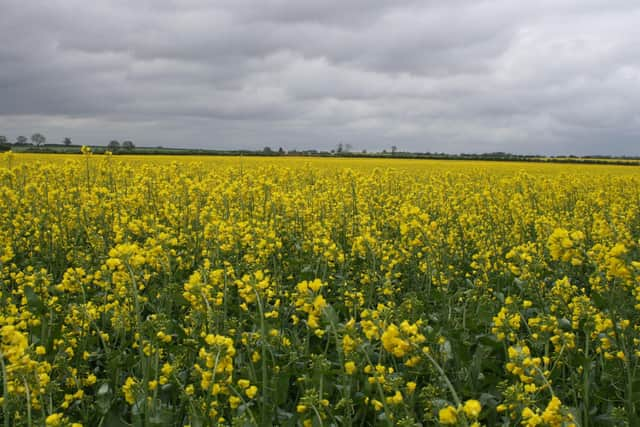

Oilseed rape
Oilseed rape is the stand out for 2025/2026, with a 30% rise to 316 Kha. While this is a significant year-on-year rise, the rise is from the 42 years low recorded in 2025 and the 2026 projection would still be clearly below 2023’s 391 Kha.
As is often the case when the oilseed rape area rises, the area of pulses is expected to fall for harvest 2026 by an estimated 12%. The total UK wheat area is forecast to increase slightly (+1%) to 1,675 Kha, though with variation across the country.
While spring wheat remains a small part of the total area, it’s important to note a sharp drop in planned spring wheat plantings from the elevated levels in 2025. The forecast wheat area would remain below the 2021-2025 average of 1,704 Kha. The winter barley area is estimated to fall a further 2% to 356 Kha, while spring barley plantings are expected to decline sharply (-15%) to 610 Kha. If realised, this would put the total UK barley area for harvest 2026 at 965 Kha, the lowest level since 2010.
The oats area is also expected to decline, down 14% to a projected 170 Kha, which would be just above the area seen in 2023. The area of other combinable cereals is forecast up 7% from 2025. However, crops of smaller area had a lesser area coverage in the survey, so these results will be subject to greater uncertainty. The last ‘catch-all’ category ‘other crops on arable land’ gains 4% and includes sugar beet, potatoes, vegetables and other crops that appear in the arable farm rotation such as temporary grass and maize. The EBS is focused on the arable farm rotation rather than all arable land which would include grass and forage rotations. For this reason, an estimate of the total area of these crops that appear in the arable rotation are used in this figure. After the area declined in 2025, the survey also points to an 8% increase in uncropped arable land in 2026.
Background to EBS
The EBS is undertaken each autumn to assess national cropping intentions. It is carried out by The Andersons Centre with help from agronomists from the Association of Independent Crop Consultants (AICC) and the Agricultural Industries Confederation (AIC): independents and nationals alike.
Seedtech director and Irish Seed Trade Association president, Tim O’Donovan, is indicating that the autumn planting season could continue through until early December.
He explained: “It’s still feasible to drill winter oats over the coming weeks. This assumes suitable ground conditions and the risk of crows absconding with the newly planted seed deemed to be low enough.”
The Seedtech representative made these comments in the wake of Teagasc publishing its 2025 autumn cereal planting estimates. These figures point to winter wheat and barley both coming in at 60,000ha with the winter oilseed rape area estimated at around 15,000ha.
Tim O’Donovan again: “Hybrid rye is well up year-on-year at around 5,000ha. However, even if growers to get winter oat crops planted over the coming weeks, the total planted area for the crop will still come in well short of 10,000ha: well down on 2024.”
The month of November normally gives agronomists an opportunity to reflect on general trends that had come to the fore during an autumn planting season. And according to Tim O’Donovan, two key issues are worthy of note, where 2025 is concerned.
He said: “The first is unusually high levels of seed borne disease (caused by Fusarium species and Microdochiumnivale) in the 2025 harvested winter wheat crops, especially in the northeast of the country. Both diseases can act to cause significant seedling death. Commercial seed companies will treat seed stocks accordingly. However, issues can arise in the event of farm saved seed stocks that have not been treated and treated accordingly.”
Tim O’Donovan continued: “The other trend of note that has been identified throughout the 2025 autumn planting season has been the growing demand for winter barley varieties that demonstrate tolerance to Barley yellow Dwarf Virus. The technology is now broadly accepted. As a result, tillage farmers are proactively seeking out these varieties.”
Teagasc publishes its 2025 Harvest Report
Teagasc has just published its 2025 Harvest Report, covering all of the combinable crops grown in Ireland. There was a recovery in total cereal production in harvest 2025, driven by increases in both area and yield for winter crops. Total cereal production is estimated to be 2.23 million tonnes, above the five-year average (2020–2024) of 2.1 million tonnes, reflecting a return to more typical planting and growing conditions after two challenging seasons. Meanwhile, the total tillage area remained stable. The cereal area increased by 4.6% from 2024 but the area of spring beans and winter oilseed rape declined in 2025. Dry weather at crucial times during the season was a significant factor in cereal production returning to normal levels in 2025.
Despite higher production levels, margins for tillage farmers remain under pressure as grain prices continue to lag behind rising input and production costs. Winter rye is included in the total cereal area for this report for the first time in 2025, reflecting an increase in area over the past five years, from 500 ha in 2020 to an estimated 5,000 ha forecast for harvest 2026. Winter cereals accounted for most of the gains in 2025, as growers returned to a more normal cropping pattern after rain disruptions in autumn 2022 and 2023.
The winter wheat area increased by 46% to 59.4k ha, producing 595k tonnes, up 73% on last year. Yields improved to 10.55 t/ha, compared with 8.90 t/ha in 2024, and above both the three and five-year averages of 9.8 t/ha. It is the highest recorded yield since the record set in 2022. The winter barley area increased by 32%, with production up 50% to 498k tonnes, supported by a average yield of 9.17 t/ha. Meanwhile, winter oats recorded a 137% increase in area and a 148% rise in production, benefiting from favourable growing conditions. Significantly, the winter rye area increased by 38% to 3.7k ha, with production reaching 36k tonnes.
Spring cereals declined in both area and production as growers shifted back toward winter cereals. The spring wheat area fell 34%, with production down 35% to 33k tonnes. Spring barley remained the largest spring crop but dropped 17% in both area and output. Spring oats contracted by 29% in area and 31% in production, continuing a two-year downward trend.
The winter oilseed rape (WOSR) area fell 25%, primarily due to the late 2024 harvest, which delayed planting. Although yields increased to 5.0 t/ha, total output was reduced by the smaller cropped area. In addition, the spring beans’ area declined 23%, as growers reacted to the late and difficult 2024 harvest. Yields averaged 5.1 t/ha, consistent with the previous year. The area of protein crops and oilseed rape claimed was the lowest since 2021 but is predicted to rise again in 2026.