
The 2026 silage season is almost upon us
Alltech has hosted a number of key events over recent weeks with a clear focus on how to maximise silage quality in 2026, writes Richard Halleron.
Underpinning this initiative is the clear recognition that quality forages are the main drivers of milk and ruminant livestock production across the island of Ireland.
The significance of the silage events was reflected in the tremendous turnout of farmers at the various venues.
Their timing has coincided in a significant spike in energy and fertiliser prices.

And, despite a temporary cease fire having been agreed to hostilities in the Persian Gulf, there is every prospect of farm input costs remaining high over the coming months.
In turn, this puts pressure on all farming businesses to maximise the value of the resources they produce themselves with high quality grass and silage at the very top of this list.
Alltech has long been to the fore as a key provider of cutting edge advice on silage making techniques: grass whole crop and maize.
This has been made possible by the international footprint of the business and its commitment to develop research and development teams with a strong international reputation where the production and feeding of quality forages are concerned.

Alltech’s 20206 forage campaign kicked-off with a ‘Silage Master Class’ in Dunboyne, Co Meath.
The event was well attended by industry merchants and representatives from all over Ireland: North and South.
Its purpose was to raise awareness of the importance of high-quality silage in Irish dairy and beef systems, both from an animal performance perspective and the economic benefits associated.
With the 2026 grass silage season just around the corner, the Dunboyne event represented a good opportunity for attendees to engage with farmers on the best practices to making top quality silage in the coming months.
There were four speakers on the day followed by a farm visit to Country Crest Beef finishing unit up North County Dublin.
Dr Dave Davies, an independent silage consultant, spoke about the economic benefits of making good quality silage in two varying dairy systems, indoor and grazing, and spoke about the economic return on using the correct silage inoculant such as Alltech Egalis Ferment.
Declan O'Neill of Alltech Ireland spoke about the company’s Better Silage Programme, launched in 2025, and how its objective is to help farmers increase silage quality by five dry matter digestibility (DMD) units and what that means to the farmer in terms of profit and performance.
He also spoke about the top ten practical management tips that can be adopted on farm to achieve a higher quality silage and how Alltech has conducted over 250 silage audits nationally to measure where improvements can be made in 2026.
The third speaker on the day was Aislinn Campbell who spoke about the threat that Mycotoxins pose to Irish ruminant systems particularly Penicillic Acid Mycotoxins originating from grass silages.
Aislinn explained the physical symptoms to watch out for in dairy cows and how performance such as milk yield can be drastically reduced if a mycotoxin threat is present in feed.
She explained about Alltech's new updated Mycotoxin binder called Mycosorb A+ Evo and how the new formulation acts more efficiently to bind the toxin threat in the rumen/gut.
The morning session finished up with a very interesting presentation from Professor Finbar Mulligan of UCD School of Veterinary Sciences who spoke about the importance of good quality grass silages in the diet of dairy and beef cattle.
Finbar spoke about the importance of good quality silage in early lactation and how high-quality silages help combat a negative energy balance improve milk production and composition and can reduce metabolic disease and increase fertility and how quality silage aids cow health in the transition period.
The evening session was on farm at Country Crest’s intensive beef finishing unit where attendees got to grips with silage quality first hand.
Dr. Dave Davies spoke about practical tips when it comes to ensiling and feedout at both a silage and maize clamp.
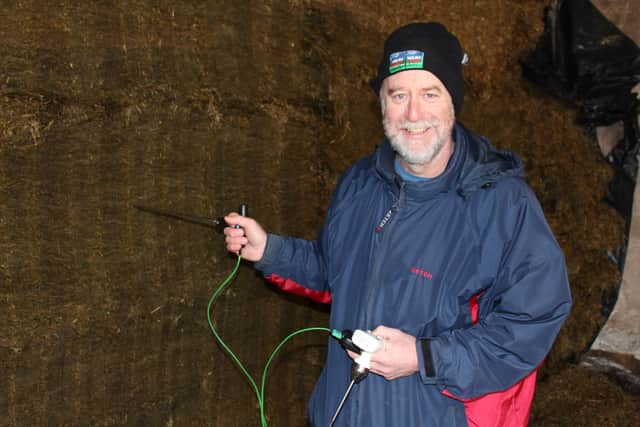
The session was very hands on where he took samples of core density for consolidation and temperature measurements were taken to assess pit spoilage.
Overall, the quality of silages on display were top quality and management was excellent, with the crowd very engaging and asking lots of technical questions.
Niall Maguire, Beef Manager for Country Crest, gave a tour of the impressive beef facility and walked those in attendance through the system from start to finish.
Meanwhile, January, February and March 2026 have been three of the wettest months on record leading to hugely challenging conditions for early Spring grass growth.
Low soil temperatures, saturated soils, slurry tanks overfilling are some of the factors leading to a less than perfect start to the year.
Then just as we turned a corner with weather in early March we were faced with another challenge, the Iranian crises leading to agricultural diesel price surges of up to 48% more than where it was pre conflict and issues with fertiliser prices skyrocketing and general availability of Nitrogenous fertilisers particularly urea.
Taking all the challenge above, farmers must focus our efforts on making good quality silage this year.
Alltech concluded its series of grass silage events with a farmer and stakeholder meeting held in Cookstown.
The event provided the company’s Declan O’Neill with an opportunity to discuss the key principles of silage making and how the main drivers of silage quality remain within the control of the farmers making it.
He commented: “Grass silage it is the second cheapest source of feedstock on farms after grazed grass.
“It is grown in our own fields and is less susceptible to global supply chain issues or price fluctuations than bought in feeds.”
Courtesy of his presentation, Niall discussed a range of proactical measures that can be applied to maximise the quality of first cut silages made in 2026.
These can be summarised across a number of subject areas
Nutrient management
With drier ground conditions and warmer temperatures getting fertiliser and slurry out on silage ground is a priority.
When it comes to nitrogen (N), grass silage utilises 2.5kg/ha/day of N (2 units/day), which means N should be applied at least 50 days before cutting to ensure it is fully used up.
Typically, a crop of first cut grass silage yielding 10t/ac will require 100kg N/ha or 80 units/ac, 20kg phosphorous (P)/ha or 16 units/ac, 125kg/ha or 100 units/ac of potassium (K), and 20kg of sulphur (S)/ha or 16 units/ac.
Soil testing will help determine the soil indexes and fertiliser requirements, and with current fertiliser prices this is even more important to ensure we are giving the crop what it needs and not over fertilising.
Slurry is a valuable resource, an average application of 3,000 gallons/ac of good quality cattle slurry of 6% dry matter (DM) will supply sufficient P and K levels and about 30kg of the N requirements to grow a crop of grass silage, slurry testing with a hydrometer can be used to see if the slurry is of a good DM.
Ideally, your P and K levels should covered through slurry which will leave you to make up the remaining 70kg of N/ha through spreading 1.5 bags/acres of protected urea + S.
If farmers are interesting in understanding more about the value of their slurry Alltech can do on farm tests for DM which will indicate P/K levels and rapid N tests for plant available N.
Reseeding
Reseding will yield higher quality silage, up to 3 tonnes more DM/ha compared to old, low-perennial ryegrass swards.
Reseeding with modern varieties can increase DMD by 2 units, with high-quality, leafy swards being critical for animal performance.
Newly reseeded swards are up to 25% more responsive to applied nitrogen, which is key in times of high fertiliser prices.
A rule of thumb is that silage ground should be reseeded every 8-10 years with a payback period of less than 3 years.
Cutting stage
IIinstead of giving a hard and fast cutting date to mow silage it is better to talk about the stage of growth of the sward.
Cutting grass young increases digestibility and protein content, however yield quantity will be lower, you will have a higher feed value silage, and it will facilitate quicker regrowth’s for grazing for second cut silage.
Once the emergence of seed heads has occurred the silage is at a 69-70% DMD, which is ok for dry cows but suboptimal for lactating cows.
An important fact to remember is every 2 days post seed heading the silage quality will drop by 1% DMD.
Wilting
The ideal dry matter (DM) we are looking for in silage to optimise consolidation and fermentation is 28-32%, which can be hard to obtain in Irish weather.
When possible, a rapid wilt of no more than 24 hours will remove unwanted water content in mowed grass.
Silage in the range of 30% DM will pack better in the clamp, will have less effluent run off and aid in nutrient and dry matter retention.
Be careful not to over wilt as dry silages can be a haven for yeasts, moulds and mycotoxins.
Preservation with Egalis® Ferment
Good preservation occurs when lactic acid bacteria present on the grass crop ferment available sugars to lactic acid.
In Irish conditions an inoculant such as Egalis® Ferment from Alltech® which contains one million lactic acid producing bacteria per gram of forage applied will drastically aid the fermentation characteristics of grass silage.
This is due to Irish grasses being lower in lactic acid naturally due to restricted sunlight and high moisture content dilutes the natural lactic acids.
Using Egalis® Ferment causes a rapid decline in pH which preserves the feed value of the stored silage.
Using Egalis® will help to retain as much nutritional value as possible from the field to the pit.
Treated silage has been proven to achieve a better feed-out, higher palatability with increased dry matter intakes, added energy content and increased digestibility, resulting in improved animal performance.