
The pace of agricultural research and learning continues to increase
The UK remains a world leading centre of agricultural research, the results of which will help drive sustainability on farms here in Northern Ireland during the period ahead, writes Richard Halleron.
Without the impact new thinking the various agricultural sector will fail to meet their production targets and their ever evolving relationship with the environment.
And, of course farming will be at very heart of society’s response to climate change.
It is particularly worthy of note that Northern Ireland is home to internationally renowned centres of agricultural research and learning.
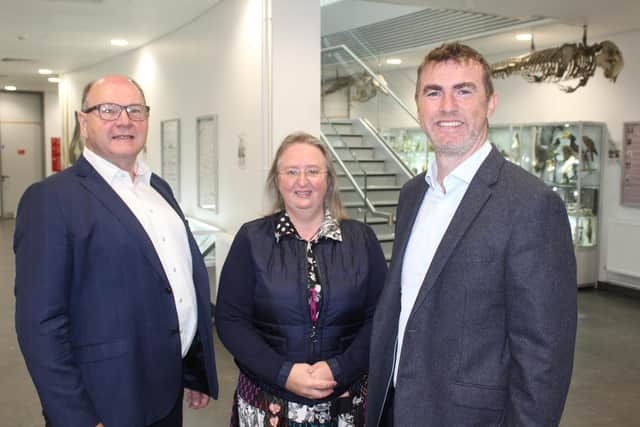

AFBI
The Agri-Food and Biosciences Institute (AFBI) has launched its Science Strategy 2030 sets the strategic direction of AFBI’s science to 2030. It presents a clear roadmap to achieving the Institute's ambitious plans to address some of society's largest and interlinked challenges such as environmental sustainability, economic sustainability, climate change, food security, and ‘One Health’.
Dr Stanley McDowell, AFBI CEO, announcing the new strategy, said: “The AFBI Science Strategy 2030 sets out how the organisation will apply the rapid advances taking place in science and technology to address challenges through innovative, collaborative and transformative science across our core remit of delivering essential statutory testing, monitoring and surveillance programmes, research and development work as well as emergency response capability and expert scientific advice.”
He added: “Society is faced with a set of major global and local challenges. These include the challenge of managing our natural environment, transforming agri-food production systems for long-term economic and environmental sustainability, and the on-going threat from emerging and trans-boundary diseases.
“Against this backdrop, the need for science to provide the evidence base, inform policymaking and develop solutions has never been greater. AFBI science enables Northern Ireland’s agri-food industry to market products nationally and internationally, provides innovations for production efficiency, promotes environmental sustainability from soil to sea, while also supporting societal health.”
“AFBI’s breath of work and holistic skill set spanning sustainable agri-food systems, animal and plant health, terrestrial and marine environments place us in a unique position to address these global and local challenges.”
AFBI's Science Strategy 2030 is based on our five corporate strategic priorities for which we have set out the outcomes that we aim to achieve, the science that we intend to apply and supported by a series of cross-cutting enablers.
“These strategic priorities include leading improvements in the agri-food industry to enhance sustainability, protecting animal, plant, and human health, and enhancing the natural and marine environment. The strategy implementation will be underpinned through regular review and adjustment.”
Queen’s University Belfast
The commitment of Queen’s University Belfast (QUB) to a new agricultural science degree marks a new phase in the provision of agricultural education in Northern Ireland.
The course will be delivered by QUB’s School for Biological Science with the first student intake scheduled for the start of the 2026/27 academic year.
At one level the new course re-establishes a clear commitment to the values of pure science underpinning a degree course in agriculture.
However, the launch of the new programme also marks the end the end of the ‘ag-tech’ degree, jointly delivered by QUB in association with the College of Agriculture, Food and Rural Enterprise (CAFRE).
Professor Nigel Scollan is the Head of the School for Biological Sciences at QUB.
He commented: “The new degree course represents a direct response to agri-food stakeholder bodies for a course of this type.
“However, Queen’s University is not cutting lionks with CAFRE. The every opposite is indeed the case as the provision of post graduate opportunities involving both institutions will be maintained.”
Meanwhile, 2025/26 represents the final year of student enrolment for the ag tech degree.
Nigel Scollan believes the launch of the new agricultural science degree course at QUB is perfectly timed given the many changes impacting on the farming and food sectors at the present time.
He said: “It is 20 years since the last new programmes were introduced into the School for Biological Sciences.
“And these are a direct result of discussions that have taken place involving representatives from QUB and stakeholders operating across the farming and food industry.
“It is the responsibility of a university to respond to need. Agricuture, food and veterinary are very big parts of our society.”
Professor Scollan continued: “The need for people who are trained and skilled in very advanced education has never been more relevant.
“The new programmes will allow our students enter into new research, government and communication pathways for the future.
“There are many different career pathways now opening up for our student graduates into the future.
He concluded: “It’s also important to emphasise that the School for Biological Sciences hosts the Institute for Global Food Security.
“In turn, the institute spreads out to other schools within Queen’s Faculty of Medicine, Health and Life Sciences and beyond.
“The end result is the provision of education, underpinned by cutting edge research.”
Veterinary biosciences
Significantly, QUB has also launched new graduate and post-graduate degree courses in veterinary biosciences.
The first tranche of undergraduate students will commence their studies at the beginning of the 2026/27 academic year.
Northern Ireland remains the only region of the UK without its own school of veterinary medicine. This is at a time when demand for veterinary surgeons has never been higher
There is now speculation that the commitment to the new veterinary biosciences courses could pave the way for QUB committing to its own school of veterinary medicine at some stage in the future.
Professor Nikki Marks, from Queen’s School of Biological Sciences, commented: “There is a lot of discussion about the possibility of bringing a degree in veterinary medicine into Northern Ireland.
“And this is very much an issue for the future.”
Meanwhile, the new degree in veterinary biosciences will offer an accelerated course completion opportunities for graduates wishing to enrol in schools of veterinary medicine around the UK.
It is envisaged that the completion of the new graduate course at QUB could bring a standard five-year course in veterinary medicine down to four years.
Nikki Marks again: “Many of our modules will be fully compatible with those taught in schools of veterinary medicine.”
The new veterinary biosciences degree courses will be delivered to reflect the overarching principle – One World: One Health.
According to Professor Marks, animal health, human health and our environment are inextricably linked.
She added: “This reality will be a key driving force for the new degree programme.
“Farming and food combined represents Northern Ireland’s largest economic sector. Driving improved sustainability within the industry is crucially important.
“Our new graduates in veterinary biosciences will be specifically qualified to make this happen.
“Stakeholders within the farming and food sector want graduates with both strong theoretical and practical experience.
“The new courses have been developed with this core objective in mind.”
New technologies, including artificial intelligence, will be used to deliver the new courses. Professor Marks envisages new drug development as being a key outcome of the new study and research programmes.
Meanwhile, a strong uptake for the new courses is envisaged.
Professor marks concluded: “We know this already, courtesy of survey work that has been carried out.”
It is envisaged that the new veterinary biosciences offered at QUB will prove equally attractive to students from Northern Ireland and further afield.”
The science of genetics
Meanwhile, Rothamsted scientists in England have uncovered how a family of genes in wheat fine-tunes the plant’s growth and grain development.
This is a breakthrough that could help breeders produce bigger harvests.
Their study focused on genes that regulate the production of gibberellins: natural plant hormones that drive growth.
By examining seven versions of GA3OX genes in bread wheat, the Rothamsted team found that different members of the gene family have distinct roles in shaping both plant stature and grain size.
“Our work shows how research into growth regulation pathways in wheat can guide the selection of gene variants that benefit farmers,” said Dr Stephen Pearce, a co-author of the Rothamsted study. “Decades of work on the gibberellin pathway led us to target these genes, which could now help develop wheat with bigger grains.”
Mutations in one set of genes, known as GA3OX2, left wheat plants severely stunted and infertile, due to extremely low gibberellin levels throughout the plant. By contrast, changes in GA3OX3 and GA1OX1 genes affected gibberellin levels mainly in developing grains.
Whereas GA3OX3 mutants had lower gibberellin levels, leading to smaller and lighter grains, GA1OX1 mutants accumulated higher gibberellin levels, producing larger grains.
In addition the study also revealed that grain-related genes can influence plant height, suggesting that hormones move between tissues more widely than previously thought. Analysis of modern wheat varieties showed that breeders have already, perhaps unknowingly, selected natural versions of these genes linked with larger grain size.
The team of Rothamsted scientists involved with this work are pointing to new possibilities for crop improvement. By harnessing natural genetic variation in hormone pathways, plant breeders may be able to balance plant height with grain yields more precisely, a longstanding goal in agriculture.
Meanwhile, another group of Rothamsted scientists have developed a simple, field-ready test that reveals how these pore networks tha exist within soils change under different types of farming, and why they matter. The focus is on macropores: larger openings formed by roots, worms and natural cracking. These pores don’t just let water drain quickly; they also control how air and nutrients circulate underground, shaping the activity of microbes that drive soil health.
Until now, studying macropores in detail often meant costly laboratory imaging. Significantly, The Rothamsted team has refined an infiltration test so that it detects when the biggest pores begin to empty. By comparing these field results with high-resolution X-ray scans and direct measurements of soil respiration, they showed the new method reliably captures differences in soil structure and function.
The work carried out up to this point has revealed clear contrasts. grassland soils, rich in macropores, support consistently higher microbial respiration than arable or bare fallow soil: even though all three had similar overall capacity to transmit water.
Rothamsted’s Dr William Rickard commented: “We often think of soil as solid but in reality, it’s more like a sponge full of passages and chambers. These pores are where roots grow, microbes breathe, and water moves.”
He concluded: “For the first time, we have a straightforward field method that links this hidden structure directly to how soils function. This means we can track the fingerprints of land management on soil health directly in the field.”