
AHWNI Flock Health Focus: Management of Mastitis in lactating ewes
The Effect of Mastitis
Mastitis in ewes is a painful disease, impacting both ewe welfare and productivity, which can range in severity with worst case scenarios leading to septicaemia and occasionally death.
Most farmers will know the general clinical signs of this disease, including heat and inflammation of the udder, milk clots, watery/bloody secretions and the possibility of blue/black bag where the udder may become gangrenous and slough off. Ewes may also present initially with behavioural signs such as apparent lameness (due to pain in the udder), in appetence and hungry lambs. If caught early it can be treatable and ewes can recover, however many ewes may lose the infected half of their udder despite treatment, resulting in a less productive ewe. In most cases these ewes should be culled, as they will only be able to rear one lamb in the next season, and certain ewes can be susceptible to mastitis year on year.
It can be difficult to spot mastitis in ewes early once they’re turned out into a large group of ewes, therefore management is the essential first step to prevent mastitis.

It Starts With Hygiene
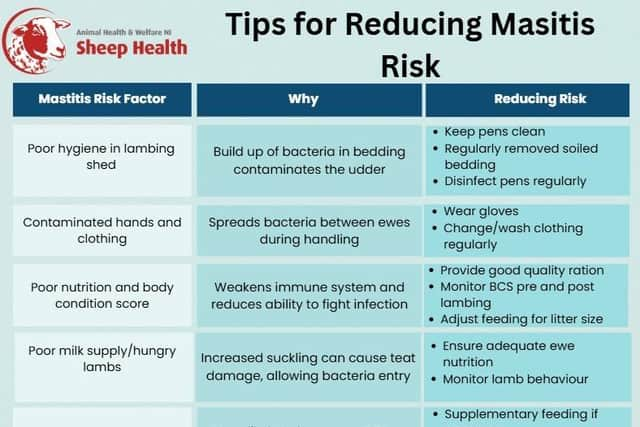
A major risk factor for ewes contracting mastitis is poor hygiene at lambing time. Mastitis can be caused by several strains of bacteria that are spread from ewe to ewe or are found naturally in the environment. If bedding is not cleaned out regularly and dirt is allowed to build up on the surface this will result in the multiplication of environmental bacteria which then increase the likelihood of udder contamination.
As well as keeping the environment clean, think about other risks of spread. Human hands and clothes can become contaminated with bacteria when working with other ewes. Ensure gloves are worn at all times during the lambing season and that clothing is regularly changed farand washed.
Nutrition and Body Condition Score (BCS)
While it may be too late for most flocks to improve on this now, adequate nutrition and a good BCS are essential factors for reducing mastitis prevalence in your flock. Ensuring that ewes are fed an appropriate ration that meets their requirements for energy and protein, especially at lambing, will aid in their ability to fight off infection. A ewe’s natural immunity tends to drop off a few weeks before and after lambing, leaving her more susceptible to diseases such as mastitis during this period.
If a ewe is not fed sufficient protein, or she has a poor BCS, the mammary gland will fail to develop fully and less milk will be produced. This will result in hungry lambs that may damage teats due to an increased frequency of suckling. Damaged teats mean that the ewe’s natural defence barriers will not be fully effective, and so the damaged areas may provide a direct entry route for bacteria to enter and infect the udder.
Older ewes also tend to have poorer BCS, and can be more susceptible to disease.
Udder Confirmation
Udder conformation and teat position can have an effect on mastitis incidence. Ewes (often aged ewes) with low udders, drooping to the ground, have been found to be more prone to mastitis. As they are closer to the ground and tend to have a large surface area they are more likely to come into contact with environmental bacteria when these ewes are standing up and lying down. These udders can also be difficult for lambs to suck, leaving milk in the udder which may lead to mastitis and increased teat trauma which can lead to infection in the udder.
By culling aged ewes and ewes with poor udder conformations, the flock incidence of mastitis may be reduced.
Isolate Ewes and Lambs
Immediately isolate any ewes that have mastitis along with their lambs. Some causes of mastitis can be highly contagious. Ensure ewes and lambs are isolated even if they are out in the field. Not only will this make treatment easier, but it will reduce the risk of cross suckling from other lambs in the field which could lead to the spread of mastitis.
Treat Promptly
Finding cases early and treating as quickly as possible will aid success in recovery. It is recommended that mastitic ewes are treated with antibiotics and anti-inflammatory medication (to provide pain relief and reduce inflammation of the udder). You should discuss with your vet the selection of which antibiotic to use. Frequently selected antibiotics are amoxicillin and oxytetracycline. If possible, taking a milk sample to identify the bacteria present can be useful, particularly for first mastitis cases of the season. Samples need to be taken before treatment. Wear clean gloves and use disinfectant wipes to clean the teats before collecting a sample into a clean pot. The laboratory results can be useful in deciding on the course of treatment for affected ewes in the flock, as in addition to identifying the bacterial cause, they can identify antibiotics to which the bacteria will be sensitive.
Be Aware of Sub-Clinical and Chronic Mastitis Cases
Most farmers will detect mastitis at the acute stage, when clinical signs are clearly visible. However, mastitis can be present in a few different forms, that may not necessarily show through obvious clinical signs.
Sub-clinical mastitis is commonly caused by bacteria of the Staphylococcus and Streptococcus species. There are usually no visible changes seen to the udder, but it affects the ewe by reducing milk yield. This can result in under-performing lambs which then take longer to achieve their finishing weight. Sub-clinical mastitis can be detected by a high somatic cell count (SCC) in the milk, but of course this isn’t always practical in a sheep flock.
Chronic mastitis differs from the acute version of the disease. Swelling will reduce and ewes may appear healthy again, however parts of the udder tissue may be permanently damaged, forming hard lumps known as palpable intramammary masses (IMM). The ewes may still milk well despite these. IMM can be missed and only noticed if examination takes place at weaning or pre-tupping, or is sometimes not noticed until the ewe has lambed if inspections are not carried out beforehand. These lumps can act as a reservoir of infection, leading to transmission to other ewes in the flock. Therefore, it’s essential to spot these cases and cull the affected ewes.
Mastitis is Not Always Bacterial - Ensure You Are Correctly Diagnosing the Cause
While the most common cause of mastitis is bacterial, mastitis can be a symptom of the virus and iceberg disease- Maedi Visna (MV). Mastitis caused by MV will usually look like chronic mastitis; the ewes will have hard, lumpy udders with little milk. Other symptoms that accompany MV are respiratory disease and chronic wasting. If you have noticed a significant number of cases of chronic mastitis in your flock, especially if acute mastitis isn’t common in it, it may be beneficial to carry out a blood test to test for MV. There is no treatment for this disease, therefore once it has infected a large proportion of your flock it can result in huge production losses. The disease has a long incubation period: clinical signs are usually only seen in older ewes, and it will eventually lead to death.