
Good news for the countryside: Trusting in the invisible parts of farming and life
Every fortnight people from a farming background, or who have a heart for the countryside in the Presbyterian Church in Ireland, offer a personal reflection on faith and rural life. They hope that you will be encouraged by it.
Leaving spring behind us, and the year picks up a pace as we enter the first of the summer months, we are fast approaching the middle of 2026. While not wanting to wish my life away, it is a fact that in three months’ time we would have crossed autumn’s threshold.
When we think of colour in the countryside, and autumn’s palette in particular, what may come to mind are the orangey-reds and burnished golds, mixed through with the rusty browns of the turning leaves that gives autumn its glorious melancholic feel, as winter approaches.
All of which is a good while off, but as I’ve driven up and down the Ards Peninsula this spring, I have been really taken by the colour and tones of the deep richness of the soil. From the light dusty beige to the deep earthy browns of the land, perfectly ploughed over small rounded drumlins – and the snow?
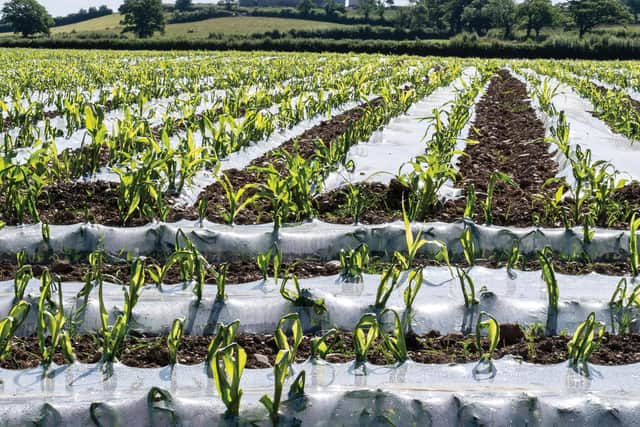

But at 20 o C it wasn’t snow. Hugging the shore of Strangford Lough a few miles north of Greyabbey, as I approached two fields from a distance, they twinkled and sparkled snow-like in the springtime sun.
As I passed, there were rows of rustling film a metre or so wide, running east-west over the fields. Surprised as I was, what seemed to be ‘snow’ clearly wasn’t, and what it covered was a mystery. Following a bit of research, I discovered that growing invisibly under the biodegradable film was probably forage maize - being helped along in its warm artificial environment.
As the maize shoots up through the drilled holes in the film, what was invisible to me will soon be revealed. Much of farming is for a time unseen - from the germinating seeds in those deeply ploughed covered furrows, to the lambs that were born during the recent lambing season – all invisible until it is time.
For many, faith is like that - if it can’t be seen, then it can’t be real. For the believer, that isn’t so. In the Bible’s New Testament, the writer to the Hebrews tells us, “Now faith is confidence in what we hope for and assurance about what we do not see” (Hebrews 11:1).
Through faith, a follower of Jesus has confidence in God’s promise of salvation through his risen Son, Jesus, who broke the power of sin and death over us forever by his own death and resurrection. We also have the assurance of what is to come, an eternal life for all who believe in him. We know a knowable God, and he knows his children.
Yet even one of Jesus’ closest followers doubted. When Jesus appeared to his disciples after his crucifixion, Thomas wasn’t there and could not bring himself to believe something that he had not seen.
A week later, Thomas was there when Jesus miraculously entered the room again. He saw the nail marks in his Saviour’s hands and the wound in his side, declaring to him, “‘My Lord and my God!’” (John 20:28). In a wonderfully reassuring reply, Jesus told him, ‘Because you have seen me, you have believed; blessed are those who have not seen and yet have believed’ (v29).
While what I saw on the A20 wasn’t snow, I have come to believe that growing unseen in its cosy biodegradable tunnel was maize. It is real and will one day reveal itself, just as I pray that Jesus will one day reveal himself to you, and as he told Thomas, you will be blessed – forever.
Before coming to live in Belfast over 40 years ago, Mark grew up in a village in rural Sussex, coming to Northern Ireland in his late teens. He is a member of Bloomfield Presbyterian Church in east Belfast and the Presbyterian Church in Ireland’s press & media officer.
If you would like to talk to someone about any of the issues raised in this article, please email Rev Kenny Hanna, PCI’s Rural Chaplain at [email protected] or call him on 07938 488 372.