
James Henderson is BGS Grassland Farmer of the Year 2025
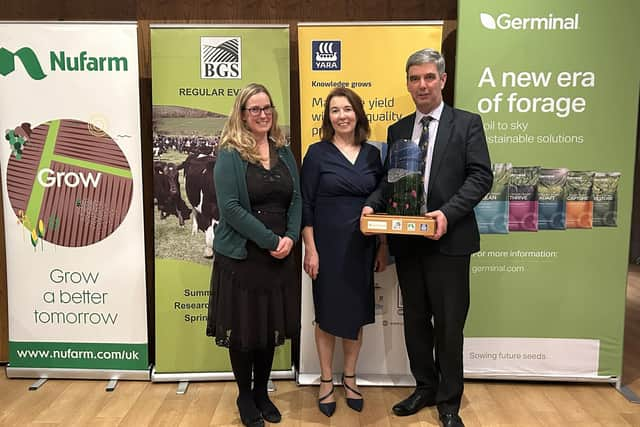
Kilkeel man James Henderson, from Ulster Grassland Society, has won the British Grassland Society Grassland Farmer of the Year competition for 2025.
The announcement was made at an Awards Evening held at The Celtic Royal Hotel, Caernarfon on 22 October 2025, jointly hosted by BGS and Anglesey Grassland Society. The competition is supported by Germinal, Nufarm and Yara. Mr Henderson wins the trophy which he will keep for a year, a cheque for £500 and will be part of the judging team in 2026.
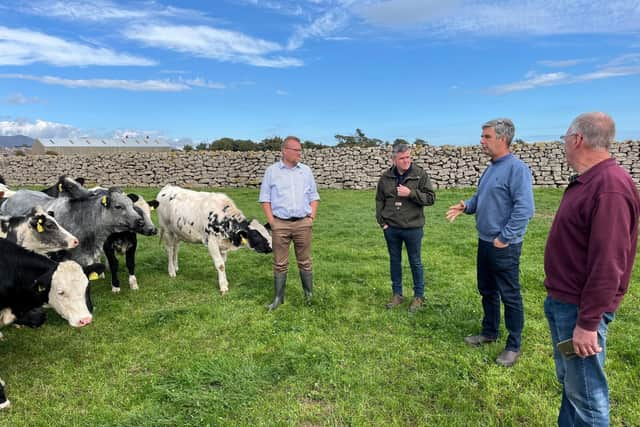

James Henderson is the fourth generation of his family to farm at Seafields Farm, Kilkeel, County Down. The farm was used as an airfield in World War 2 but now extends to 61 ha (149 acres), most of which is long-term leys.
The beef system utilises calves from the dairy herd. In October-November, 85–90 heifer calves, mostly British Blue and Aberdeen Angus crosses, are bought in at two to three weeks of age. When grazing, cattle are kept in two mobs based on age, using a two-day paddock system. Native breeds finish off grass during their second grazing season, whilst continental crosses are housed for a further 30-40 days and fed silage plus a barley-based home-mix. Cattle are sold around 20-24 months, at 350 kg carcase weight.
The sheep flock of 220 ewes and 60-70 home-bred ewe lambs is in transition to becoming Aberfield-Belclare crosses. Meatlinc and Primera rams are used as terminal sires. Post lambing, sheep graze three to four day paddocks. Ram lambs are finished on forage rape and perennial ryegrass swards, with 200 g/d of home-mix. Ewe lambs are grazed on herbal leys and red clover aftermaths, with no concentrates. The average age at sale is 168 days, with a carcase weight 21.5 kg.
Grass is measured using a rising plate meter and AgriNet software is used. Three cuts of both grass silage and red clover silage are taken each year. Reseeding is carried out approximately every ten years. Farmyard manure, or seaweed from the neighbouring beach, are incorporated into the soil. Following ploughing, winter barley is planted, forming the basis of the home-mix ration for all stock on the farm. Post-harvest, either a herbal ley or red clover is established.
Seafields Farm is part of the GrassCheck project and has been a Technical Demonstration Farm for CAFRE since 2020.
Head judge Graham Parks described Seafields Farm as a traditional Northern Ireland family farm with the potential to grow plenty of grass and utilise it very efficiently with dairy beef and sheep enterprises. There is exceptional attention to detail.
One of the highlights was how James used data to inform management decisions to drive animal performance. The grassland management ethos on the farm was summed up well by James when he said, “We were a farm which kept cattle and sheep. Now we are a grassland farm where beef and sheep keep us.”
The runners-up in the competition were Mike and Caroline Hawking (Bude Grassland Society) and James Witter (Cheshire Grassland Society).
Mike and Caroline Hawking are the third generation to farm at Highweek Farm, Beaworthy, Devon. They have recently installed solar panels on the cubicle shed and have commenced work on a new slurry tower and slurry separator. Cow numbers have increased to 197 autumn calving pedigree Holstein Friesians. Average milk yield is 9726 litres/cow with 33% from forage. The fat and protein contents of the milk are 4.50% and 3.53% respectively. The 94 ha (230 acre) farm is mostly long-term leys with some permanent pasture, a herbal ley, and around 25 ha (60 acres) of maize. Up to four cuts of silage are taken each year, with the first at the beginning of May.
James Witter from Wheelock Hall Farm near Sandbach, is also a third generation dairy farmer. Most of the 283 ha (693 acre) forage area is long-term leys, with some permanent pasture, short-term leys and around 40 ha (98 acres) for wholecrop silage. The majority of the 525 cows are Holstein Friesian, with ten Jerseys. Cows are split into two groups - spring and autumn calving. The average yield is 8509 litres with 46% from forage. Fat and protein contents are 4.12% and 3.39% respectively. Pre-mowing is utilised widely across the grazing platform. The aim is to make five cuts of silage annually with all work done in-house.