
Rain now required in many parts of the UK to maintain crop growth
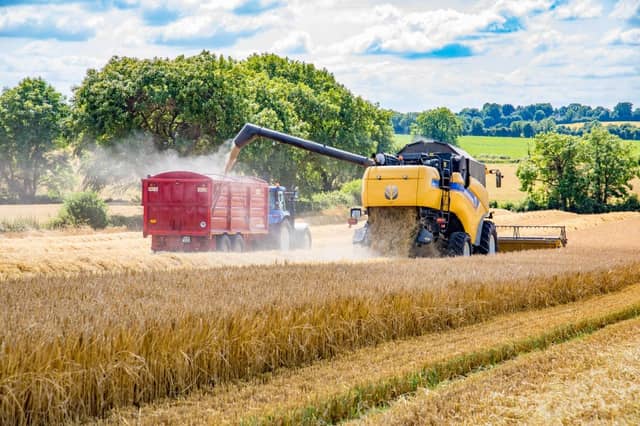

The Agricultural and Horticultural Development Board (AHDB) has published its latest crop development report for the UK.
And it makes pretty good reading for growers.
This has been one of the best recent years for spring planting: drilling of spring wheat, barley, and oats was completed during March and April.
However, challenges have been noted with spring oilseed rape drilling, and areas not yet planted are likely to be switched to other crops.
Overall disease pressure for all crops remains low.
However, the dry conditions are
beginning to affect crop development.
Some spring barley and spring oat crops also needed to be re-drilled in some areas.
Meanwhile, winter oilseed rape has been replaced with spring linseed in some areas of severe pigeon damage.
From March to early April, conditions were dry, with UK average rainfall below the long- term average. Eastern England had just 6mm of rain in March, making it extremely dry.
By mid-April, rainfall returned although there were substantial regional differences with the South West experiencing higher levels, while the West Midlands saw comparatively little.
Prior to the mid-April rainfall crop growth had stalled. However, since the rain, crops that received rain have begun to develop.
Some winter barley is now well ahead of its usual growth stage.
In the West Midlands, where following 10 to 20 mm of rainfall, nitrogen is now being taken up and crops are showing signs of recovery.
In the far north of North East England, conditions remain very dry with no recent rainfall and crops are showing signs of stress.
Meanwhile, in the East Midlands, barley has been irrigated where water resources are available. Parts of Scotland also received less than 10mm in April.
It’s also worth noting that the withdrawal of the Sustainable Farming Incentive (SFI) in England to new applicants has led to an increase in the retention of very poor crops.
These crops would otherwise have been taken of production and the land entered into the scheme.
Wheat
Winter wheat crops are picking up in regions that had rainfall. Overall pest and disease pressure is low with the exception of yellow rust where T0 fungicides were not applied. Growth stages typically range between growth stage (GS) 31 and GS32.
At the end of April, 60% of the GB winter wheat crop is in excellent or good condition. This is down from 67% at the end of March but still well above the 45% reported a year ago (end-April 2024).
But the proportion in excellent or good condition is still below the 88% recorded in April 2023 and 83% in April 2022.
Spring wheat drilling was completed in April, but dry weather has resulted in slow early development.
Most growth stages currently range between GS20 and GS29.
Winter barley
Winter barley is developing rapidly, with flag leaves emerging when plants are still only around two feet tall.
Growth stages typically range from GS33 to GS37.
An estimated 68% of winter barley crops are in good to excellent condition at the end of April, down slightly from 70% last month and notably below April 2023’s 90%. However, the rating is still well above the 56% a year ago.
Spring barley
While an estimated 1% of crops are still to emerge, 74% of crops were in good or excellent condition at the end of April.
Comparisons to previous years are not meaningful due to the larger areas that were yet to be planted or emerge. Dry conditions are beginning to impact crop development.
Oats
At the end of April, 72% of winter oats were in good to excellent condition, down only one percentage point from the end of March. It is also still well above last year’s 53%.
While the proportion in good or excellent condition is below April 2022’s 85% or March 2023’s 81%, it’s by a smaller margin than other winter cereals. Growth stages are typically between GS31 and GS32.
Spring oats are growing well. Most crops (73%) are tillering, though there a few crops at GS30 and GS31.
Oilseed rape
Most winter oilseed rape crops have now reached the yellow bud stage and are starting to flower, with the most advanced already at mid-flowering. Crop condition is variable, but in general crops look very good in the absence of feeding damage. Overall, 59% of winter oilseed rape is in a good to excellent condition at the end of April, up slightly from 57% at end-March.
This is also notably above the 47% seen at this point last year, but below the levels seen in April 2022 (70%) and April 2023 (66%).
For spring oilseed rape, most of the crop has only recently emerged, and there remains a notable proportion of crops still to be planted or emerge. There are reports of farmers substituting spring oilseed rape with spring linseed, and remaining unplanted areas are likely to be replaced with alternative spring crops.
In contrast tillage farmers across the island of Ireland have enjoyed a favourable spring so far, with approximately 60mm of rainfall recorded over the second fortnight of April.
Disease levels within Irish crops remain low.
However, the growing threat of yellow rust in many parts of the country is giving considerable cause for concern as is the first confirmation of glyphosate resistance within an Italian ryegrass population.
Teagasc
Meanwhile, Teagasc’s latest crop report makes for positive reading where both winter and spring cereals are concerned.
Winter barley has good yield potential with good shoot numbers this season. Earlier- maturing barley varieties such as Joyau and Integral are at or near the awn emergence stage.
Other varieties will reach this stage within the next 10 days. Recent favourable growing conditions have helped crop recovery following the final application of plant growth regulators.
Disease pressure remains low overall.
However, some mildew has been reported, especially in fields where there was a long interval from the first fungicide. Ramularia will be the target of the final fungicide in the next 10 days.
Spring barley has had an excellent start to the season with excellent establishment and good growth in recent days. Early sown crops are well into tillering and weed control is the priority as weed size increases.
It is very hard to make a case for insecticide use for Barley Yellow Dwarf Virus (BYDV) this year given the March sowing dates and rapid growth of crops.
Most crops now have leaf 3 fully emerged with leaf 2 at the 50-75% emerged stage. This is depending on the variety and sowing date.
Many crops have already received a leaf 3 fungicide while the remainder will receive it over the coming days. Crops have greened up well in the last few days after the recent rains.
Most are generally clean but there are some reports of mildew in Isabel. Most crops are between Growth Stage (GS) 32 and 37 at the moment, although some late sown crops are still at GS 32.
The 2025 Teagasc crops open day is planned for Wednesday, June 25 at the Teagasc Crops Research Centre in Oak Park, Carlow.
This year’s event will cover the latest research on all the main tillage crops and horticultural field crops.
It will also include a major machinery demonstration, with a particular focus on sprayers and the technology available for more accurate applications.
In general terms, cereal crops currently growing in the UK and Ireland retain significant yield potential. However, rain will be required in a number of areas over the coming days in order to retain this upward trajectory.