
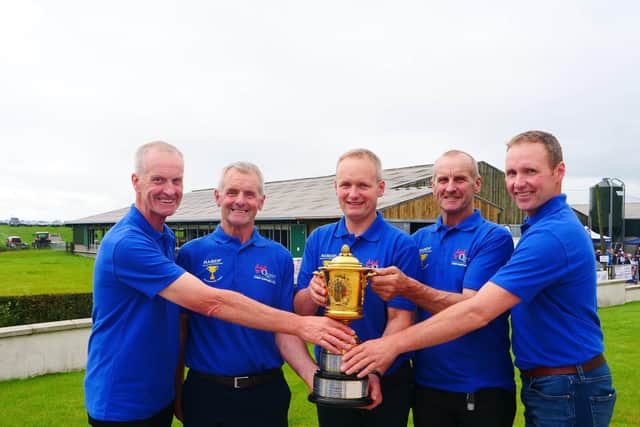
Successful open day for the Logans as they celebrate their Gold Cup win
Over 600 visitors made the trip to visit the Logan Family’s Gold Cup Open Day, held in Northen Ayrshire last week (10 Aug).
Holehouse Farms isn’t necessarily the typical type of farm you’d associate with dairy farming, let alone a Gold Cup winning dairy farm, given its location in a testing region of the country. The large crowd that gathered last week is testament to the achievements of the Logan Family.

Open to the elements, the farm has adapted to ensure it can continue dairy farming in a sustainable, progressive and profitable way. Visitors on the day were able to hear from industry specialists who have played key roles in this success through a series of talk stations.
Michael Fallon, MBM Veterinary Group, who is the farm’s clinical director, outlined how the herd has evolved genetically over time and how this process has been closely linked with genomic testing. Whilst specific to individual farms he outlined what breeding aims the Logans’ look for to ensure their cows are as successful as possible.
Rhona McAlister, from animal health company Zoetis, discussed how to breed for a sustainable dairy herd. She explained how initially you need to look at your breeding concepts, all of equal importance, and that, if implemented correctly all contribute to the desired outcome – keeping only healthy heifers who will be profitable to your business.
“Rearing costs – replacements and therefore heifer rearing, is the second or third largest variable cost to a dairy business – with it often taking until second lactation for a heifer to pay back her rearing costs,” says Ms McAlister.
Heifer genomics contribute greatly to overall profitability and sustainability and allows farms to make decisions earlier with more targeted investment into other resources then being possible. By accurately describing genetic potential differences genetic selection decisions are more likely to impact profitability and allowing the herd to make the most out of its best animals.
As explained by Ms McAlister it is clear to see the increase in the rate of genetic improvement when both sire and female genomics are used.
“A selection index brings simplicity and convenience to multi-trait breeding goals by creating one value for producers, weighting each trait, and combining information on a number of traits accounting for the relationship between traits.”
Other speakers included CowManager’s European account manager, Marc van Mensvoort, who highlighted the benefits of monitoring your herd with software, if you want to improve overall efficiency and performance.
RABDF managing director, Matthew Knight, said it was a great day for the industry, celebrating the best of the best when it comes to dairy businesses.
“It was humbling to see such a great crowd of people turning up on the day to support the Logan Family and the industry. With the ever-increasing challenges facing us as a sector it’s important to remind ourselves we are stronger if we work together.”
For further information on the day please visit www.rabdf.co.uk