
Teagasc director reflects on another challenging year for crop production
Teagasc director, Professor Frank O’Mara has highlighted the continuing challenges that face the tillage sector in the Republic of Ireland, writes Richard Halleron.
He is also confirming the need for government to step in and provide a bespoke support package for the industry.
Speaking at Teargas’s 2026 national Tillage Conference, he confirmed that last year saw a recovery in grain yields relative to 2024,adding: “However, grain prices fell by 10% year on year.
“Overall tillage farmers achieved a net margin of €270/ha in 2025 across all the cereal crops they produced, relative to the previous year. This figure represents a €35/ha increase on that recorded in 2024.

“However, it is still a very challenging result, given the high level of investment required in growing all tillage crops.
“And, unfortunately, the outlook for 2026 is not much better. Input prices are rising while grain prices remain in the doldrums.”
According to Frank O’Mara, Irish grain is a top quality feedstuff. This reflects the very high inherent value of our grains, the exceptionally low carbon footprint of the sector as a whole and the high standards of traceability that are achieved by the industry.
He continued: “But it’s all about adding value. Exports from the Irish drinks’ sector are valued to €2billion per annum. Inherent within all of this is Ireland’s clean, green image and our sustainable production systems.
“Meanwhile tillage land is an extremely important resource when it comes to the best utilisation of the slurries and manures produced by our livestock sectors.
“Straw is another import output from the tillage sector while crops such as maize and fodder beet continue to represent extremely valuable forage sources on dairy and other ruminant livestock farms.”
Meanwhile, new research will continue to drive the tillage sector forward with Teagasc playing a key role in this regard.
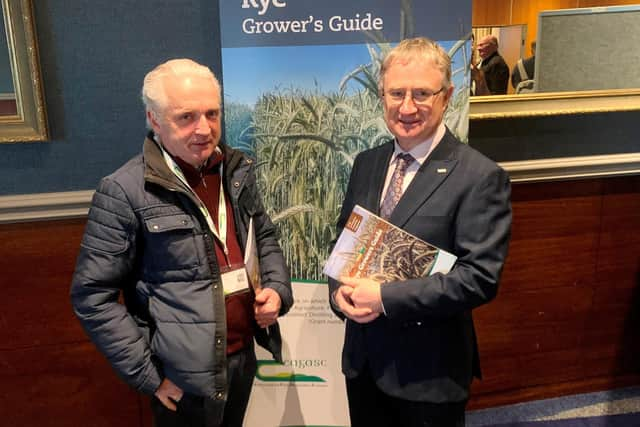
Frank O’Mara specifically referenced the backdrop of the conference being used as the launch pad for a new Hybrid Rye Growers’ Guide.
He concluded: “The tillage sector continues to drive very high levels of economic activity. This includes the purchase of inputs, the high utilisation of contractors by farmers and those providing professional services to the industry.
“The end result is a tremendous contribution to the viability of our rural areas.”
The future for hybrid rye
Teagasc is indicating that approximately 5.000ha of hybrid rye were planted out last autumn: up from the 500ha figure of 2020.
Teagasc crop scientists, Dr. Richie Hackett commented: “Increasing numbers of Irish tillage farmers are now recognising the benefits of rye within a crop rotation.
“It is a high yielding crop with an enhanced level of inherent resistance to Take-All and
Barley Yellow Dwarf Virus.
“Rye crops will also make very efficient use of applied nutrients.”
While some Irish merchants remain hesitant to handle the cereal, demand continues to grow at farm level with pig farmers leading the way in this regard.
Research and commercial farm trials have confirmed that rye is a highly valuable, cost effective and sustainable inclusion in pig rations.
It acts as an excellent substitute for the likes of barley, wheat and maize. Moreover, the cereal’s high, fermentable fibre content acts to improve gut health, increases satiety and reduces aggressive behaviour in pigs.
Richie Hackett again: “It’s important that growers have customers for the rye crops they intend growing before actual planting takes place.
“And we are seeing significant evidence of tillage farmers agreeing supply contracts with pig producers to make this happen.
The Teagasc representative was speaking at the launch of a new Rye Growers’ Guide, specifically drawn up to reflect the agronomy associated with the cereal crop when grown under Irish conditions.
According to Richie Hackett, rye crops show good drought tolerance and produce high yields of both grain and straw.
The crop’s high yields and good nitrogen use efficiency contribute to a low carbon footprint and as a result rye can contribute towards lowering the carbon footprint of Irish arable systems.
Rye is a relatively new crop in Ireland in the modern era although it was grown in the past. As the area began to increase it became apparent that there was little Irish information on the agronomy of modern varieties of rye and growers were largely reliant on information from abroad.
Agronomy research on rye began in Teagasc Oak Park in 2018 in order to develop agronomy guidelines for the crop under Irish conditions.
This research sought to provide information to support the main agronomic decisions involved in producing rye. A considerable amount of the research was carried out as part of a DAFM research grant entitled ‘Distilling and Brewing–Building Capacity’.
The new publication is the culmination of the work carried out to date.
While a considerable amount of knowledge has been generated there are still aspects that will require more research going forward and as a result this guide will be updated as new information becomes available.
BYDV tolerance
There is now strong evidence confirming that claims made for Barley Yellow Dwarf Virus (BYDV) tolerance by plant breeding companies do hold up under the scrutiny of an independent trials’ process.
Moreover, the varieties of winter barley concerned demonstrate this tolerance in the context of the aphid populations and the specific variants of BYDY thar are fiund in Ireland.
As part of the 2026 National Tillage Conference, Teagasc Walsh Scholar, Jack Perry, provided an overview of research aimed at validating the use of tolerant winter barley varieties to manage BYDV in this country.
He explained: “BYDV is transmitted into barley by aphids feeding on the crops. There are three BYDV species present in Ireland: BYDV MAV, BYDV PAV and BYDV PAS, with the dominant species being BYDV MAV.
“The main species present within mainland Europe is BYDV PAV, putting Ireland in a different BYDV environment than mainland Europe.”
Although promising tolerant varieties to BYDV have become available, Jack Perry noted that much testing on these varieties has been carried out in relation to BYDV PAV in mainland Europe.
To quantify their effectiveness in Ireland against BYDV MAV, lab and plot scale trials have been undertaken at Teagasc’s Crops Research Centre, Oak Park.
Perry continued: “On the Department of Agriculture, Food and the Marine’s Recommended List, four varieties have some form of tolerance gene.
“Two of them have an Ryd2 gene and two of them have an Ryd2 + Ryd3 gene. These genes have been well studied against BYDV PAV in mainland Europe.
“But they have been under studied towards BYDV MAV in Ireland.”
Courtesy of the Teagasc BYDV study, five different winter barley cultivars were examined: one susceptible and four with tolerant genes present.
“In laboratory studies, susceptible varieties had higher transmission scores than all four tolerant cultivars, which was to be expected.
In the field and working off average yields from harvests in 2024 and 2025 the trial results are confirming that tolerant varieties; when left untreated with insecticide; showed lower levels of BYDV symptoms.
However, BYDV was still present within the crop.
With regard to the yield impact recorded, the Teagasc Walsh Scholar added: “Susceptible varieties that are unsprayed suffer a yield penalty of around 2t/ha, something that we expected to see. In cultivars with the Ryd2 genes, we see a much-reduced drop in yield.
“When we examined the Ryd2 + Ryd3 cultivars, we do see a yield reduction when they are left unsprayed. This is only about 1t/ha and it is less than the yield penalty we see in response to susceptible cultivars treated for BYDV.”
He concluded: “Our research has shown a proven reduction in BYDV transmission efficiency in tolerant cultivars and these tolerant cultivars maintain high yields despite visible BYDV symptoms. Tolerant varieties also show a reduced yield penalty when left without an insecticide.”
Teagasc publishes the 2026 Crops Costs and Returns booklet
Teagasc’s Crops Costs and Returns 2026 booklet serves as an informative guide, allowing tillage farmers to examine their costs of production while also forecasting potential crop margins.
The publication was launched at the 2026 Teagasc National Tillage Conference.
Many of its core themes had been alluded to by Teagasc’s team of tillage specialists prior to the event: specifically the mounting pressure on machinery and land rental costs.
A key issue well flagged-up has been the growing threat of Yellow Rust in 2026 winter wheat crops. This year’s booklet makes specific provision for a T0 spray, specifically to address the potential threat posed by the disease.
The publication provides all-embracing guideline costs for the main cereal crops, both winter and spring, along with non-cereal and forage crops such as beet, maize, potatoes, beans and peas or winter oilseed rape.
Teagasc tillage specialist, Ciaran Collins, said: “Tillage farmers are coming off the back of a challenging year for income. Although crop yields were relatively good for the most part, the price received for deliveries crossing the
weighbridge left a lot to be desired.
“Unfortunately, economists in the Teagasc National Farm Survey Department are forecasting that prices will probably remain similar to the 2025 harvest, so before committing to sow this spring, farmers really need to undertake a thorough appraisal of the costs of running their businesses."
He continued: “Within the Teagasc Crops and Returns 2026, we provide farmers with guideline costs for materials, machinery costs and fixed costs to make this task easier, but farmers must factor in land suitability, rotation, risk avoidance and husbandry skills when both setting target yields for your farm and deciding on which crop to set.”
According to Shay Phelan, variability in both costs and yields has become increasingly common on tillage farms.
Along with assessing crop margins through the Crops Costs and Returns 2026 publication, tillage farmers are encouraged to complete a full financial appraisal of their business using the Teagasc Profit Monitor and Teagasc Machinery Costs Calculator to assess the strengths and weaknesses of their tillage operation.
As detailed within the publication, machinery continues to be a significant expense on tillage farms, with Shay Phelan adding: “Investments in machinery require a thorough financial appraisal before any purchasing decision is taken. The cost of machinery is the second largest cost on tillage farms, typically about 25 – 30% of total growing costs.”