
24 hours to back farming: UFU takes final Budget message to Westminster
With just 24 hours until the Autumn Budget, Ulster Farmers’ Union (UFU) president John McLenaghan and parliamentary officer Alexander Kinnear have travelled to Westminster in a final push to ensure the voices and concerns of Northern Ireland’s farming families are heard ahead of the Chancellor’s Budget speech.
The visit forms part of the UFU’s ongoing engagement with Government and political representatives, making direct representations on behalf of its members and reinforcing the need for a Budget that recognises the mounting pressures facing Northern Ireland’s farming industry.
The UFU has warned that the challenges facing agriculture extend far beyond any single policy decision. Rising production costs, uncertainty over inheritance tax, mounting employment pressures and declining investment confidence are placing increasing strain on farm businesses across Northern Ireland.
The Union has already presented the Treasury with its comprehensive ‘A Budget to Back Farming’ submission, setting out ten key measures aimed at addressing these pressures and supporting the future viability of the industry.
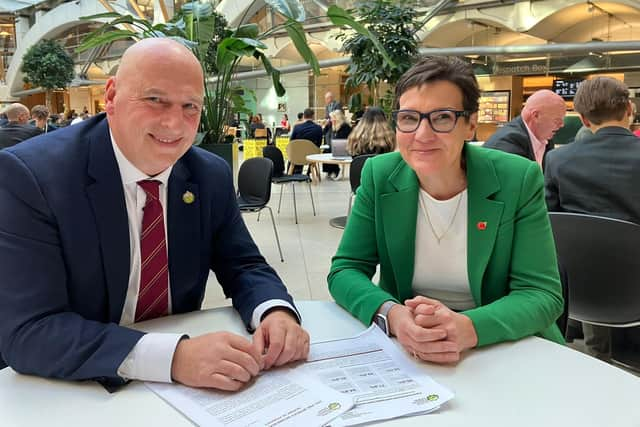

The submission is reinforced by the UFU’s recent membership research, which provides direct evidence of how financial and policy pressures are affecting farming families, business decisions and future investment, further strengthening the Union's case for Government action.
UFU president, John McLenaghan, said: “Tomorrow's Budget is an important opportunity for the Government to demonstrate that it understands the pressures facing farming families and is prepared to take meaningful action. We have spent months making the case for agriculture, engaging with Ministers and parliamentarians, and presenting the evidence of what is happening on farms across Northern Ireland.
“Our message has been consistent. Farming needs more than warm words. It needs a joined-up package of measures that restores confidence, supports investment and allows businesses to plan for the future.”
Inheritance tax remains a central concern for the Union, with its membership survey revealing that 88.6% of respondents reported increased family stress or worry because of the changes, while 71.4% said their confidence in passing on a financially viable farm had been reduced.
More than half (58.5%) expected the changes to create or increase an inheritance tax liability, while 49.2% reported that their intended successor had become less willing, less financially able, or both, to take on the family farm.
The research also highlighted wider concerns about the financial sustainability of farming, the cost of doing business and the ability of farm enterprises to continue investing, with 72.6% of respondents identifying high input costs as a barrier to investment.
The UFU’s pre-Budget submission calls for the restoration of full Agricultural Property Relief and Business Property Relief, alongside a permanent reduction in red diesel duty, index-linking Northern Ireland’s ringfenced agricultural budget, greater support for capital investment, measures to address rising fertiliser costs and scrap the proposed Carbon Border Adjustment Mechanism (CBAM), which risks placing further financial pressure on farm businesses.
The Union has also called for an uplift in Northern Ireland’s agricultural funding baseline to reflect inflationary pressures, alongside improvements to capital allowances, and reforms to the tax treatment of compulsory land purchases.
Mr McLenaghan continued: “Inheritance tax has understandably dominated much of the discussion, but our survey and engagement with members show that it is one part of a much wider picture.
“Farmers are facing significant increases in the costs of producing food, uncertainty over future taxation and growing pressure on the finances available to invest in their businesses.
“These pressures do not exist in isolation. Every additional cost, every delayed investment and every new uncertainty has a cumulative impact on the ability of a farming business to remain competitive and financially sustainable.
“The Government cannot consider inheritance tax, fuel duty, employment costs or capital investment in isolation. It must recognise the combined pressures that farming families are facing and respond with a package of measures that reflects the realities of running a modern agricultural business.”
Mr McLenaghan concluded: “Our members have told us what matters to them, and we have translated those concerns into a clear set of proposals for the Chancellor. These are practical measures designed to give farmers the confidence to invest, improve productivity, maintain domestic food production and pass viable businesses to the next generation.
“The decisions taken tomorrow will influence much more than the immediate finances of individual farms. They will help shape the future of our food supply, our rural economy and the next generation of farmers.
“The Chancellor has our evidence, the Government knows our concerns, and the measures needed to support agriculture have been clearly set out.
“Backing farming is not simply about supporting individual businesses. It is about protecting our capacity to produce food, supporting rural jobs and economic activity, and ensuring there is a viable industry for the next generation.
“Tomorrow is an opportunity to deliver a Budget to back farming, restore confidence and demonstrate that Northern Ireland agriculture has a secure place in the Government’s economic plans.”