
Brussels Notebook: The UK is continuing with the same tired EU green policies of 2016
I remember – perhaps wrongly – that buildings like Stormont and the City Hall in Belfast included in their design recognition of Northern Ireland’s great industries.
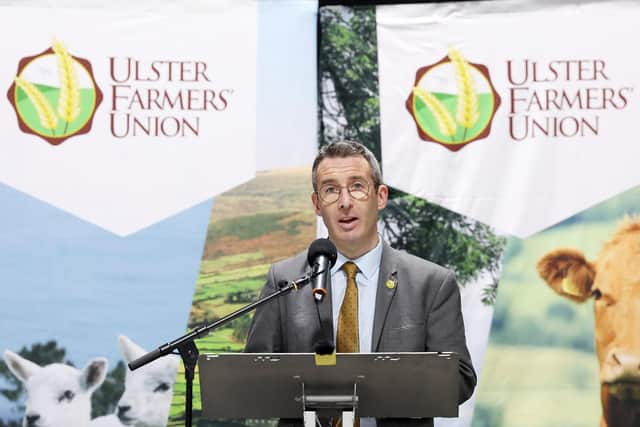
These were linen, heavy engineering and farming. The first two have gone in the form originally celebrated, but we all thought agriculture was an invincible part of the economy. This is in no small measure because it is the biggest source of employment in food and the industry that has shaped the countryside and rural society for generations. However that unique status now seems as uncertain as the fate of those other once great industries. I still find it hard to believe the Ulster Farmers’ Union’s passing of a vote of no confidence in DAERA, and by definition that has to mean the policies of the minister in charge, commanded so little political attention. That is disappointing and a reflection of how empty were the words of the many politicians that sought votes from farmers with assurances their interests would be to the fore at a local assembly. We are well used to the constitutional orange and green debate, but for farmers that debate has shifted to the environmentally green obsession of DAERA in the policies it pursues and where it focuses its attention and interest. This week the issue of Northern Ireland having a so-called independent environment agency has been doing the rounds. The claim is that this would be better than being part of wider UK structures, but no arguments have been advanced as to why that should be the case. Instead it would be another drain on the taxpayer purse at a time when there are many more important priorities; on top of that, based on comments about some recent public appointments in this area, this could be a very cold house for farmers and rural communities. The last thing they need are yet more urban focussed ideas from “experts” who lack a real understanding of the need for balance between economic and biodiversity interests. Our position over this issue is not unique. Even the Irish government has altered its priorities around agriculture, food and the environment. This was partly, indeed probably largely, driven by the demands of EU policy but that excuse does not exist here. Brexit gave the UK and by extension Northern Ireland the chance to break away from a European green agenda in favour of more practical solutions. Instead we have ended up worse off than the EU. We have a Westminster government that daily demonstrates it has no interest in agriculture and no vision for it. Here the same applies, which in the historic context of the power agriculture once had is both shocking and frustrating for all people with a genuine interest in rural areas. In the EU the greens are a spent political force; policy from Brussels is now much more farmer friendly, with a focus on the future in farming for young people and the importance of food security in an uncertain world.
The UK is continuing with the same tired EU green policies of 2016, when the Brexit vote happened. That is understandable for the rest of the UK, with its urban focus, but it is as wrong-headed here as it is possible to be. In the past, green policies were forced on us by EU diktat. Brexit ended that policy driver, but now farmers are witnessing local politicians wedded to those second-hand EU policies. They seem happy to use farmers as an excuse for disastrously poor decision making and investment failures right across the public sector. There used to be an old joke in Ireland, based on a competition by a newspaper for the most unlikely headline imaginable. The winner was a simple one – Farmers are Happy. That was a joke with a jag in the past, but now it has a more serious edge. Farmers are far from happy with politicians, which is ironic when financially the industry is doing better. This is thanks to higher global food prices and that is something for which politicians here can take no credit. A vote of no confidence in local politics was never a headline people here could have imagined, but it has happened.
Time will tell whether Northern Ireland ultimately follows others with an urban-focussed agenda.

The big question then for politicians and rural communities will be whether, as in some EU countries, that attracts sufficient opposition to drive people to stand for election on a rural fairness ticket. Watch this space.