
Foyle Agriculture Autumn Producer Event
Over 200 farmers braved the conditions on Friday 3 October and travelled to the Foyle Farms of Excellence for the annual Autumn Producer Event.
There were presentations given by Leslie Dwyer from Future Ag, Gareth Anderson, independent nutritionist at FarmGate Nutrition and representatives from Alltech.
Key areas covered in the event included precision nutrition and key performance statistics, Aberdeen Angus Superior Genetics, products for feeding soil biology and soil health improvements.
Additionally, a presentation was given by William Johnston, Group Health and Safety Manager at Foyle Food Group, before guests enjoyed a steak BBQ.

Precision Feeding through Keenan Self-Propelled Diet Feeder
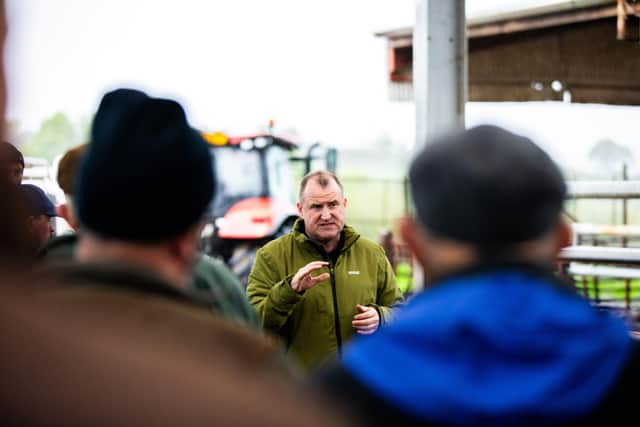
Alltech’s Adam Smyth, Regional Business Manager, discussed the key features of the Keenan Self-Propelled diet feeder, purchased for the finishing unit in early Spring. The milling head on the machine results in six times faster loading and less silage fibre destruction, leading to a reduction of feeding time by two hours overall. The NIR technology in the milling head analyses the dry matter content of the silage as it is harvested into the feeder, enabling more accurate measurement of dry matter fed per head per day.
Darragh Murtagh, InTouch Feeding specialist, also talked through Alltech’s feeding management software which allows each pen on the farm to be fed accurately based on a dry matter intake per head using the software’s pen function.
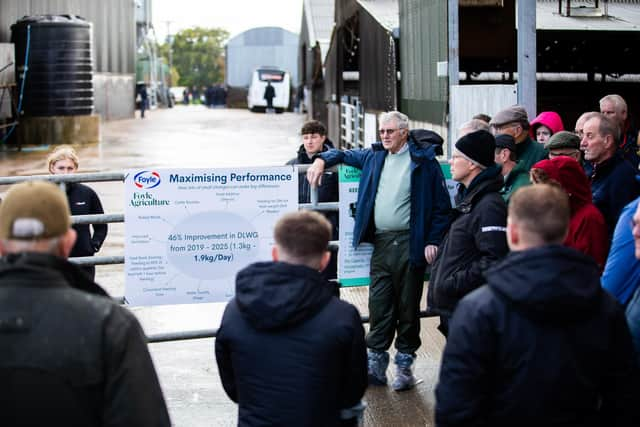
Current performance statistics of cattle being finished on the farm was summarised by Cara Moore, Agriculture Specialist at Foyle Food Group, who discussed daily liveweight gain (DLWG) improvements and the incremental management tools helping “small changes lead to big differences”.
Since 2019, DLWG of finished cattle from the farm has increased by 46% from 1.3kg/day to 1.9kg/day on average. Products such as FerAppease, toxin binders, switching from ground to rolled maize and the inclusion of a feed additive, Elensis have contributed to this increase along with infrastructure changes including better ventilation in sheds, light programmes allowing seven hours of darkness per day and cattle brushes. Similarly, simple management tasks such as consistent feeding times, cleaning drinkers more often, better quality silage and feed bunk scoring, with feed finished one hour prior to feeding, all support how performance is maximised.
Superior Genetics Programme
In terms of the Superior Genetics Programme, Andrew Clarke, Agriculture Manager at Foyle Food Group discussed the benefits of selecting breeding bull’s based on Estimated Breeding Values and terminal traits. On the Foyle Farm, the focus has been placed firmly on selecting sires with breeding values within the top 1% of their breed.
This ensures that alongside calving ease and short gestation, progeny have higher production traits and better feed efficiency. Progeny top 1% Aberdeen Angus bulls used on the farm were on show on the day, calves which have consistently demonstrated 10% performance improvements when compared to conventional sires with an average daily liveweight gain of 1.27kg/day from birth. Since the farm walk a number of these animals have been processed with an average carcass cold weight of 349kg at an average age of 522 days. This transpires to an average deadweight gain of 0.66kg/day, 34% higher than the average AA from the Foyle supply base and 50% higher than the average of all breeds within the Foyle supply base.

This highlights the remarkable advantages of using high genetic merit bulls, improved grazing and management practices and correct nutrition throughout the finishing period.
Working alongside Eamon Kelly from Aberdeen Angus Quality Beef, these top 1% genetics have been made available to producers to facilitate improved performance and efficiency within the supply base. Eamon Kelly outlined two key incentives designed to support producers of Aberdeen Angus cattle. A payment of up to £900 is available toward the purchase of high genetic merit bulls, provided they meet the qualifying thresholds for both terminal and maternal indexes. Secondly through Foyle’s Superior Genetics Program, producers supplying Aberdeen Angus cattle to the scheme can gain access to semen from top 1% bulls, further enhancing the genetic potential of their herds. Contact Eamon Kelly on 07813176939 for more information.
Soil health improvements at Foyle
There was a focus on soil health from Catriona Marshall, Agricultural Innovations Specialist, with a focus on the improvement achieved on the Foyle farm over the past 12 months with earthworm counts increasing in a 400mm² sample area from 13 to 33, a 154% improvement. Catriona highlighted the importance of earthworms within soil to improve nutrient cycling and alleviate compaction resulting in better drainage and soil structure.
Furthermore, the monitoring of Brix readings within the soil has shown a 40% improvement between 2024 and 2025. Brix readings directly indicate a plant’s health and nutritional status and also relates to their resistance to pests and diseases. It is a measure of the total soluble solids in plant sap with a higher Brix level indicating a well-nourished plant able to produce robust structures and a strong immune system.
Feeding the soil with Tow and Fert
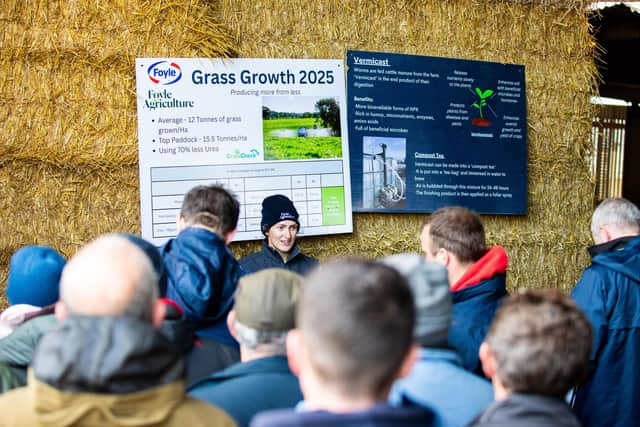
Leslie Dwyer, managing director at Future Ag, explained soil health further and the benefits of getting the correct mix of fertiliser applied to your ground. Leslie highlighted Foyle’s continued improvement in soil health coupled with a reduction in fertiliser use since purchasing the Tow and Fert machine. A 70% reduction in Urea application and the incorporation of alternative products has helped to reduce costs and improve grass growth. This has been achieved through the use of foliar-applied nutrients, allowing more efficient uptake through the leaf and reducing overall chemical input.
Over the past year, Foyle averaged 12T DM/Ha of grass growth, on just 42 Kg N/Ha split over 3 applications. The foliar mix included biologically enhancing products such as seaweed, humates, molasses, and limeflour, supporting both plant growth and soil microbial activity. Leslie also noted that Irish grassland soils have up to 7000 Kg N/Ha stored in organic matter, and that the Tow and Fert system helps stimulate the natural release of this nitrogen, improving soil health, reducing fertiliser costs, and supporting more sustainable grass production.
Keynote Presentations
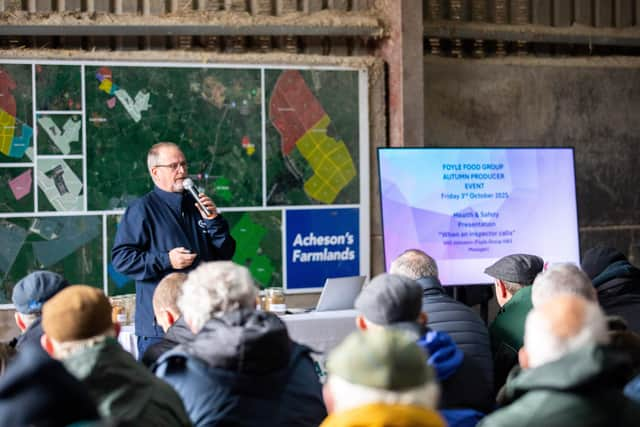
Following the farm tour there was presentations from William Johnston, Foyle Food Group Health and Safety Manager and a member of the Northern Ireland Safety Group on the importance of farm safety. There was a focus on the risks associated with dust inhalation and the importance of suitable PPE specifically FFP3 masks to filter out dust.
There was a further presentation from Gareth Anderson an independent nutritionist at FarmGate Nutrition who is responsible for the diet formulation on the Foyle farm.
He spoke on the importance of good nutrition through measures such as maximising silage quality in achieving high DLWG and performance on farm. He also highlighted the importance of non-nutritional factors including regular cleaning of water drinkers and consistency in feed timing and quantities.
He also discussed minerals and feed additives including Glycopass, RumenAid 250, Rumenate and Elensis used on farm.
There were also donations collected on the night towards the work of the Air Ambulance Northern Ireland with over £1,500 raised.