
Humility is definitely not a card that Trump knows how to play
With a suggestion that he is happy to continue the blockade of Iranian ports Donald Trump sent oil prices to a new spike.
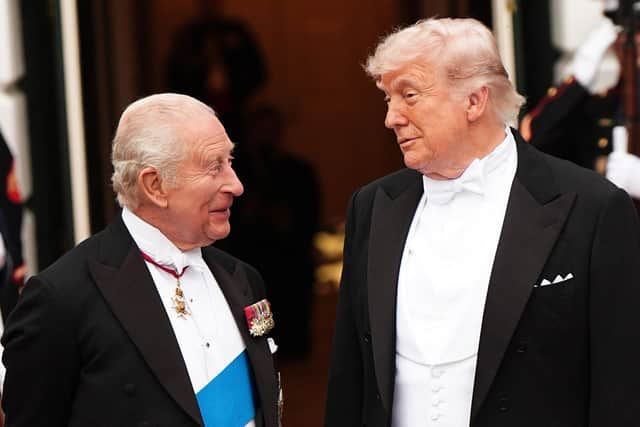
This doubtless helped some of his supporters who have successfully taken trading positions to benefit from such announcements. This bizarre suggestion that the best way to open the Straits of Hormuz is to keep them closed came after he claimed King Charles would have supported the UK backing the US in the Iran war.
People here will see that as a comment so facile that it underlines Trump’s growing detachment from reality. But some Americans will believe his latest efforts to explain why he is globally isolated over his approach in Iran and his failure to end the conflict.
Humility is not a card he knows how to play – but any negotiator would tell him he cannot have a peace deal while claiming victory.

That he should know from his boastful and largely unreadable Art of the Deal book. Politics aside this is all leaving things even worse for agriculture.
Input costs are set to remain high in the absence of a peace deal to get world trade flowing again.
It was interesting this week that the UAE (United Arab Emirates) said it would leave the oil suppliers’ cartel, OPEC, so that it would be free to produce and sell as much oil as possible to recoup losses the war brought.
This points to a fall in energy costs, if only a sensible deal to end an ill-conceived conflict can be found.
In response to the crisis a number of countries, including Ireland, are stepping in with support schemes for farmers. The Irish government reduced all fuel duties a few weeks ago and this week it introduced new measures specifically aimed at farmers and agricultural contractors.
The support is targeted at green diesel – the Irish equivalent of our red dye – and with the weather driving a catch up in field work this comes at an opportune time.
In total Dublin is spending 500 million euro to ease fuel prices, with 100 million going to agriculture, based on a farm or contractor’s use of diesel last year.
On top of this a planned increase this month in a much loathed green carbon tax has been dropped until at least the autumn budget. At the same time the European Commission has eased state aid rules to make it simpler for governments to step in with support.
It is allowing member states to help with up to 70 per cent of the rise in fertiliser and fuel costs compared to last year.
This effectively gives member states free rein to act, with the only limitation how deep their financial coffers are at a time when many economies are suffering the fallout from a global slowdown.
It however gives farm lobby groups an agenda to pursue, unlike the situation here where aid for agriculture is not even on the agenda in any meaningful way. Irish farmers would have liked more, but this is a nonetheless good outcome from intense lobbying.
There is a key difference that allowed Ireland to be generous.
It has a multi-billion euro budget surplus, thanks to a surge in corporation tax payments by foreign direct investment companies.
By contrast the UK has a weak economy, no control of spending and a mountain of government borrowing getting worse by the day.
In this situation there is little point in farmers seeking support, because neither the funding or a desire to help, by reducing fuel duties, exists at Westminster where these decisions have to be made.
That leaves farmers facing a tougher summer and winter than their counterparts in other European countries or indeed Ireland as its nearest neighbour. While the farming lobby is still seeking support with input costs it knows deep down that funding will be targeted elsewhere.
For the Westminster government its priority is to help families already on welfare, rather than businesses.
This means that when the dust settles the economy and job prospects will be even worse, but with a prime minister already under pressure from his backbenchers this is a government that puts maintaining an already bloated welfare budget ahead of all else and certainly ahead of long term planning for a growth-driven economy.