
Watch: 'Every single policy, every practice on Lough Neagh needs to be under urgent review'
The destruction of Lough Neagh has become a major issue for John Blair - and he knows that clearing its water will be a lifetime commitment.
"Interestingly, I have colleagues here in Antrim who would tell you that when they were young in Antrim - going back 50 years - they can remember times when the water at Rea’s Wood was full of algae," he said.
Adding he is not a scientist, the AERA committee member said properly addressing the situation could take “20 or 30 years” but “it follows logically that the more effort you make now, the more quickly you might see results”.
Mr Blair said he is also aware of how the condition of the water has impacted businesses, dog walkers, fishermen, and fresh water swimmers.
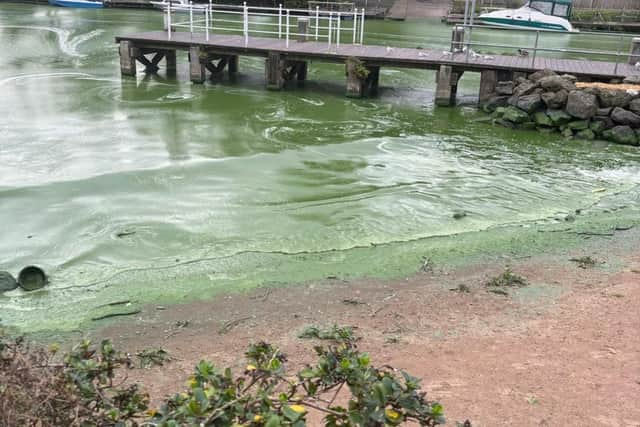

"Even before I got my office in Antrim in 2022, I was dealing with constituents whose dogs who had died after entering water in Lough Neagh at Rea’s Wood.
(Rea's Wood is a protected National Nature Reserve and Special Area of Conservation (SAC) located in Antrim).
"At the start we had conversations with the local council from an environmental health inspection point of view.
"Then in 2023 the blue green algae emerged and choked the lough, killing the wildlife and bringing the worlds attention to it.
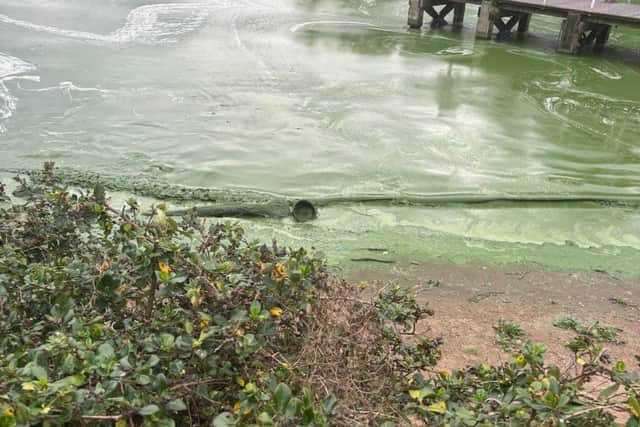
"Locals who have lived in the area more than 60-years had seen algae in the area before and said they always knew when not to swim in the water."
Mr Blair who has a background in "inland fisheries" said he needed to "follow the science" rather than "pretend to be a scientist".
"I can tell you now that 10-12 years ago, DAERA was shutting down lakes, in Hillsborough and Castlewellan and some others scattered around the country, because of blue green algae in the late summer or the autumn.
"So it's not a new phenomenon. But I would only say that in 2015, and a number of times in years before it, the fishing lakes in Northern Ireland were being closed for periods of the late summer, early autumn because of algal blooms".
The quantity of algal blooms then made headlines when they re-emerged in Lough Neagh in 2023 – bringing problems to the environment, local communities, water quality and local wildlife.
"It's symptomatic of how we treat our environment when we allow industry, whatever industry that is, to do whatever it wants,” he said.
"Quite often, with exceptions or exemptions or a bye-ball given.
"There are millions upon millions of tonnes of sewage and pollution pumped into the lough every year by Northern Ireland Water.
"Their monitoring stations are nowhere near the capacity they should be,” he said.
Mr Blair said through his role in the AERA committee he will ‘continue to ask Northern Ireland Water if they are reprioritising and reprofiling work to ensure that whatever resource they have is put into the biggest crisis we have environmentally?
"I don't think it's unreasonable to ask them to show me how they have reprofiled work on Lough Neagh, whether that's hard cost resource or resource in staffing terms.
"I know that every single policy, every single practice on Lough Neagh needs to be under urgent review, and continually reviewed.
"So whether that's recreational boats, whether it's fishing, whether it's farming, the impact needs to be reviewed.
"I'm not suggesting for a moment that all of those things cause a problem and I am certainly not suggesting that they all cause an equal problem – but hopefully that kind of focus will help.
"That focus is all part of the Lough Neagh Action Plan – so I’m satisfied that most of those things are being looked at in some detail.
"But what we need is the political will to bring this forward."