
Recognisable names and being part of a bigger family
Every fortnight people from a farming background, or who have a heart for the countryside in the Presbyterian Church in Ireland, offer a personal reflection on faith and rural life. They hope that you will be encouraged by it.
Traditionally, varieties bred by AFBI at Loughgall are given Northern Ireland place names. Over the years these have included Galgorm, Ballintoy, or Gracehill. Each one means that there is instant recognition by local farmers. Other plant breeding stations throughout the United Kingdom adopt different prefixes so that their varieties can easily be identified by prospective customers.
On several occasions, as part of my work, I visited the famous Plant Breeding Institute at Maris Lane, Trumpington near Cambridge. Traditionally, all their new varieties had the ‘Maris’ prefix, the name of the family who had farmed the land prior to the establishment of plant breeding programmes. Over many years, ‘Maris’ varieties including Maris Kestrel kale, Maris Bard potato and Maris Huntsman wheat, were widely grown throughout the UK and further afield.
Probably the most famous variety belonging to the Maris family is Maris Piper, which has been a mainstay of the potato industry since it was first introduced 60 years ago this year. With its distinctive creamy-white flesh, golden skin and fluffy, floury texture, Maris Piper is ideal for making chips and roasties, while also being excellent for mash and baking.
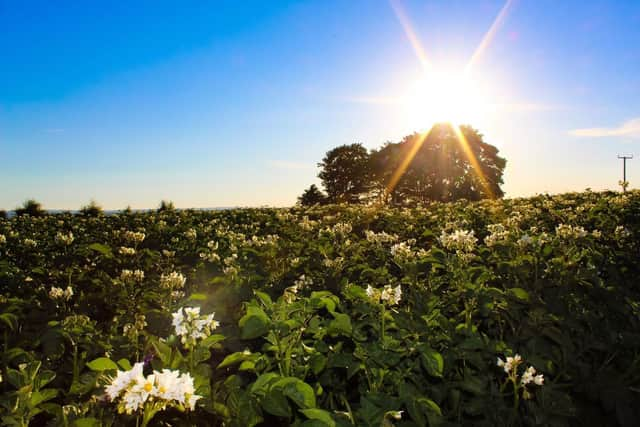

It was something of a revolution when it was first released in 1966 as it had resistance to strains of Potato Cyst Nematode, a pest which caused major problems for potato growers. Sixty years on, Maris Piper is still very popular throughout the British Isles and is exported to continental Europe.
The Maris prefix on plant varieties was always recognised as an assurance to British farmers of a ‘family’ of varieties, which had been bred and thoroughly tested under local conditions and management practices.
Far more importantly than any plant family, is being part of the family of God. The Bible tells us that if we repent of our sins and accept the Lord Jesus as our Saviour, we “…are no longer foreigners and strangers, but fellow citizens with God’s people and also members of his household” (Ephesians 2:19).
In the early days of the Christian church there was much persecution and many new believers were rejected and disowned by their families. So, to encourage fellow believers in Rome, who were going through dangerous and very challenging times, Paul the apostle wrote “the Spirit himself testifies with our spirit that we are God’s children. Now if we are children, then we are heirs—heirs of God and co-heirs with Christ, if indeed we share in his sufferings in order that we may also share in his glory” (Romans 8:17).
What a wonderful thought it is, that irrespective of our background, our status, our tradition or past history, we can be ‘heirs of God and co-heirs with Christ’, and our sins can be completely forgiven.
As we approach Easter next week, may we be reminded of Jesus, the sinless Son of God who willingly laid down his life for our sins, who defeated death and rose again. He is waiting in heaven to receive all who are part of His special family. Have you decided to be part of Christ’s family here on earth?
David is married to Pauline and they have four grown up children. Since retiring from the Grass Breeding Department at AFBI Loughgall, he grows Bramley apples which he supplies to local processors and packers.
David is a member of Loughgall Presbyterian Church.
If you would like to talk to someone about any of the issues raised in this article, please email Rev Kenny Hanna, PCI’s Rural Chaplain at [email protected] or call him on 07938 488 372.