
'Britain’s food and farming sectors have huge potential to help solve a crisis in youth education, employment and training'
Britain’s food and farming sectors have huge potential to help solve a crisis in youth education, employment and training, according to a leading voice in Higher Education.
Professor Ken Sloan, Vice-Chancellor of Harper Adams University in Shropshire, made the comments after the university’s work creating new pathways into education, skills and careers for young people was highlighted by a Government minister in a major speech this week.
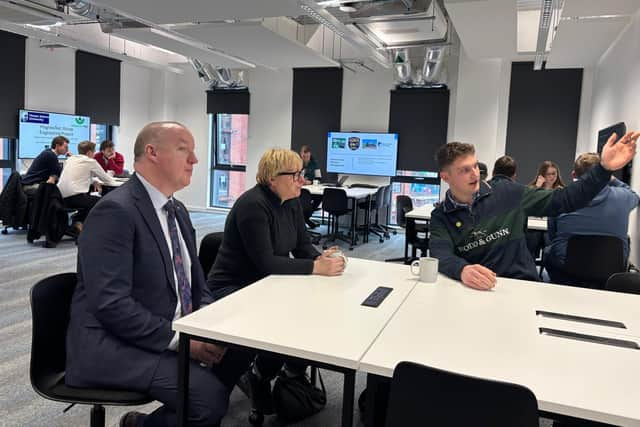

In 2024, Harper Adams opened the first urban hub in its 125-year history as part of the Station Quarter development in the heart of Telford.
Working alongside its rural campus at Edgmond, the Harper Adams hub in the Quad building has created new pathways into education and employment, delivering skills, training and degree programmes tailored to the needs of young people and the industries that underpin the economy of Telford and the surrounding area.
The hub was visited by the Secretary of State for Environment, Food, and Rural Affairs, Dame Angela Eagle, in December of last year – and she recalled her visit during a speech to the CLA Rural Business Conference yesterday.
She said: “Earlier this week, Alan Milburn published his watershed report on how we address the huge social and economic issue of having more than a million of our young people not being in education, employment or training.
“The report outlines a vision that ensures that another generation is not written off as they were in previous times.
"The farming and land management sector has huge potential to be part of this vision and part of the solution to provide meaningful, rewarding careers for young people, including those who may not thrive in a traditional classroom setting.
"But a significant barrier to that, I think, is the fact that we haven’t been reaching out and showing people what a modern career on the land actually looks like.
“Ask someone who’s never worked in this world to picture a land-based job.
"What do they see? Probably not someone using a drone to understand what’s happening to a field.
"Probably not robotics in a glasshouse. Probably not people restoring peat, creating habitats and using precision technology.
“And I was particularly struck when I saw first-hand that Harper Adams has moved the campus to the centre of Telford. Just by putting a campus in an urban community, they’re taking this world to people who might otherwise never come across it.”
Among the work which Harper Adams has been doing at the Quad has been an ongoing programme with Future Leaders UK - a nationally recognised social mobility organisation which gives 16 to 18-year-olds from disadvantaged backgrounds the tools they need to succeed.
So far, two cohorts of students have received leadership training, mentorship, and access to work experience through the programme, working both with Harper Adams and local employers.
This has run alongside other opportunities the University has offered at its Edgmond campus, such as the Sustainable You(th) Challenge with global charity LEAF (Linking Environment And Farming) and the NFU’s AgriFuture Scholarship Programme.
Professor Sloan said: “I was glad to see the Secretary of State recognise that Government has a role to play in tackling this crisis in her speech yesterday, and I agree with her that we all have a responsibility to paint a ‘positive and optimistic vision’ about careers in the sector.
“We do that through dedicated programmes - such as Future Leaders or our work with the NFU and LEAF – and through our regular Experience Days and other events which welcome young people onto our campus.
“We have had industry placements as a core part of most of our undergraduate degrees for many years – which means when our students graduate, they are already equipped with the skills employers need and have tested them in the real world. It is little wonder, therefore, that we have a consistently strong graduate employment record.
“However, there is more to do – as set out in the recent report our School of Sustainable Food and Farming produced alongside Arla.
“It found lots of young people are interested in careers in the sector – but don’t yet know how to access them.
"If we can square that circle – with industry, Government and the education sector working together – the benefits for our country could be transformational.”