
NI Weekly Market Report
04 August 2025
04 August 2025
Grains
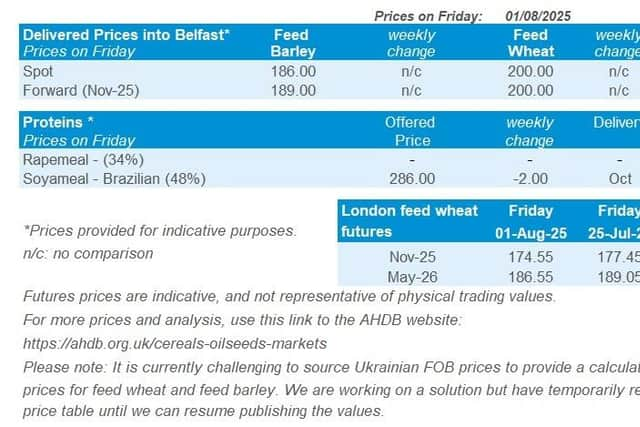
UK feed wheat futures edged lower last week (Friday to Friday), closing below a key support level of £175/t.

The RSI eased from 49 to 47, reflecting limited market momentum.
As a result, key technical levels are now seen at £190/t (resistance) and £170/t (support).
Market drivers
Global wheat prices eased last week (25 Jul–1 Aug), pressured by strong supply prospects, harvest progress, currency movements and lacklustre export demand.
Nov-25 UK feed wheat futures fell by £2.90/t (–1.6%) to close at £174.55/t, tracking declines on global markets.
The larger fall in Chicago was driven by a stronger US dollar after the Federal Reserve held interest rates steady.
Harvest progress is weighing on markets amid expectations of ample global supply. In the US, 80% of the winter wheat crop had been harvested by 27 July, with spring wheat harvesting underway in some regions.
However, forecasted rainfall across the Midwest may cause delays. In France, 89% of the soft wheat crop had been harvested by 28 July, up from 86% the previous week and well ahead of 63% at the same time last year. Meanwhile, persistent rainfall in Germany and Poland is disrupting harvest and raising concern over crop quality.
Recent rainfall has enhanced soil moisture levels across Argentina, supporting the 2025/26 wheat crop as planting nears completion.
According to the Buenos Aires Grain Exchange, nearly all sown areas are now in normal to optimal condition.
In the Black Sea region, SovEcon has trimmed Russia’s 2025 wheat crop forecast to 83.3 Mt (USDA: 83.5 Mt) from 83.6 Mt, due to weaker yields in the south.
Despite this, the export projection remains steady at 43.3 Mt. Meanwhile Ukraine’s wheat exports are off to a slow start, with only 487 Kt shipped so far this season, compared to 1.4 Mt at the same point last year.
Export demand remains subdued.
Weekly US wheat export sales totalled 592.1 Kt for the week ending 24 July, down 17% on the previous week, though still broadly in line with recent averages.
EU soft wheat exports also continue to lag behind last year’s pace. However, renewed interest from Jordan, Bangladesh and Egypt offered a modest lift to market sentiment.
Rapeseed
Last week (Friday–Friday), Paris rapeseed futures (in £/t) finished below the 20-day moving average, closing at over £411.59/t. The relative strength index (RSI) decreased this week from 56 to 45 showing a decline in momentum in the market.
Market drivers
Paris rapeseed futures (Nov-25) fell last week to finish at €475.00/t down €10.75/t on the week.
The global oilseed complex moved downwards on ample global supply and sluggish export demand, favourable weather in the US and Canada, and weaker Chinese demand.
A soya meal glut in China has weakened demand ahead of the key US soyabean export season.
Strong imports earlier in 2025 and lower demand from animal feed producers have pushed up soya meal inventories in China. This is pressuring Chicago soyabean futures (Nov-25) which fell to their lowest level since April, with a predicted bumper U.S harvest adding further weight to prices.
Chicago soyabean futures (Nov-25) declined by -3.1% last week, for a second weekly fall.
To offload excess stocks, China has been selling soya oil and meal to India at a $15–$20/t discount compared to South American suppliers. India, which is typically reliant on Argentina and Brazil, secured 150 Kt of soya oil for delivery between September and December, attracted by both price and faster shipping times.
Last week, Argentina announced it would permanently reduce export taxes on soyabeans from 33% to 26%, and on soyabean by-products from 31% to 24.5%, as part of President Javier Milei’s broader push to support the agricultural sector.
Ukraine has been the world’s leading producer of sunflower seeds, having harvested 13 Mt (USDA) last year.
This season’s crop faces threats, severe drought in the southeast is already impacting yields, while locust infestations have spread across six regions. Conventional pest control efforts have been hampered by the ongoing war.