
SNHS – Soil sampling update and results
The Agri-Food and Biosciences Institute (AFBI) is finalising preparations for the closing phase of soil sampling under the Soil Nutrient Health Scheme (SNHS) which will take place this autumn/winter, with sampling carried out by Tetra Tech, the SNHS contractor.
Since the Scheme was launched in 2022, significant progress has been made, with over 536,000 fields sampled to June 2026 (equating to 22,700 eligible farm businesses registered), representing around 93% of all eligible businesses applying for SFP in 2024/25 in Northern Ireland (NI) – making this the largest, focused soil sampling scheme in Europe. Participating farm businesses receive their results by post & email, and they can access their soil sample analyses and runoff risk maps online via their DAERA Online Services account.
The soil reports and online maps contain essential information on soil nutrient status, including pH, phosphorus, potassium, magnesium, calcium and sulphur levels. AFBI Sampling Programme Project Lead, Alex Higgins, identified some of the trends thus far:
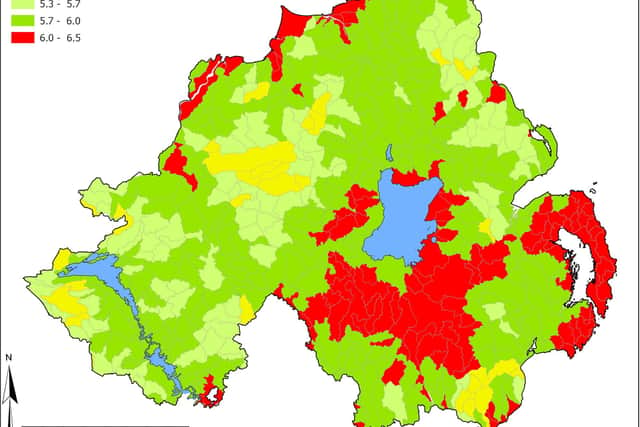
“Soil pH is the most important factor to address, enabling crops to make most efficient use of any nutrients applied to fields and existing nutrients in the soil, as this will both optimise crop production and potentially reduce loss of nutrients to waterways. As Figure 1 illustrates, the soil pH measured in SNHS varies considerably across NI, reflecting the influences of agricultural enterprises, geology and the acidifying impacts of higher rainfall and altitude.

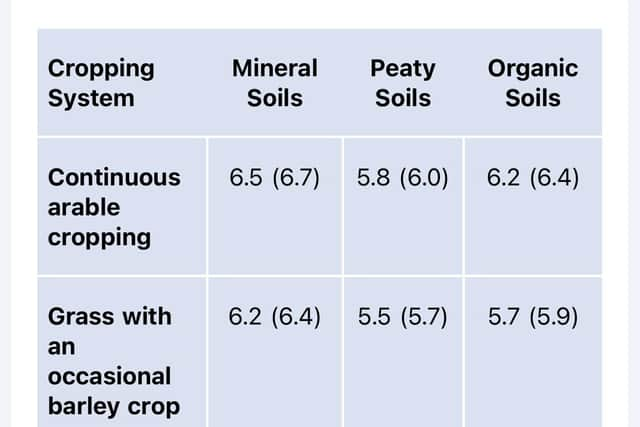
The soil optimum pH will depend on factors such as the crop to be grown and soil type – the current RB209 optimum and target values are shown in Figure 2. SNHS participants can find their current cropping information and mapped field-by-field soil type in Section 1.1 of their paper report – if this needs to be updated, soil results can be brought into the CAFRE Nutrient Calculator and appropriate details entered to generate new recommendations.”
“Results to-date from across NI indicate that the average value in mineral soils is pH 5.8, with pH 5.5 for organic soils (both below the optimum), and pH 5.5 for peaty soils (at optimum). Overall, this indicates the potential for significant production gains in some grazing and silage systems. For example, moving a mineral soil from pH 5.8 to target pH 6.2 could increase dry matter offtake by up to 2 tonnes per hectare with no increased use of fertiliser. If a heavy application of lime is recommended (in excess of 7.5 t/ha), the best approach is to slowly raise the soil pH (we would recommend splitting it over two years), as a very large single application can disrupt nutrient availability. Another point to note is where farms might be considering a shift to multi-species swards or clover mixes, that it would be important to get tailored advice from your agricultural advisor regarding the optimum pH for your soil type, which may be higher than the grass optimum to suit that mix”.
“Optimising pH will significantly improve the efficiency of plant uptake of nutrients in soils, including the key macronutrient, phosphorus (P). In 40% of fields sampled, soil P Indices are above the soil target optimum of Index 2+ for intensively managed grassland. There is considerable variation within farm types reflecting the level of nutrient input. For example, more intensive enterprises such as Arable and Dairy have average values of 32.7 mg/l and 28.5 mg/l respectively (both Olsen Index 3), while Beef and Sheep dominated enterprises, generally less intensive, have average values of 24.3 mg/l and 24.2 mg/l respectively (both Olsen Index 2+). Farmers should carefully consider their P applications to reduce surplus soil P with a view to drawing it towards the 2+ index level (2+ for silage, intensive grazing and other cropping, 2- for lower intensity grazing), as this plant available form of P is also susceptible to loss to waterways which can lead to problems through encouraging algal growth.”
The connectivity of land to water in NI is very high with around 5 km of watercourses (open drains, streams and rivers) in every square kilometre. The runoff risk maps being produced as part of the project (and available through the farm DAERA Online Services account) are intended to highlight areas within fields where there is greatest risk of nutrient and soil loss during heavy rainfall events. Farmers are encouraged to look at these areas and see if there are any steps that can be taken to break the connection between land and water at these times.
As each farm is unique it is essential that farmers consider their individual crop requirements and the environmental setting of their fields when planning any changes in nutrient management. Alex Higgins continues: “Participating farmers have access to resources which will help them to interpret their soil results and help plan more efficient nutrient application. We would encourage farmers to avail of the information in their paper and online reports and maps and participate in the CAFRE online or face-to-face training sessions.”
Farmers who have yet to do so, are encouraged to complete their CAFRE SNHS training as soon as possible to make the most of the Scheme’s benefits and resources. Taking part in the Scheme and completing the CAFRE training is a conditionality for the new Farm Sustainability Payment since January 2026. Register for training now at www.cafre.ac.uk/snhs-training.